All Change
19 March 2008
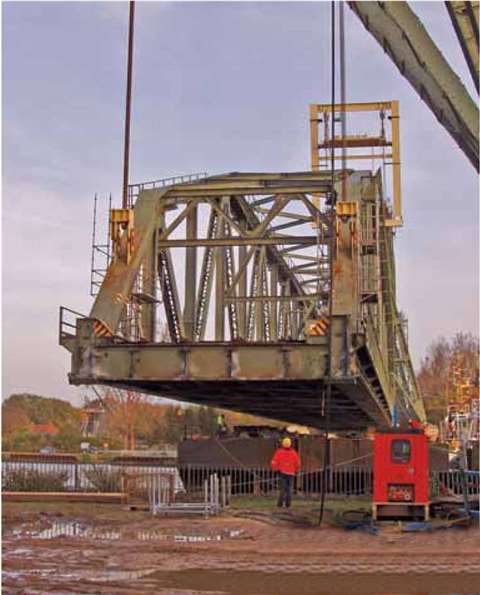
The Hochdonn railway bridge, which crosses the Kiel Canal near Hochdonn in Germany opened on 1 June 1920. Since then it has served to connect the city of Hamburg with the island of Sylt in the North Sea, passing the famous Hindenburg Dam.
General deterioration of the main span and, in particular, damage caused by two ships colliding with the bridge, made it necessary to replace the centre section with a new span. The refurbishment of the adjacent bridge spans should extend their life by decades.
The idea was to maintain the existing support points of the main span and use them with the new centre section. To do this meant that a method had to be found to pass the old, 122 m long span, through the clear gap of only 120 m between the supports. On completion of this phase of the project the steel structure would be lowered onto a transport barge for removal.
The method chosen was to use two special portal frames installed near the support axes of the bridge. Each frame was held back and adjusted to the required inclination by means of two VSL strand units type SMU 220/550.
For the actual lifting and lowering, two strand jack type SMU 330/550 units were mounted vertically in platforms suspended in the upper part of the frame. These strand units meant that the span was hooked up at four points. Using this arrangement it was possible to move the suspended span by about 2 m longitudinally and to incline it, which permitted the span to be lowered through the narrow point between the bridge supports.
On one day late last year the old bridge section was lifted free, shifted, inclined and lowered onto a waiting barge on the river. Two days later, the new central bridge span, which had arrived on another barge the night before, was lifted into place. Replacement was a reversal of the removal procedure.
All planning design and erection activities had to be organized to meet a fixed schedule given by the railway and canal authorities. While the rail link was interrupted a rail replacement bus service was in operation. While lifting and lowering work was going on, that section of the canal was closed.
During this time a number of ships waited until it reopened instead of navigating the alternative route around the Northern tip of Denmark in stormy weather. Poor local weather conditions were also a factor to contend with during the lifting and lowering operation.
The Hochdonn railway bridge used to be the one that, by its clearance height above the river, governed the maximum height of ships that could travel on the waterway. A feature of the new span is its 42 m clearance height, which is similar to other bridges over the Kiel canal. It gives 500 mm more clearance than the old span, achieved by laying the rails of the train track directly on the steel structure.

CONNECT WITH THE TEAM