Read this article in 中文 Français Deutsch Italiano Português Español
Power in transition: Stijn Sarens on working in the energy sector

29 June 2026
Stijn Sarens, global key account manager and board member at Sarens, talked to Alex Dahm about his company’s vital role in the energy transition, especially in nuclear and renewables.
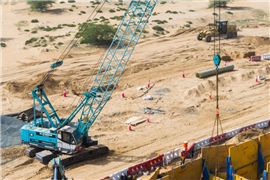
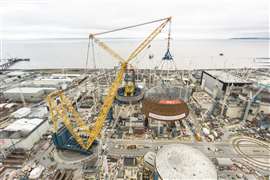 The SGC-250, nicknamed Big Carl, at work on the Hinkley Point C nuclear power station construction project in the UK
Global heavy lift, engineered transport and crane rental company Sarens is playing a major role in the energy transition all around the world.
Stijn Sarens, global key account manager and board member, spoke about changing demand in nuclear and renewables, from new-build plants to wind farm maintenance and nuclear decommissioning.
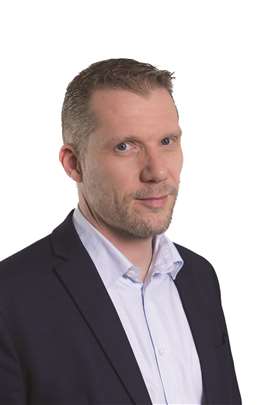 Stijn Sarens is global key account manager and board member at Sarens. Photo: Sarens
I began by asking Sarens about global demand for lifting and transport in the incredibly busy energy sector and what is influencing requirements now compared to five years ago.
“We follow the demand in the market. If you talk about nuclear, for example, we can see there is much more demand with all the new plants being built, the SMRs [small modular reactors] coming up, and they typically require different equipment.
“Fifteen years ago, we were all still building coal-fired power plants. They required a very different type of equipment. Same with the onshore wind industry. The equipment you use on those is different now. It will be bigger ring cranes or the largest of the conventional crawler cranes.”
In onshore wind, turbines continue to grow taller and heavier, driving a move from 600 tonne to 1,000 tonne crawler cranes for the same work.
Which type of energy generation is presenting the biggest lifting and transport challenges?
“For us the biggest transport challenges are in the onshore wind sector, while that sector now presents probably the least of the lifting challenges.”
Nuclear projects present the biggest lifting challenges because components are heavier and often require the specialized super heavy lift ring cranes developed by Sarens rather than the regular crane manufacturers.
The sector’s strict safety culture also increases engineering and administrative requirements.
Nuclear needs
On nuclear projects what are the most important technical requirements for Sarens as a lifting and transport provider?
“We are heavily involved in nuclear and we have a decent track record in it. Regardless of whether it’s a French plant or a US plant, it always involves the biggest of cranes, even with SMRs. We’re building the first SMR in Canada now.”
Sarens has supplied heavy lifting on major European nuclear projects including Finland, Flamanville and Hinkley Point, and has secured further work in France.
“It is not only on the heavy lift scene, also on the maintenance, component exchange and the decommissioning, which is coming up now. We do a lot of work that is part of the decommissioning process. In Belgium, for example, we have also started on that.” Decom is not necessarily heavy lift cranes, it is more about lifting and moving things like stators and steam generators.
In this expanding area of decommissioning, how does Sarens’ involvement, types of equipment, processes and so on, differ from construction?
“It is a lot different. For the maintenance and component exchange and decommissioning, those three are more or less the same. Decommissioning is only half the work of component exchange and it doesn’t usually involve a crane at all.
It relies mainly on gantry systems, skidding, strand jacking and SPMT rather than large cranes. “Equipment is removed with millimetre precision from turbine halls or reactor buildings before being lowered and transported away. The only crane we use is typically the one to offload the SPMT or to offload our equipment.”
In the renewable energy sector, with its larger turbines, are you approaching the limit in terms of serially produced cranes? Are you going to have to start bringing in your super heavy lift ring cranes for wind work?
“Not yet,” Sarens explains, “We see the crane manufacturers and the wind turbine manufacturers as quite well aligned. I’m pretty sure they talk to each other when they are developing a new type of turbine to see if there is a crane able to install it.
We also get those questions and we can liaise a bit between the wind turbine manufacturers and the crane manufacturers.”
Serially produced cranes have so far been able to meet turbine installation requirements. Early lifts with cranes such as the CC 8800 and LR 11000 were challenging but are now routine. Now there is also the Tadano CC 78.1250-1.
“In onshore wind we can do everything with ‘off-the-shelf cranes.’”
 Stijn Sarens. Photo: Sarens
A growing trend
How much is modularisation playing a part in reducing risk and improving efficiency on energy projects?
“In recent decades we’ve seen a lot of modularisation in everything. Now even the SMR manufacturers are trying to build a completely modularised nuclear power plant. We have already been transporting and assembling pipe racks or modules in all types of industry for a long time.”
How do safety standards and regulations, for example, in the nuclear industry, affect equipment selection and the choice of how to build something?
“A lot. We get the safety standards from the power plant owner or from the contractor we’re working for. An example is where what the crane can lift on the job needs to be reduced to a certain percentage of the actual capacity. The safety factor can go as high as six times. We also then would rather choose to have newer equipment on the nuclear power plant job. Even just to avoid the need to do so much maintenance.”
Older equipment can still be used, but nuclear clients increasingly prefer newer cranes so it might be wiser to choose newer equipment with all the valid certifications in place.
Some companies in the energy sector, for example, wind turbine manufacturers have bought their own cranes. Is this a growing trend?
“If you have the money, anybody can buy a crane, or you can even have a crane made but you then need to be able to operate maintain and repair them, do some engineering on them and then there’s transport.
In onshore wind there were several turbine manufacturers who followed the idea of starting their own equipment fleet and their own installation teams. “I think all of them have come back from that. Some still have a few of their own cranes but not the amount they used to.
“It is a business on its own, and if you want to do it successfully, you have to put a lot of effort in. You have to run it as a real crane business.”
Technological requirements
How are client requirements affecting equipment and technology selection, for example, is there a growing call for more redundancy, extra monitoring, digital tracking, that sort of thing?
“Yes, we see a lot of increase there. For example, in onshore wind, Clients increasingly request live monitoring systems, including online wind-speed tracking, reporting and incident-data access. Very often they also need to prove downtime to their clients. It was rare a couple of years ago but now it’s almost a standard request.”
Looking ahead, what equipment innovation is going to be vital for the coming generation of energy projects – what would you like in your toolbox that you haven’t got yet?
“For offshore wind and nuclear projects the industry still needs more capacity, particularly in the 3,000 to 5,000 tonne range. The higher capacity cranes are needed for the marshalling and handling of monopile foundations or the transition pieces.
“Away from the big cranes, we do a lot of general crane rental. Requirements there have not changed that much. They still need flexible telescopic cranes that can drive to job sites. There I see more innovation or more future in making them greener, more environmentally sound, for example, software upgrades, smart ballasting systems, smart outrigger position systems.
“But in the project sector – nuclear, offshore – I think heavy lift capacity is the key.”
Does that also mean cranes bigger than the SGC 250?
“I guess, but I don’t know. Lifting capacity has always gone up, right, in all the years we’ve been doing this business. Not in big steps but I think gradually it will increase.”
STAY CONNECTED
Receive the information you need when you need it through our world-leading magazines, newsletters and daily briefings.
CONNECT WITH THE TEAM