From reaction to prevention: SC&RA committees redefine safety strategy

25 March 2026
As regulatory pressure, jobsite complexity and workforce expectations continue to evolve, SC&RA’s committees are increasingly focused on anticipating change rather than reacting to it. Across both the crane and transportation sides of the Association, committee leaders are reassessing priorities, expanding collaboration and sharpening how guidance, education and advocacy are delivered to members.
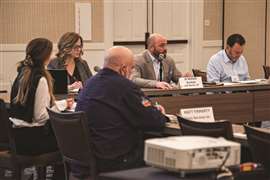 SC&RA committees continue refining education and oversight as projects grow taller, denser and more complex.
For Randy Sever, with PSC Crane & Rigging, and chair of the Crane & Rigging Safety Education & Training Committee, mental health is currently at the top of the Committee’s agenda from a safety and workforce perspective. “It’s front and center,” he emphasized. “We’ve experienced it recently within our own company – and it impacts not just employees, but extends to family members and beyond.”
Strategic priorities take shape
That focus was formalized during the Committee’s 2025 strategic planning process, which identified four core objectives: increasing committee engagement, enhancing safety awareness, staying ahead of technology and regulation, and advancing mental health awareness.
On the Committee’s education and training front, Sever pointed to ongoing collaboration between SC&RA and the Commercial Vehicle Safety Alliance (CVSA) as one of the most significant developments underway. “One of the biggest things I’d point to is how SC&RA and CVSA are working together on recommended weighing procedures for mobile cranes,” he said.
A key part of that progress, Sever said, has been the involvement of SC&RA’s transportation expertise. “The fact that the Permit Policy Committee has convened a task force with members from both crane and specialized transport has been critical in our efforts. The task force’s knowledge and experience working with DOTs from different states, understanding of permitting – is really driving this effort productively forward.”
Additionally, Sever highlighted the Committee’s continued focus on developing practical resources for SC&RA members “These resources are developed by industry professionals with decades of hands-on experience,” he noted, “and reflect real-world processes and procedures used across crane and rigging operations.”
Looking ahead, Sever said the Committee is deliberately changing how it identifies priorities and engages with members. “We’re not only relying on committee members to drive topics, and we’re not sitting back in a reactionary mode waiting for OSHA or other regulatory changes to force our hand,” he said. “We’re seeking broader member engagement.We want members to share what they’re struggling with, what challenges they’re seeing and what may be prevalent in their region – and, in turn, how proactively we should address it.”
Tower crane committee tackles urban and regulatory challenges
As projects grow taller, denser and more urban, said JR Moran, with Brasfield & Gorrie, and chair of the Tower Crane Committee, his group is increasingly focused on challenges that sit just outside traditional crane operations but have direct operational impact.
Urbanization continues to drive new legislative and regulatory pressures, Moran said, and at the same time, workforce challenges remain persistent. “Additionally, economic uncertainty has added another layer of complexity, with fluctuations between commercial and infrastructure work and tariff-related pressures – slowing fleet investment and modernization.”
Those headwinds, he emphasized, may be indirect, but they shape the environment tower crane operators are navigating every day. “From a safety and planning standpoint, the committee’s work centers on two parallel tracks. One focuses on regulatory engagement at the local and state level, and the other centers on providing practical guidance to the industry.”
On the education side, in 2025, the Committee published the Guide to Tower Crane Procedures, which Moran said is available to the entire industry (and free as a download for SC&RA members) and served as a basis of design for the recently launched CCO assembly and disassembly director certification.
Looking ahead, Moran said the Committee is placing increased emphasis on strategic planning and member engagement. “In June of last year, the group launched a formal strategic planning effort that now guides our work across regulatory and legislative issues, workforce development and collaboration with the SC&RA Foundation,” he said.
As part of that effort, Moran said the committee is preparing to survey members to better understand what they know and what they want to know relating to tower cranes and wind-related considerations.
Permit policy challenges grow with automation and enforcement
Permit policy continues to be a moving target for Permit Policy Committee chair, Bryce Baker, with Oxcart Permit Systems, LLC. “It requires this committee to constantly evaluate which issues can be addressed quickly and which demand longer-term effort.”
While Baker echoes Sever in recognizing the cross-over work SC&RA is pursuing via size and weight coordination with CVSA, he pointed out that some of the most immediate challenges for his group stem from the unintended consequences of automation.
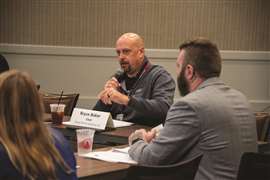 Permit Policy conversations at recent SC&RA meetings have zeroed in on automation and enforcement considerations affecting specialized transport.
“While the industry has pushed hard for automated permitting systems, several states are now encountering friction as those systems come online,” he said. “We’ve seen issues arise in one state with unaccounted-for bridge data, and in another state, automation led to staffing reductions that left agencies without the human capacity needed to resolve problems when they arose.”
Baker said those examples illustrate the balancing act facing permit authorities and carriers alike as automation expands. Progress is being made, he affirmed, but the transition has not been seamless.
Circling back to collaboration with CVSA, Baker said the Committee’s longer-term work is now focusing particularly on mobile crane enforcement.
“For years, CVSA guidance has treated mobile cranes the same as trucks, without accounting for their unique configurations and operating characteristics. But that’s finally changing – resulting in a draft guidance document now advancing through board processes within both CVSA and SC&RA. Once finalized, the document will clearly outline recommended weighing procedures for mobile cranes.”
Training gaps highlight need for judgment-based safety approach
Dave Merrill, with Pahoa Express, chairs the Transportation Safety Education & Training Committee. He indicated that many of the most pressing safety and training gaps facing specialized operators today have less to do with missing regulations or equipment and more to do with judgment and execution.
“Too many issues are traced back to overreliance on route verification and GPS, and a limited understanding of how permit conditions actually govern a move. Of course, many SC&RA members manage those challenges well, but the issue remains widespread across the broader industry.”
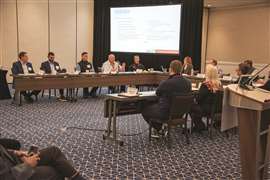 Cross-committee collaboration remains a priority as SC&RA leaders examine emerging workforce, safety and policy issues.
Currently at the center of a lot of challenges in the space, added Merrill, is a lack of judgment-based training as drivers approach complex sites. “That’s where last-second decisions come into play,” he said, emphasizing the need for more deliberate preparation before those moments occur.
Merrill underscored that education becomes far more effective when it is rooted in real-world experience rather than theory. “Training is far more meaningful when it’s built around actual enforcement encounters, trends and incidents that we all come across,” he said.
Looking ahead, Merrill said some of the most impactful initiatives underway within his committee involve a more proactive, judgment-driven approach to safety.
“Improved use of data and operational feedback is helping companies identify patterns in routing, permitting and last-mile execution before they result in violations or incidents. We’re also putting an emphasis on the importance of elevating dispatch, planning and permitting roles within organizations. They need to be recognized as core safety functions, not just administrative roles.”
As data tools continue to improve, Merrill said companies will gain a clearer view of where their pain points lie. While technology adoption varies by fleet, he said the broader trend is clear. “Everything is moving toward a more proactive approach and better outcomes.”
CONNECT WITH THE TEAM