Happy Birthday USA

06 July 2026
Saluting the 250th anniversary of the United States, American Cranes & Transport rounded up a slew of patriotic jobs.
Two hundred and fifty years ago, the signors of the Declaration of Independence could not have imagined the amazing achievements their fledgling nation would one day accomplish.
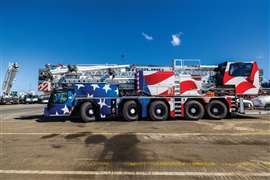 Featuring a compelling stars and stripes wrap, Sterling Crane USA welcomed a new Liebherr MK 140-5.1 to its fleet. The crane is a tribute to Sterling Crane veterans
The determination and ingenuity defining America’s founding fathers has been instilled in subsequent generations who play a vital role in advancing the economy and moving the country forward.
As the United States celebrates its 250th anniversary, ACT and crane and Transport Briefing are shining a spotlight on the lifting, rigging and specialized transportation sector and the jobs they perform in the realm of national security, infrastructure development and assuring the country’s democratic legacy continues.
These jobs, large and small, show the grit and resourcefulness of an industry that lifts and moves the world.
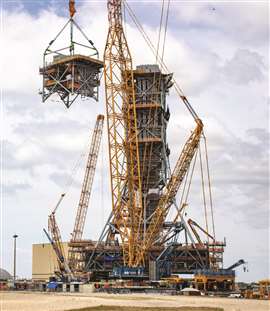 Sarens USA has played a critical role in assembling and positioning the infrastructure required to support NASA’s next-generation Space Launch System Block 1B rocket.
Prepping for the moon
Sarens is working to help the USA return to the moon.
At NASA’s Kennedy Space Center, a new generation of infrastructure is rising to support the Artemis program. Standing at the heart of that effort is Mobile Launcher 2 (ML2), one of the most significant pieces of launch infrastructure currently under construction in the country.
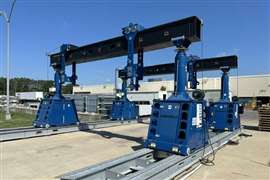
Partnered with Bechtel, Sarens played a critical role in assembling and positioning the infrastructure required to support NASA’s next-generation Space Launch System (SLS) Block 1B rocket. Through a combination of engineered transport, precision jacking and heavy lifting operations, Sarens helped transform thousands of tons of steel into a launch platform capable of supporting missions far beyond Earth’s orbit.
The scope of work has included the offloading and transport of massive, prefabricated steel trusses, assembly of the launcher’s base structure, precision jacking operations utilizing Sarens’ CS350 climbing jack system, transportation and installation of major modules and E-Rooms, and the erection of the launch tower using a CC 8800 crawler crane equipped with Boom Booster and Superlift technology.
Artemis II recovery
In April, the Naval Facilities Engineering Systems Command (NAVFAC) Southwest Metro Production Department (MPD) Crane and Rigging team executed a series of critical lifts to support the recovery of the Artemis II spacecraft in San Diego, California.
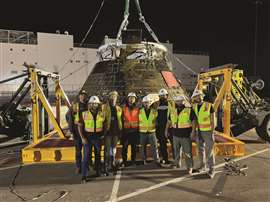 The Artemis Orion crew module measures about 16.5 feet in diameter and 11 feet in height. Its haul weight was just less than 12,000 pounds.
A Link-Belt RTC-80110 Series II was used to lift the 11,700-pound spacecraft into a cradle for its post mission trip to Florida.
The spacecraft was lifted out of its temporary staging area and secured to a customized protective frame on a flatbed trailer. Because of its diameter, it was classified as an oversized load and required specialized route planning from San Diego to Florida.
Jayhawk hero
A retired Coast Guard rescue helicopter took its final flight of sorts last May as Bay Crane completed a coordinated lift to position the aircraft inside the future National Coast Guard Museum in New London, Connecticut.
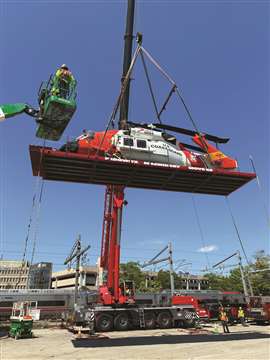 Using a Liebherr LTM 1160, Bay Crane hoisted a Jayhawk helicopter five stories into the museum structure, where it will eventually be suspended as an exhibit.
Using a Liebherr LTM 1160, Bay Crane hoisted the 14,500-pound Jayhawk helicopter approximately five stories into the museum structure, where it will eventually be suspended within the Atrium as a centerpiece exhibit.
The helicopter itself has a notable Coast Guard service history. Delivered in 1995, HH-60J Jayhawk Tail No. 6004 served at Coast Guard Air Stations, including Florida and Alaska.
The National Coast Guard Museum, currently under construction along New London’s waterfront, will be the nation’s only museum dedicated exclusively to the history and service of the United States Coast Guard. It is expected to open in 2027.
Federal cool down
A Potain MDT 809 M40 was used at the Ronald Reagan Building and International Trade Center to replace the original cooling towers.
Due to the many site restrictions and capacity requirements, a standard mobile crane solution would not work within the allowable working hours and permitted temporary road closures. An alternative solution was to place a tower crane on top of the building with sufficient capacity to perform the work. This created several challenges, including transfer of the tower crane loads to the building, supporting the tower crane above the roof, erection of the tower crane and dismantling of the tower crane. To support the tower crane, a structural steel frame was designed and fabricated, transferring the crane loads into the building columns.
 A Potain MDT 809 M40 was placed on top of the Ronald Reagan Building to replace cooling towers. The tower crane required almost 230 feet of hook reach to cover the extremely tight work area. PHOTO: Getty Images
The sequence of work included one weekend to erect the structural steel frame that would support the tower crane. On the second weekend, the ballasted base and tower crane were erected. Then, over the next several months, the work was completed in phases to ensure the building remained fully operational. When all the work was completed, mobile cranes were brought in again to dismantle the tower crane.
Stars and stripes
Sterling Crane USA recently welcomed a new Liebherr MK 140-5.1 to its fleet; said to be the first MK 140-5.1 in the Gulf Coast region of the country. The unveiling coincided with America’s semiquincentennial celebration, with the crane featuring a stars-and-stripes wrap to recognize US veterans.
“The stars-and-stripes wrap is a meaningful tribute to the veterans within our organization and reflects Sterling’s continued commitment to supporting the communities where we live and work,” said Brian Boudreaux, vice president of Sterling Crane USA.
Moving America’s shield
When Oxbo was selected to support deployment of the XBR2 Radome for the Sea-Based X-Band Radar (SBX-1) program, the assignment would ultimately span more than 4,100 miles, cross 11 states, involve hundreds of personnel and require thousands of hours of engineering and field execution.
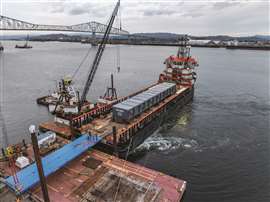 Oxbo helped deploy one of the most recognizable components of the nation’s missile defense system through a 4,100-mile multi-phase, coast-to-coast operation.
Before the new radome could be transported across the country and installed aboard SBX-1, it first had to be tested. Inside an historic hangar in Elizabeth City, NC, the 130-foot-diameter inflatable radome was lifted from a horizontal position using four RTs and positioned inside a custom-engineered Radome Envelope Container (REC). Using 12 lines of Goldhofer PST/SLE, a specially designed tripping frame and a 600-ton hydraulic crane, the structure was upended into a vertical position for inspection, testing and verification.
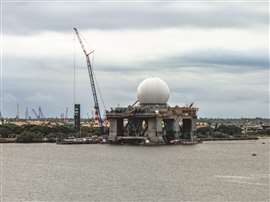 At Rainier, Oregon, Oxbo developed and executed a detailed vessel loadout plan to transfer the REC from land transportation to marine transport.
The next challenge was transportation. Encased within the REC, the cargo measured approximately 150 feet in length and weighed more than 200,000 pounds.
At Rainier, Oregon, Oxbo developed and executed a detailed vessel loadout plan to transfer the REC from land transportation to marine transport. The operation required consideration of river currents, tidal fluctuations, vessel positioning constraints and low-water conditions. Using 12 lines of Goldhofer PST/SLE, the REC was transported across the pier and positioned for loading onto the Missile Defense Agency-contracted support vessel Black Watch.
The project culminated at Ford Island in Pearl Harbor, where Oxbo supported removal of the existing radome and installation of the new XBR2 system atop the SBX-1 radar platform. Once secured, the radome was inflated and the system brought online, marking the successful completion of a project years in the making.
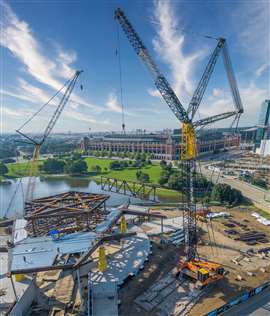 Buckner HeavyLift dispatched a Liebherr LR 1750 and LTR 1100 to the Medal of Honor Museum in Arlington, Texas. The LR 1750, configured with a 138-foot S main boom and 138-foot W luffing jib, installed the first 69,000-pound belt truss at the museum.
STAY CONNECTED


Receive the information you need when you need it through our world-leading magazines, newsletters and daily briefings.
CONNECT WITH THE TEAM