Read this article in 中文 Français Deutsch Italiano Português Español
Head for heights: the rise of Falcon Tower Crane Services

01 July 2026
Falcon Tower Crane Services in the UK is going through a lengthy and extensive transformation while also continuing to look at further change on the road ahead. Alex Dahm reports
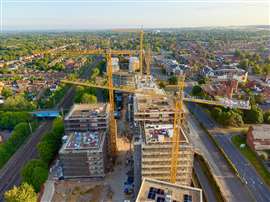 Falcon tower cranes at work: four units from the 450-strong fleet
In the ever-evolving landscape of construction and infrastructure, some companies stand tall and resilient. Falcon Tower Crane Services in the UK is one of them, according to managing director Andrew Brown.
Established in the early 1970s, Falcon has grown from being a regional tower crane supplier to the largest in the UK. Brown has been with the business for 25 years, witnessing firsthand the company’s transformation, not just in the tower crane rental sector but across areas as diverse as exports, haulage, power, industrial painting, and metal fabrication.
Having weathered multiple economic cycles, Brexit, and the Covid 19 pandemic, Falcon’s journey already spans six decades. Today it is a national force contributing to major UK infrastructure projects such as the Hinkley Point C nuclear power station and the HS2 high speed rail job.
“The strategic foresight of both past and current management has enabled the company to evolve into an international brand, selling tower cranes across six continents. As Falcon looks toward the next decade, a new vision is taking shape, one that integrates operational strength with sustainability, digital transformation, and global collaboration,” Brown says.
 Andrew Brown, managing director at Falcon Tower Crane Services in the UK
The early years
In the beginning Falcon ran a small fleet of self erecting tower cranes from its headquarters in Shipdham, Norfolk, in the east of England. During the 1980s and 1990s, the company transitioned to traditional saddle jib and luffing jib tower cranes, models that now dominate UK skylines. The fleet continued to expand.
By the early 2000s, Falcon’s fleet had grown to more than 200 tower cranes. A strategic decision was made to standardise the fleet through an agency agreement with Spanish manufacturer Jaso Tower Cranes. Other manufacturers’ models were phased out, allowing Falcon to build a consistent and high-performing fleet, Brown says.
During the 2008 financial crisis, UK rental activity declined, prompting Falcon to shift its focus from domestic rental to international exports. This proactive move allowed the company to retain the majority of staff and positioned it for substantial growth during the recovery years. “Over the past 15 years the company has nearly doubled its fleet to 450 tower cranes and now employs over 450 people,” says Brown.
Diversification
Crane rental remains a core business but Falcon has diversified into road haulage, power rental, industrial painting, fabrication, training and, more recently, contract lifting. Its export division continues to thrive, selling more than 60 cranes a year, both from its rental fleet and as a broker for other crane users.
“While there is value in ‘sticking to what you’re good at,’ Falcon recognised the importance of spreading risk in a volatile construction market. A key shift occurred in 2017 with a focus on exports and fleet modernisation.”
Previously, machinery was only sold during economic downturns but this new strategy made exports a year-round focus. It not only strengthened Falcon’s global partnerships but ensured the UK fleet could be kept modern, with an average age of the equipment being under six years.
Falcon trades regularly with countries across mainland Europe, including France, Spain, Italy, Netherlands, Sweden, Slovakia, and Romania. Its reach now also extends to Chile, Mexico, Canada, Israel, Vietnam, Australia, and New Zealand.
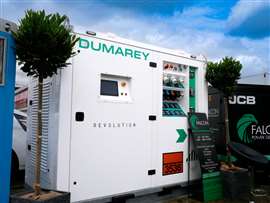 Falcon’s power supply division includes units from Dumarey Green Power among others
Falcon power
In 2018 Falcon Power Generation was established, the company’s first major diversification outside tower cranes. Falcon had long operated diesel generators to support its crane operations but this new division made these solutions available to external clients.
Initially based in Birch, Manchester, and later relocating to Swinton, the division now manages a fleet of nearly 500 units, including diesel generators, Punch Flybrid flywheel energy storage systems, Hush Pods, and various battery options from 28 kWh Dumarey Revolution batteries to 281 kWh and Voltpacks.
“Every tower crane in Falcon’s fleet can be supplied diesel-free, assuming minimal mains power (32 amps) is available on-site. Even without mains power, Falcon can deploy a 40 kVA generator to manage battery systems, eliminating the need for larger, standalone generators.”
Operating from depots in Norfolk, Manchester, Dunstable, and Newport, this division generates around 50 per cent of its turnover from external rental. Applications span construction, events, hospitality, and welfare.
Falcon Freight
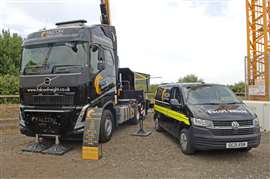 Falcon’s transport division
In 2019 Falcon entered the haulage market through the incorporation of Falcon Freight Ltd. This was enabled by the acquisition of TJ Robins Ltd, a crane-focused haulage company with a 2.3 acre (0.93 hectare) site in Dunstable, Bedfordshire. At acquisition, the company operated eight heavy goods vehicles (HGVs), joined by two of Falcon’s trucks.
Falcon retained much of the TJ Robins Ltd customer base, workforce, and the Dunstable freehold. Growth was further accelerated following the 2025 acquisition of Guy Crane Hire Ltd, adding a further 4 HGVs. Falcon Freight operates more than 40 vehicles and 65 trailers.
While still supporting tower crane logistics, the division has expanded to cover cabins, containers, plant movements and much more.
Painting and making
Falcon has also invested heavily in its industrial paint shop and its metal fabrication facilities. Originally focused on tower cranes, the paint shop now operates four booths, four bake ovens, and three shot blast booths. It handles everything from Ministry of Defence (MoD) fuel tanks to dinosaur sculptures for local attractions.
Tower crane work now accounts for less than 20 % of the paint and fabrication division’s revenue. Large scale infrastructure projects, such as the drum screens for Hinkley Point, civil engineering work, fuel tanks for the MoD, containerised pumps and even a rollercoaster, are just a handful of projects going through the door on a day to day basis.
The success of the paint shop led to the formal creation of Falcon Fabrications. In 2025, this division achieved BS EN 1090 Execution Class 2 accreditation and is working toward Class 3 across the Norfolk and Manchester sites.
Contract lifting
Falcon entered the contract lifting space in 2023. With an experienced in-house team handling tower crane erection, dismantling, and planning, the move was natural and strategic, Brown says. As standard, Falcon holds a comprehensive range of lifting accessories from a range of leading manufacturers in the industry.
“We possess the expertise to manage lifting operations that range from the most basic to the most complex, thereby minimising the risks involved. In addition to selecting the appropriate mobile crane configuration or one of our modern fleet of Hiab units, we also provide our customers with industry leading standard method statements, risk assessments, insurance and CAD drawings.”
Offering contract lifting and AP-IS services complements the existing crane business, allowing Falcon to provide an end-to-end lifting solution: transport, repair, repainting, site return, and installation, all under one roof.
Infrastructure and investment
Falcon’s rapid growth has required significant infrastructure investment. Unlike virtual businesses, Falcon’s operations demand high capital expenditure, large land holdings, and extensive workshop facilities. Managing a modern crane fleet involves much more than ownership, it demands safe storage, skilled maintenance and strategic logistics.
In 2020 a 10 year infrastructure plan was launched. Key goals are outlined below:
Norfolk HQ: installing two new bake ovens and a shot blasting booth (completed in 2024 and 2025)
Expanding ground space from 26 to 54 acres (10.5 to 22 hectares). An additional 12 acres has already been secured
Building three new 20,000 square foot (1,858 square metre) workshops
Establishing a 6 acre (2.4 hectare) truck park and a 2 acre (0.8 hectare) power division.
Manchester: Falcon operates four sites across Manchester (Birch, Heywood, Swinton, and Burnley), and the intention is to acquire a single depot large enough to consolidate these four activities. In early 2025 Falcon acquired a 3 acre freehold with a 30,000 square foot (2,800 square metre) workshop. Work has already begun on consolidating the depots into this central location and continues throughout 2026.
“Falcon’s facilities are among the best in the UK, and continuous improvement remains a core objective,” Brown proudly asserts.
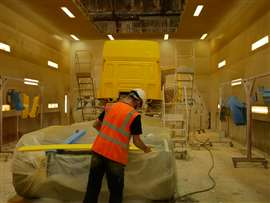 One of the Falcon paint shop’s four large spray booths
People and training
“At the heart of Falcon’s growth is its people, from directors and managers to operators and labourers. Clear strategy and communication have been essential, ensuring employees are aligned with the company’s direction and empowered to lead initiatives.”
Falcon has built a dedicated Lifting Training Centre led by Mel Edwards, formerly of the Construction Industry Training Board (CITB). It is supported by experienced lifting professionals to deliver internal and external training, with regular refresher courses to assess ongoing competence.
As a CITB-approved training organisation (ATO), Falcon works closely with the CSCS and CPCS schemes to ensure industry-relevant and engaging training.
Running parallel to its training programme, Falcon invests heavily in apprenticeships. Each department employs at least one apprentice. A 17 week trainee erector programme is run biennially.
“In an ageing industry facing critical skill shortages, Falcon’s commitment to training the next generation is not just admirable, it’s essential. As testimony of our training and apprenticeship programme, Falcon won an employer Apprenticeship of the Year award for East Anglia in 2023.”
The digital revolution
We have discussed equipment, diversification, infrastructure and people – all central to the growth and success of Falcon. “Complementing these pillars is our strategic investment in digital technology, which is transforming the way we operate across the business.”
In 2018 Falcon embarked on a long-term journey to review its internal processes, workflows, and operational efficiencies. The goal was clear: to harness technology not only to streamline operations but also to improve accuracy and reduce duplication across departments.
“Our digital journey began with the development of an internal app focused on digitising our method statements and risk assessments (RAMS). This included the ability to digitally record the completion of key hold points within those documents.”
What started as a focused solution has since evolved into Falcon’s full enterprise resource planning (ERP) system. This bespoke platform, developed in-house, now incorporates automation, artificial intelligence, and image recognition technology to revolutionise how Falcon manages daily operations.
“Importantly, it also opens up part of the process to our customers. Clients have access to live documentation, performance statistics, both across Falcon and specific to their project, and even real-time wind speed data from their tower cranes.”
Continued development of this software will see it grow in parallel with the company’s expansion into new sectors. Its capabilities are limited only by our imagination.
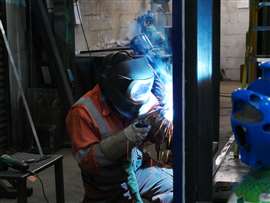 Falcon Fabrications operates from sites in Norfolk and Manchester
STAY CONNECTED


Receive the information you need when you need it through our world-leading magazines, newsletters and daily briefings.
CONNECT WITH THE TEAM