Read this article in 中文 Français Deutsch Italiano Português Español
Maximising ROI: a longer life for your cranes

11 March 2026
Extending a crane’s useful life is an increasingly popular way of maximising the return on investment and it has sustainability benefits too. Alex Dahm reports.
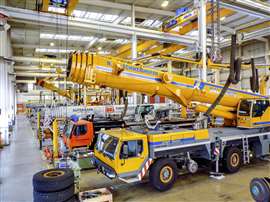 Crane manufacturer Liebherr also has extensive facilities for repairing and refurbishing cranes. Photo: Liebherr
Crane owners are looking more closely at ways to get the most out of their equipment and maximise their return on investment.
Prolonging a crane’s useful life is an increasingly valid and practical way of doing this in the longer term. It makes sense when you consider how so many resources go into the design, development, building, testing and so on for a new crane, in addition to all the materials, energy, water and the direct investment cost.
Sustainability is quickly becoming a more prominent element to consider in this equation. More and more it is helping to tip the balance in favour of holding on to a machine for longer, repairing it if it gets damaged and refurbishing it when parts wear out.
Replacing an old or damaged machine might be too expensive, take too long to wait for delivery or there might just not be anything quite right to do the job. From planned long term maintenance and service life extension projects, to drastic emergency repairs, it can all be done and – more often than you might think – be economical too.
Refurbishment or major overhaul of equipment is becoming more interesting from a cost perspective and due to availability of required equipment, according to Mammoet, the world’s largest crane-owning company.
 Hermen Kamp, Mammoet asset manager in the global project and assets team. Photo: Mammoet
Hermen Kamp, Mammoet asset manager in the Global project and assets team, explains, “The reason for refurbishment is a decision based on availability of new equipment, the cost price for the new equipment and market competition. For some equipment groups it is more interesting to do a mid-life overhaul rather than purchasing new.”
Manufacturer Manitowoc has a rebuild, repair and remanufacturing operation EnCore. Nate Pears, Manitowoc EnCore director, says, “In the current economic climate, many customers are looking to see what additional value they can extract from their cranes through an EnCore refurbishment. There will always come a tipping point, however, when a crane must be replaced, even if that takes several decades.”
Who does what
Larger crane-owning businesses often have their own facilities to maintain, repair and refurbish their own kit. At Mammoet Kamp explains, “As a lot of our equipment is specialized and manufacturers or dealers are not always nearby, our technical crews can maintain, repair and refurbish our equipment. We operate as a global team and share specialisms and resources wherever required.”
Andreas Köhler owner of Köhler Kran Service, an independent crane repair and spare parts business in Germany, says, “crane owners are increasingly outsourcing repair and refurbishment work rather than doing it in-house. Modern cranes have become highly complex, requiring specialized knowledge, diagnostic tools, and certified processes. This makes professional service providers like us essential for ensuring safety and compliance.”
Whoever does the work and wherever it is done, “A key factor is that repairs are executed using manufacturer-provided repair procedures and parts with original quality; certified and approved,” Kamp continues.
To that end, from a manufacturer point of view, Liebherr says, “The trend is that more repair work is being given to us as a manufacturer because cranes are becoming more complex and staff need intensive training.”
Manufacturer Manitowoc is banking on strong growth in this area with its EnCore operation. Nate Pears says, “There is not much EnCore can’t do. It spans a range of services from parts remanufacturing up to full machine rebuilds, all completed to OEM standards for added peace of mind. Grove, Potain, and Manitowoc cranes are built to last – not just for one lifetime, but multiple lifetimes, and EnCore is the programme that delivers it.”
Independent repair specialists are a popular option. Köhler Kran Service has more than 50 years of experience and workshops to handle pretty much everything, including boom and cylinder repairs, winch refurbishment, testing and a whole lot more.
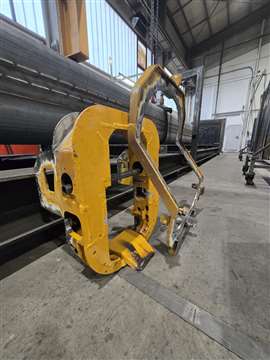 Telescopic boom repair, seen here at Köhler, is a common but highly specialized job for crane repairers. Photo: Köhler Kran Service
Andreas Köhler comments, “We continuously invest in modern diagnostic tools, precision machining, and advanced welding techniques to keep pace with technological developments in crane design. Our team undergoes regular training to stay updated on the latest OEM standards and safety regulations. Additionally, we integrate digital solutions for parts sourcing and documentation, ensuring efficient and transparent processes for our customers.”
Boasting an even longer experience record is Avezaat Cranes headquartered in the Netherlands. “We are specialized in the repair and new building of boom sections and crane structures of crawler cranes and telescopic cranes with more than 87 years’ experience. Our welders and workshop are DNV.GL certified to work on crane booms and crane related steel structures,” explains Bert Avezaat, proprietor.
Avezaat Cranes has extended its activities even further to now also build complete new lattice and telescopic booms for cranes with capacities from 25 to 2,000 tonnes. It requires commitment, “We always follow the latest developments in new and higher steel material qualities and grades and the latest welding technologies. For example, we invested last year in semi-automatic welding robots for the production and repair of telescopic boom sections.”
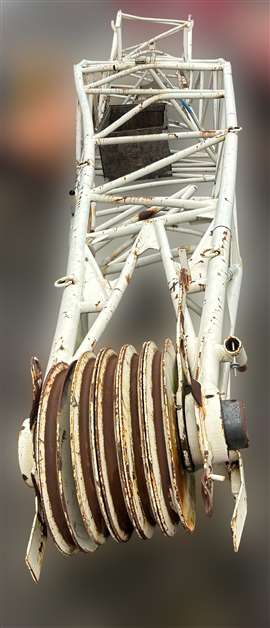 Lattice booms are a particular speciality at Avezaat Cranes, both to repair and build new. Photo: Avezaat
The sustainability element
“We see an increase of the need for good and certified repairs works because of the differences in prices and delivery times but also because of the sustainability,” Avezaat continues.
“From the point of view of sustainability, the repair and refurbishment of crawler cranes and telescopic cranes is a very interesting and most of the time a much better solution because when you choose for the repair or partly renew of a mobile crane you can extend the lifetime of the equipment without the need to demolish or scrap the damaged parts and buy or build new parts,” Bert Avezaat says.
“If you repair or partly renew the equipment it will save a lot of energy, materials, etc. so repair or partly renew is, most of the time, very effective with regards to sustainability,” Avezaat concludes.
Andreas Köhler concurs, “Repair and refurbishment significantly reduce resource consumption compared to manufacturing new parts. This approach minimises waste and carbon footprint.”
Interest is growing. Nate Pears at Manitowoc says, “Customers are more conscious of the sustainability benefits that EnCore repair and refurbishment offers than they were 10 or 20 years ago … The analysis of repair and refurbishment versus replacement inevitably offers highly favorable comparisons in terms of cost and sustainability.”
Performance and sustainability
In addition to whole life cost and ROI, repairing and refurbishing a crane is an opportunity to upgrade an old machine to give better performance or a better environmental operating standard.
An example of a performance upgrade is Liebherr’s LTM 1750-8.1, initially a 750 tonne crane which became an 800 tonner. “We have upgraded cranes in the field. We also retrofit new boom systems to cranes that have been delivered already,” the company points out.
Talking of retrofit Kamp says, “Retrofit of equipment is sometimes a good solution to extend the capabilities of the equipment. Examples are boom extension or boom upgrade kits, or software to provide different configurations.”
As Nate Pears says, “a refreshed crane can deliver improved capabilities over the original … There are many opportunities to include upgrades as a part of this. For example, with an EnCore Premium Rebuild on a Potain tower crane, we could replace the crane’s hoisting, trolleying, and slewing mechanisms with the latest variable-frequency technologies. This could offer a range of advantages over the original.”
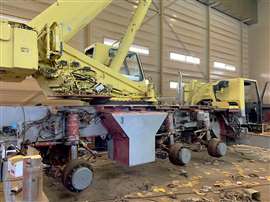 Bringing new life to a Grove GMK 3050 all terrain crane in Manitowoc’s EnCore programme. Photo: Manitowoc
Similarly, “with an upgrade to an older Manitowoc crawler crane, we might replace the engine with a newer generation unit to increase reliability and reduce the environmental impact compared with the older generation model,” Pears continues.
“With an overhaul you should then also replace the engines with lower or no emissions,” Kamp at Mammoet agrees, while also offering a word of caution, “Making too many changes to the crane itself would also require new (CE) certification, meeting state-of-the-art EN / ISO standards and the Machinery Regulation in Europe. These are complex and expensive processes that would not necessarily be cheaper than a new state-of-the-art machine.”
Expanding on the point about taking it a step further, Kamp says, “With refurbishment we also look where we have the possibility for electrifying the equipment instead of the current diesel engine.”
With electrification comes new challenges. As technology advances how are repairers adapting and developing their capabilities?
“Ongoing training and qualification is necessary. One example is the new electric crane drives. There are very high requirements when working on battery storage systems. And we have to comply with legal requirements for the qualification of personnel,” Liebherr says.
Equipment with a worn or otherwise expired power system is an opportunity to look at the available alternatives. “Can we, as Mammoet, develop any, as we did with the electric SPMT? Are these alternatives zero-emission or hybrid? Might the new energy source introduce complications, or particular infrastructure requirements? What will the market ultimately be for the used equipment? In the end, our goal is to serve the needs of our customers, who are increasingly looking for more sustainable alternatives that can be deployed to project sites,” Kamp concludes.
Repair and refurbishment combined with some upgrades may well be the most favourable solution all round.
STAY CONNECTED


Receive the information you need when you need it through our world-leading magazines, newsletters and daily briefings.
CONNECT WITH THE TEAM