Read this article in 中文 Français Deutsch Italiano Português Español
Mammoet lowers 2,300 tonne Texas bridge span in single piece

11 June 2026
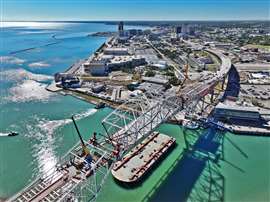 The Corpus Christi ship channel and downtown skyline frame the Harbor Bridge center span mid-descent, as Mammoet controls the load during the daylight lowering operation. Photo: Mammoet
International heavy lift and transport specialist Mammoet used four 900 tonne strand jacks and a barge-mounted self propelled modular transporter (SPMT) to remove the center span of Corpus Christi, Texas’ US 181 harbor bridge in a single lift; clearing the ship channel within a 36 hour operational window and marking the final major milestone of a US$1.3 billion (€1.1 billion) replacement project.
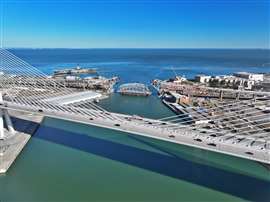 The generational contrast is stark: traffic moves across the new cable-stayed US 181 Harbor Bridge as Mammoet strand jacks control the descent of its 1959 predecessor 50 metres below. Photo: Mammoet
The new cable-stayed US 181 harbor bridge was built by project developer Flatiron Dragados LLC (FDLLC) and opened in 2025.
The removal of the old truss span (constructed in 1959) followed four months later, completing the transition.
Choosing the method
The Texas Department of Transportation (DOT) and FDLLC evaluated several removal strategies before selecting the lift-and-lower approach; piece-by-piece dismantling and controlled explosive demolition were both considered and rejected.
The single lift method reduced the number of workers required at height, shortened the shipping lane closure, and limited environmental exposure to the surrounding marine environment; a key consideration given the proximity of the Texas State Aquarium.
Setting up the lift
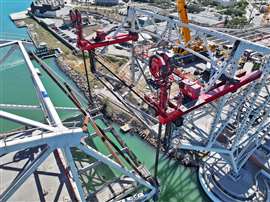 Two of Mammoet's four 900 tonne strand jacks sit positioned at the end of the 1959 Harbor Bridge deck, their pre-coiled wire configuration eliminating the need for workers to manage strands manually during the lift. Photo: Mammoet
Two strand jacks were positioned at each end of the span.
Before the initial load transfer, the team made an “eyebrow cut” above each pin connection to create a small opening.
“This gave us an opportunity to check the deflection of the bridge and ensure everything was stable,” said Bobby Martija, Mammoet project manager. “Once everyone was satisfied that all the clearances were correct, the cutting began.”
The span’s weight – estimated at 2,300 tonnes from historical records – carried a built-in contingency to account for any deviation. Lowering was scheduled for daylight hours only.
The strand jack configuration also required a design decision. A standard umbrella setup, with 54 strand wires resting across the bridge deck, was abandoned in favor of pre-coiled wires managed by two coilers, sub-assembled at Mammoet’s yard in Rosharon, Texas, and brought to site ready to deploy.
“We realised that [the umbrella configuration] would be too time-consuming, with people required to manage and arrange them,” Martija said.
Lowering onto a barge
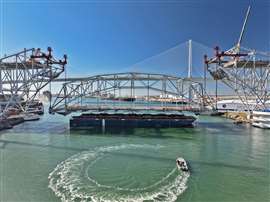 Photo: Mammoet
The night before the operation, Louisiana-based Canal Barge Company’s Prometheus – a 300 foot by 100 foot (91 x 30 metre) deck barge – was positioned beneath the span, equipped with winches, support grillages and SPMT. The 36 hour window began October 25 and concluded October 28, when the span was shipped 10 nautical miles to dock.
The span descended nearly 50 metres on 54 strand wires. Once on the barge, 54 axle lines of SPMT were used to lift and transport it to steel supports for decommissioning. Before that move the underside of the span was reinforced with welded steel; work that would have required height access earlier in the sequence but was completed safely on the barge deck.
Replacement project context
The Harbor Bridge replacement project started in August 2016 and ran for nearly nine years.
The new bridge carries six lanes of US 181 plus a shared bicycle and pedestrian path, with a main span of 506 metres and 62 metres of clearance below; enough for larger vessels than the 1959 structure could accommodate.
Approach structure demolition on both sides of the ship channel will complete the decommissioning.
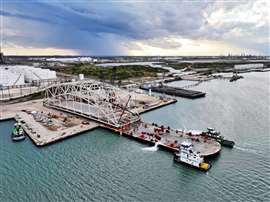 Mammoet SPMT positioned beneath the 1959 Harbor Bridge center span at the offloading dock, where the structure was transferred from the barge and set onto steel supports. Photo: Mammoet
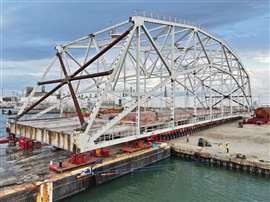 With the barge transport complete, Mammoet SPMT trains take the weight of the center span for final placement – the last move in a months-long removal sequence. Photo: Mammoet
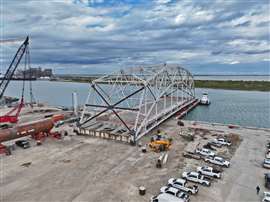 Mammoet SPMT beneath the 1959 Harbor Bridge center span at the offloading dock, where the structure was transferred from the barge and set onto steel supports. Photo: Mammoet
STAY CONNECTED


Receive the information you need when you need it through our world-leading magazines, newsletters and daily briefings.
CONNECT WITH THE TEAM