Read this article in 中文 Français Deutsch Italiano Português Español
Record-breaking dragline move by Mammoet

13 August 2025
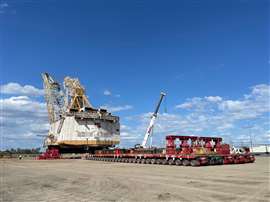 Preparing to drive the 560 wheels of SPMT under the jacked up dragline. Photo: Mammoet
Giant draglines used in open cast mining usually ‘walk’ mechanically by themselves when they need to be relocated. Depending on the distance this typically takes about a month and presents quite a spectacle for onlookers.
No less spectacular was an enormous dragline weighing more than 3,000 tonnes being carried on 560 wheels of self propelled modular transporter (SPMT) at a mine in Australia.
International specialized transport and heavy lifting giant Mammoet set a new benchmark for dragline transport when it relocated a Marion 8050. It was a 27 km journey completed in only 10 days. SPMT can travel at up to 5 km/h while under its own power the dragline would take 12 hours to cover 1 km. Saving so much time minimised downtime for the mine operator and reduced wear and tear on the dragline’s mechanical systems.
As the 3,100 tonne machine is powered by electricity, relocating it under its own power would also have meant “a lot of ancillary transmission and generation equipment to move between dig sites,” Mammoet said. Not least of which would be a portable substation connected via a long ‘umbilical’ cable linked directly to overhead power cables on site.
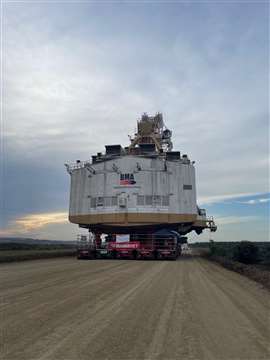 Away down the road: the dragline on its 27 km journey. Photo: Mammoet
On its way
Working for BHP Mitsubishi Alliance (BMA), Mammoet relocated the dragline from one end of the Peak Downs coal mine in Queensland, to another one 27 km away.
Time really was of the essence in that “failure to reach and cross a rail line by a certain deadline would result in considerable downtime and cost to the project,” Mammoet explained.
First, the dragline had to be jacked up so the SPMT could be driven underneath. Eight JS500 jacking towers were set up underneath and lifted it 2.5 metres. Knowing the weight and the centre of gravity was crucial, not helped by it being an old machine with limited information available.
“In the past, dragline jacking in Australia has been performed using climbing jacks, which require manual handling of timber stacks to gradually lift the load,” explained Jack Whittaker, mammoet project manager. “The JS500 system requires fewer jacking towers and uses cassettes, which are inserted at its base. This saved a lot of time, resulted in less equipment and removed the need for manual handling.”
On wheels
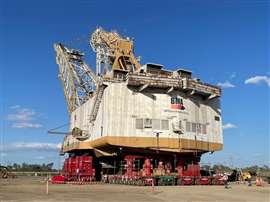 The JS500 jacking towers and the SPMT under the 3,100 tonne dragline. Photo: Mammoet
Five columns of 28 axle lines – 560 wheels in total – of SPMT were driven in underneath the load. The weight was evenly distributed for a ground bearing pressure of less than 9 tonnes per square metre.
BMA devised and built a route for the move. Steel mats were placed on the areas of soft ground to stop the SPMT getting bogged down.
To protect the SPMT operator from the sun a seat with a canopy was installed on the deck of the front module. It allowed the operator to sit with the control box instead of walking and carrying it.
Once on the move the transport covered 8 km a day.
In the 72 hour window for the railway line closure a temporary ramp had to be built over the track, the dragline had to cross it and then things had to be put back as they were. “One of the key reasons that BMA reached out to us was because the Aurizon rail crossing is a critical line – transporting coal from different mines in the region to the coast for exporting,” said Laura Ewen, Mammoet branch manager.
“Peak Downs had competing projects in the area at the time, and the shutdown crossing window wouldn’t align again for another three months. The dragline was required for coal extraction in the southern pits for production,” Ewen continued.
STAY CONNECTED

Receive the information you need when you need it through our world-leading magazines, newsletters and daily briefings.
CONNECT WITH THE TEAM