Mike Appling continues to make waves

27 July 2026
With his new crane business expanding, and having taken a lead role in arguing federal government tariff relief, Mike Appling is doing what he loves.
It’s been almost 20 years since Mike Appling made his debut in the crane industry. From 2023 to 2024, as he waited for a non-compete clause in his contract with TNT Crane & Rigging to expire, he contemplated “what’s next?” After the one-year non-compete expired, he researched the idea of buying an existing crane company or starting a new one.
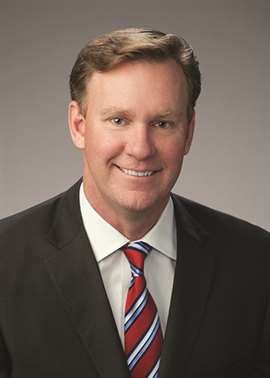 “Everything starts with putting experienced people in the field, giving them reliable equipment and executing the work safely.” Mike Appling, CEO, LiftHigh Crane & Rigging
After looking at some 15 crane companies, he determined that they were either too expensive, their safety records were not great or their fleets were too old.
“Brad Hopper, CFO, and I met with Sam Land in February 2025 and decided to do a start-up,” he said, referring to his new venture LiftHigh Crane & Rigging, based in Houston, Texas. “It has worked out great, and we are very happy we do not have anyone’s old historical lingering headaches.”
Hit the ground running
The idea for LiftHigh started with a call from crane operator Joshua Scott, Appling said. Scott, who now works for LiftHigh, encouraged Appling to talk to Land, who started branches for Americrane and Sterrett.
“I met with Sam, and the more I talked to him, the more I got comfortable that he knew how to do this,” Appling said. “Having Brad Hopper and Thi Tran in the corner to help with finance and legal was a huge leg up. Collectively we all got it figured out, but honestly without those three people this would have been a colossal flop, and I owe all of them.”
LiftHigh hit the ground running in early 2025. Last month, the company announced an increase in its credit line and the opening of a new branch in Central Texas.
“We are incredibly excited about our New Braunfels branch,” Appling said. “We are right in the middle of the I-35 corridor between San Antonio and Austin. It is an incredibly active market, and we are assembling an absolute crane Dream Team there, just like we have done in Houston. A year from now we will have 15 if not 20 cranes there, and people will look around and say, ‘What did these guys just do?’ I think we will have a $20 million branch there in short order.”
I’ve known Mike Appling all of his 20 years in the crane industry, meeting him on a layover in route to a SC&RA meeting in Florida. Through the years he has been one of my most reliable and amusing crane industry sources. I think you will be interested in what he has to say.
What are the challenges that a small startup faces in today’s market?
That is such a multi-faceted question. I cannot really express the support we have had from Huntington Bank and multiple other distributors and finance companies. I mean seriously, who gets a $10 million line of credit three months after opening, expands it to $20 million a few months later. If I had to guess, we will be at $40 million in September 2026. Customer acceptance has been unbelievable in all markets. For example, most industrial companies have a three-year safety record requirement. We have received waiver upon waiver upon waiver. Our top 12 or so people have a combined 300 years of experience.
We have an all-new crane fleet and more experience than anyone in the industry. Our TRIR for the first full year is zero. Our customers have asked, ‘Why would we not work with you?’
One of the proudest moments in this journey was at our open house in October 2025. As we walked out toward our Liebherr LTM 1750, one of our operators asked, ‘Do you know how many people we have that can run that 900-ton crane?’
I started counting: Sam Land, Jimmy Clary, Jeff Clary, Jacob Strahan, Eli Elizondo, John Webb and Kevin Donovan. We have seven dudes that can run that crane.
The operator then asked, ‘Do you know who else has seven people who can run that crane?’
His answer to me was no one. Since then, we have added David Sandefur Jr. to our team, who can also run that 900-ton crane.
When you start with a group of operators that I would put up against any company in the world, then a lot of startup challenges go away. The customers gravitate to those that are best in class across the board. At the end of the day, our customers are trusting us with some of their most critical lifts. Everything starts with putting experienced people in the field, giving them reliable equipment and executing the work safely.
What distinguishes LiftHigh in the markets it serves?
We have hired the best of the best. Operators, salespeople, managers – we have the best in the business. We hired Gary Via at TNT in 2008, one of the best things I have ever done. He is now with LiftHigh.
John Webb was one of the first operators I hired. I knew he would be right for the culture. He is now a million-dollar a month sales guy. The customers love him. Jimmy Clary is an absolute rock star. I trust that guy with anything and everything. I cajoled, lured and ultimately begged Sandra Stewart out of retirement. Her ability to work with Thi and the team and process all the new MSA’s and bid packages is off the charts.
Sandra Thornton runs the office. She started at TNT in 2000 and is now with LiftHigh. She has seen it all and covered all facets of back office and operations interface. Frances Hoover and I have worked together for the most part since 2002. She really keeps me lined out.
We are just really blessed to have this group of people together and we all realize it. There is not a thing our group has not seen or cannot figure out.
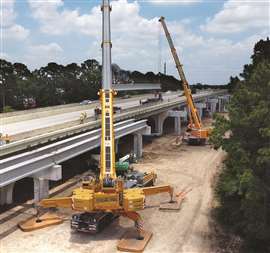 LiftHigh crews work on a bridge infrastructure job where they lifted and set 36 bridge beams weighing 110,000 pounds and were in excess of 119 feet long. The cranes used included 400-ton Liebherr LTM1350-6.1 and a 900-ton Liebherr LTM1750-9.1.
Customers understand this very quickly. Then we show them our crane list, which is all new models from 2025 and 2026. That seals the deal. We don’t own anything older than a 2024 model.
Just do things the right way. Our guys coined a phrase, ‘Lift it right, lift it high.’
Do you envision further new branches? Acquisitions?
You have not met my wife, Leslie. I have promised her we are not going back to me running 47 branches and generating $400 million in revenue. There are a few acquisitions that we have kicked around and considered. Nothing is imminent. We honestly have enough to say grace over with our three branches.
Could I see expanding to a few more locations, or doing a few acquisitions with strategic partners? Sure. But we are not focused on a big expansion and flip. We are building this for the long term.
Maybe our management teams’ children get involved in the business, maybe they don’t. But we have a lot of talented people in their 40s or early 50s with plenty of runway. We will focus on building up the next generation of leaders. We plan on LiftHigh being here 50 years from now.
You have been working with SC&RA and Joel Dandrea on the issue of tariffs in the crane industry. What exactly is the issue for the crane and transport sector?
There are two primary issues. Unnecessary cost and the shift in tide to China. Ninety-seven percent of all-terrains used in the U.S. are manufactured outside of the U.S.
I think Link Belt is an awesome company with a great heritage. They make a 175-ton, a 225-ton and a 300-ton all-terrain in the U.S. There are literally 30 sizes of ATs between 30 tons and 1,000 tons capacity, and most of them are not made here.
So why are we adding a 15, 25 or 40 percent tariff, depending on the day you look at it? I am all about buy American. I am on driving my fourth Ford F150 over the last 30 years. It is a great truck, and it is 100 percent assembled in America. I literally have ragged on people for 25 years driving around their Infiniti’s or Range Rovers that they should buy American. But that does not work in the crane industry.
Honestly, I do not think any manufacturer with the constantly shifting political winds will raise their hand and say, sure, let’s rely on these tariffs and build a $4 billion factory in the U.S. that we will complete in five years. The economies of scale do not work. There are plenty of cranes built in the U.S. and our share of production is fairly tied to what we consume, but it is largely an import market to the tune of 80 percent, and that will not change anytime soon.
Then the second issue is Chinese cranes. There are people now buying Chinese cranes that have told me for years they would never do that. I am not a fan. I do not believe in their quality, the ability to fix with available parts and mechanical know-how. I think they are a safety issue. That is my opinion. China is an economic threat that is stealing technology across the world every day. We have implemented policies that help China and that are a detriment to good trading allies such as Japan and Germany.
How have tariffs affected crane-owning companies?
Simply put, in August of last year we had $12.5 million ready to ship in five cranes at the port in Germany. The section 232 steel and aluminum tariffs were announced August 15, 2025 and implemented August 18, 2025. That $12.5 million turned into almost $16 million, and it took crane manufacturers almost three months to figure it all out as they had to go to all of their sub-contractors and calculate crane by crane. Some companies had cranes on the water and had a hard time getting them through customs. There were huge delays on equipment being delivered.
Has there been some relief?
I think going down to 15 percent is a win if it holds. It just seems to change all the time. We also need to get relief on high-tensile strength steel, which is not manufactured in the U.S. I think we are heading in a good direction, but there is more work to do. It can also change, month to month, depending on what goes through the courts. Hopefully this all settles down soon.
Having worked with some incredibly talented people in the industry on this issue for over a year, there has been some relief, but the honest answer is that I have no idea. Being part of a group of people that put time and sweat into this issue, I really cannot describe how many cool and talented people we have in the crane industry. I am fortunate to be a part of it and involved in this cause.
What is it about the crane industry that keeps you engaged?
Every day is a different challenge. The crane industry and industrial services sector at large are not for the faint of heart. I love it.
Multiple long-term veterans questioned my sanity coming back into the industry. Some of these same people are the third generation in the business or have been working in the business for 40 years. I made a choice.
After almost 20 years in this business, I still kind of consider myself an outsider compared to some of the just off-the-wall talented people in this industry. I did not grow up in the industry, and I wasn’t running a crane at 18 years old, and I have so much respect for the knowledge those people have over me.
But I will use a Texas analogy: “I didn’t grow up in the crane industry, but I got here as fast as I could. And I ain’t leaving!”
STAY CONNECTED


Receive the information you need when you need it through our world-leading magazines, newsletters and daily briefings.
CONNECT WITH THE TEAM