Read this article in 中文 Français Deutsch Italiano Português Español
Handling the transport of oversize mega components

15 May 2026
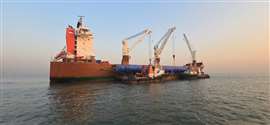 Transferring the two 330 and 248 tonne process columns between vessels at sea. Photo: EXG
Express Global Logistics (EXG) transported two oversized process columns by road and barge from its domestic market of India to an overseas site.
Process columns are used in the chemical, petrochemical, and refining sectors to separate mixtures by exploiting differences in characteristics such as boiling point or solubility.
The two process columns moved by EXG comprised a high-pressure column measuring 70 metres by 8 metres by 5.6 metres, weighing 330 tonnes, and a low-pressure column measuring 65 metres by 8 metres by 5.3 metres, which weighed 248 tonnes.
The work involved moving the two columns from the fabrication facility in Dahej, on the west coast of India, to an overseas site owned by oil and gas multinational Exxon. This included co-ordination across road transport, load-out, marine transit, and the final delivery stages.
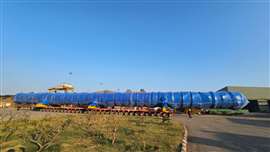 One of the two 70 metre-long columns on land and on the self propelled modular transporter. Photo: EXG
SPMT from the beginning
For the initial leg in the fabrication yard, where manoeuvring space was restricted, EXG used self-propelled modular transporter (SPMT) configured with 30 axle lines. This required the load distribution across the axles to be calculated in advance to ensure stability, and the movements of the SPMT to be carried out gradually and under technical supervision to avoid structural stress on the equipment.
From there, the SPMT transported the columns to a nearby load-out jetty – necessitating a detailed assessment of ground conditions, turning radii, and pathway clearances – and loaded on to a 230-class barge, supported by a 2,000 brake horsepower tug.
The load-out window was limited by tidal constraints and so required accurate timing. The EXG team completed the sea fastening process within a compressed timeframe of six hours, before the barge travelled along the western coastal route to the designated port anchorage and the cargo delivered under free alongside ship (FAS) terms.
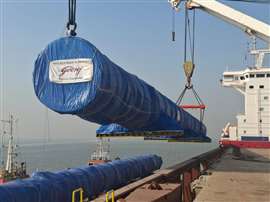 Showing just how long and narrow these process columns are. Photo: EXG
STAY CONNECTED


Receive the information you need when you need it through our world-leading magazines, newsletters and daily briefings.
CONNECT WITH THE TEAM