Read this article in 中文 Français Deutsch Italiano Português Español
Six Wolff cranes build Munich district amid active demolition

23 November 2026
Six Wolff flat-top tower cranes are demolishing and rebuilding a city block next to Munich Central Station at the same time.
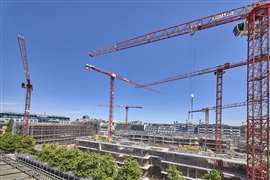 A total of six Wolff tower cranes are working on The Verse project in Munich, Germany. Photo: Wolffkran/Erik Bohr
The former Postbank-Karree is becoming “The Verse”, a business district due for completion by the end of 2028. The cranes have worked on it for construction firm Riedel Bau since 2025.
Riedel Bau runs three rental cranes and three from its own fleet. The fleet includes a new Wolff 8038.20 Clear, which the contractor bought for this project. It is the largest flat-top crane in Wolffkran’s portfolio. The crane sits in the middle of the site with a Wolff 7534.16 Clear. With a 75-metre jib, the 8038.20 lifts 4.7 tonnes at the tip and 20 tonnes at maximum, and its hook height is 73 metres. The two central cranes lift reinforced concrete sections of up to 12 tonnes cut from the existing structure. They also moved concrete buckets and precast elements weighing up to eight tonnes.
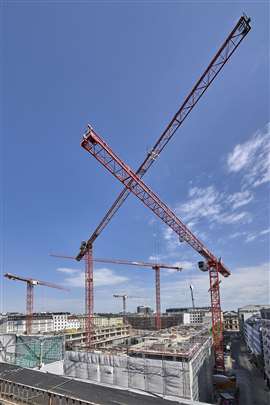 The six Wolff cranes mainly operate in two-fall operation. For heavy loads such as precast staircases or reinforced concrete sections cut out of the existing structure, they are switched to fourfall operation as required. Photo: Wolffkran/Erik Bohr
Two Wolff 7032.12 Clear, a 6015.8 Clear and a 6031.8 Clear work the edges of the site. Together, the six will move around 10,000 tonnes of demolition material, 5,000 tonnes of steel and 35,000m³ of concrete before they leave in May 2027.
An existing building leaves little choice over where cranes stand. Wolff mounted all six on cross frames and gave each outer crane its own foundation. The 6015.8 Clear stands on bored piles, and the two 7032.12 Clear stand partly on existing basement walls and partly on cast-in-place foundations and micropiles. The 6031.8 Clear sits on a newly built wall and a pad foundation, which routes its loads around underground utility lines. Wolff coordinated the four outer positions with the city authorities and utility companies. The cranes sometimes lower loads up to five floors into existing building shafts. The site has almost no storage space, so deliveries and removals have to follow the work.
Mobile cranes erected five of the six. The 8038.20 then erected the 6015.8 Clear, and it will dismantle that crane and one of the 7032.12 units. A 450-tonne mobile crane with a luffing jib will take down the two central cranes, because the new building now blocks the courtyard access that crews used to erect them. The mobile crane will reach over the new building edges.
“We work closely with Wolffkran, especially when planning crane erection and dismantling,” said Daniel Martinas of work preparation at Riedel Bau. “What we value about our partner is not only the clearly structured crane portfolio, but also the consistently well-thought-out, individual solutions, especially for demanding projects like this one.”
The cranes mainly work in two-fall operation and switch to four-fall for heavy loads such as precast staircases and concrete sections. Herzog & de Meuron designed The Verse, which will have around 76,000m² of gross floor area. Wolff is also supplying nine cranes to a similar redevelopment at 1 Victoria Street in London, some of them standing on foundations more than 60 years old.
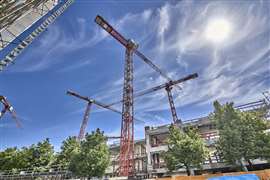 The six Wolff cranes mainly operate in two-fall operation. Photo: Wolffkran/Erik Bohr
CONNECT WITH THE TEAM