Read this article in 中文 Français Deutsch Italiano Português Español
Tadano crane reaches ‘record’ 199m hub height in Germany

12 November 2026
German construction firm Max Bögl needed a crane to reach a turbine hub 199 metres above Bavaria, and lifting specialist Steil Kranarbeiten turned to a Tadano CC 78.1250-1 lattice boom crawler crane to complete the work.
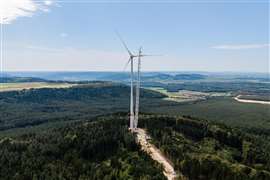 Tadano CC 78.1250-1 lattice-boom crawler crane reaches a “record” height in Germany. Photo: Tadano
“We chose this crane because, at present, there is no other machine capable of erecting this type of turbine,” said René Perlich, crane operator at Steil Kranarbeiten.
Steil used the Tadano lattice boom crawler crane (1,250 tonnes) to erect a Vestas V172-7.2 MW turbine at Winnberg, near Sengenthal. The turbine stands on a hybrid tower developed by Max Bögl and measures 285 metres overall. Max Bögl and Vestas call it the world’s tallest series-produced onshore wind turbine.
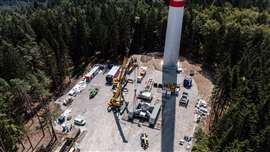 The CC 78.1250-1’s carbody and crawler tracks sit on timber mats at the foot of the tower while a Steil crane lifts components. Photo: Tadano
Steil rigged the crane with a 203.5-metre main boom with Boom Booster and a 15-metre fixed jib, which Tadano says gives the greatest height currently available on the market. The CC 78.1250-1 is the first of its kind in Europe, and Steil says this configuration is a first worldwide.
“We listened very closely to our customers and observed market trends,” said Andreas Hofmann, Tadano’s managing director for research and development. “We anticipated the types of turbines that would be coming, responded well in advance, and that is why we are now ahead of the curve.”
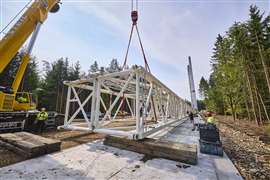 Steil’s Tadano GTC-2000 telescopic crawler crane lifts a lattice boom section as crews assemble the CC 78.1250-1. Photo: Tadano
Tadano provided an on-site service team for the build. Michael Hopp of that team said the Boom Booster needs no special transport arrangements, because crews fold the components for transit and bolt them back together on site. Perlich said the crane set up easily despite the sloping ground at Winnberg. Its footprint is just 12 by 13 metres.
Once commissioned, the turbine should generate about 17 to 18 GWh a year. Combined with Max Bögl’s existing generation at its Sengenthal headquarters, that would cover about two-thirds of the site’s energy needs.
“Despite its size, the CC 78.1250-1 operates much like a CC 38.650-1,” Perlich said. “It’s completely undemanding to use... even at these extreme heights.”
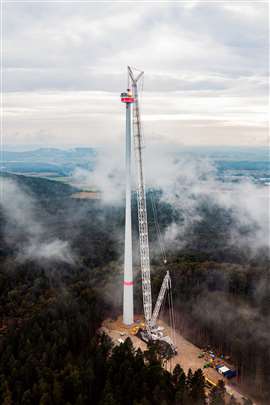 The CC 78.1250-1 stands beside the Max Bögl hybrid tower at Winnberg, its boom reaching the tower top above the cloud. Photo: Tadano
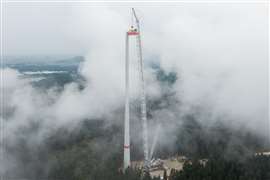 The CC 78.1250-1 reaches the top of the Max Bögl hybrid tower at Winnberg, with low cloud drifting through the forest below. Photo: Tadano
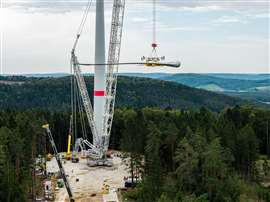 A Tadano CC 78.1250-1 lifts a rotor blade beside the tower at Winnberg, near Sengenthal, Germany. Photo: Tadano
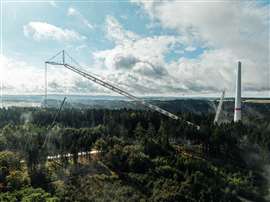 Crews raise the CC 78.1250-1’s boom during setup beside the tower, with a Steil mobile crane at the boom tip. Photo: Tadano
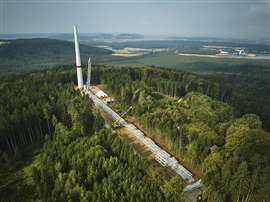 Boom sections for the CC 78.1250-1 lie in a row along a cleared strip through the forest as crews assemble the crane. Photo: Tadano
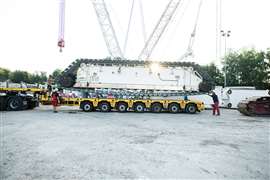 Crews lift a crawler track unit off a heavy-haul trailer ahead of assembly of the CC 78.1250-1. Photo: Tadano
CONNECT WITH THE TEAM