Read this article in 中文 Français Deutsch Italiano Português Español
Tower crane power: efficiency gains

18 September 2025
A new drive system for tower cranes promises an energy consumption reduction of 40 %, slashing running costs and contributing to sustainability goals. Alex Dahm reports.
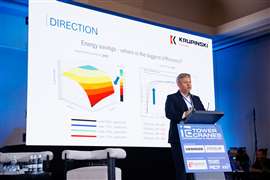 Daniel Gwóźdź explaining the energy saving drive system. Photo: Joe Mather/KHL
As the only tower crane manufacturer in Poland Krupinski has been making a name for itself over the last six or seven years, first in Poland, now in the rest of Europe and beyond.
One differentiating factor it has worked hard to achieve, from a technology standpoint, is its new electric drive system for tower cranes to bring energy saving benefits of as much as 40 per cent to the crane owner and-or operator.
It was explained by Daniel Gwóźdź, CEO and co-owner at Krupinski cranes, in his presentation at the International Tower Cranes (ITC) conference in Rome, Italy, in July 2025.
Many tower cranes, probably by far the majority, now have frequency inverter drives – computer controlled, electronically regulated power delivery. Krupinski’s goal was to find a better solution.
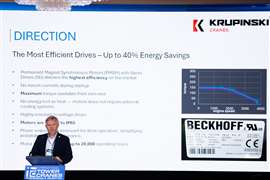 Savings of as much as 40 per cent can be achieved, Daniel Gwóźdź said. Photo: Joe Mather/KHL
Energy savings
A reduction in electricity consumption of as much as 40 % can be achieved with Krupinski’s new drive system, Gwóźdź highlights. “To achieve the energy savings we decide to move from the asynchronous motors to permanent magnet synchronous motors (PMSM) with servo drives which deliver the highest efficiency on the market.”
PMSM are known in industry but not in cranes, Gwóźdź says. They have no inrush current during startup which is very important on the power connection to the crane. Maximum torque is available from zero revs. So the brake becomes just a piece of safety equipment on the hoist.
Cranes are designed to be operated with very fine and smooth control of movement. No energy is lost in heat so the motor also does not require an external cooling system, especially beneficial in hot countries.
Unlike on other cranes phase sequences are not an issue. If the site power supply cable is cut overnight and service people repair it but changed the phases, the crane will still work normally, Gwóźdź says. The warranty given by the motor manufacturer is for 20,000 operating hours, for mechanical and magnetic field issues. That equates to about 10 years of operation.
Comparing the asynchronous motors on a typical 5 tonne crane shows stark contrast in terms of weight. An 18.5 kW asynchronous hoist motor weighs 350 kg but the equivalent 22 kW PMSM type only weighs 85 kg. Similarly on the 3 kW slewing motor, typically 90 kg, as against a 4 kW PMSM that weighs 17.3 kg. The typical 4 kW trolley motor weighs 85 kg while its equivalent PMSM type is 5 kW and weighs less than a quarter at 20.1 kg. Even with the vastly reduced weight there is still more power at the shaft, Gwóźdź says.
How it is done
 Daniel Gwóźdź, CEO and co-owner at Krupinski cranes. Photo: Joe Mather/KHL
“We couldn’t fathom it out in the beginning – why is there such a big difference in the energy saved between asynchronous motors and servo drives?” Examining three dimensional charts showing the power pattern of the motor at work gave some answers. Running standard motors at maximum speed and under a range of loads gave an efficiency range from 84 down to 70 % while the PMSM drive was almost always more than 90 % efficient.
At slower speeds the difference was even more pronounced. With tower cranes, you often work very slowly with precise movement, and there the difference is huge, Gwóźdź says. Efficiency of asynchronous motors in that situation is only 40 %. The rest of the energy is lost as heat, requiring the motors to be cooled.
“To take the situation further, we decided to apply energy management to the cranes, putting a [43 kW-h] battery pack between the grid power connection and the crane.” Krupinski added a regeneration or energy recovery capability to all drives to put power back into the battery. “Our eight tonne crane can work continuously with a single phase [230 Volt, 60 Amp] grid connection. Without a mains power connection, you can work up to 17 hours on the crane with that battery.”
Before building a prototype crane, the new drive principle was tested for almost two years at the University of Gdansk in Poland. Data gathered helped motor and drive suppliers to build the new drives. Hoists for cranes from 5 to 10 tonnes were built and tested. The first crane with servo drives was erected in 2021 and testing began, live on a building site, with good results, Gwóźdź says.
See a video of this Krupinski presentation by Daniel Gwóźdź at the 2025 ITC conference.
STAY CONNECTED


Receive the information you need when you need it through our world-leading magazines, newsletters and daily briefings.
CONNECT WITH THE TEAM