What modular construction means for lifting and transport

18 February 2026
As modular construction accelerates worldwide, 2026 is shaping up to be a defining year for heavy lifting and engineered transport.
Across global construction markets, modularisation is no longer a niche strategy. It has moved from “future trend” to frontline practice as developers, energy producers, manufacturers and governments look to build faster, cut on-site risk and control costs.
 Joel Dandrea, SC&RA chief executive. Photo: SC&RA
For SC&RA members 2026 is shaping up as the year modular lifts and moves become central to major projects, not occasional exceptions.
With that in mind, energy transition work demands components that are larger, heavier and more complex than traditional builds. Data centres add mega modules packed with power and cooling that must arrive on precise timelines. LNG terminals, hydrogen hubs and gigafactories depend on off-site fabrication to compress schedules, while public housing programmes around the world are turning to modular methods to hit volume and sustainability goals.
What ties these sectors together is the rising need for higher capacity lifting, engineered transport and meticulous corridor planning – the work SC&RA members specialise in.
Consistent steps
Modularisation changes the geometry both of construction and transport. In Europe large offshore wind components are pushing the limits of heavy lift fleets, and onshore projects are increasingly relying on mega crane configurations to place nacelles and blades assembled in controlled environments.
In the Middle East, giga-scale developments are incorporating modular hotels, utility buildings and data infrastructure requiring co-ordinated heavy transport across borders. North American energy producers are turning to modular plant sections to combat labour shortages and shorten outage windows.
In Latin America, mining expansions and industrial rebuilds often rely on prefabricated modules because remote conditions make on-site fabrication inefficient.
All these trends translate to specific demands: larger crawler cranes, higher-capacity self propelled modular transporter (SPMT), multi-state or multi-country permit sequencing, route surveys with tighter tolerances and engineering teams capable of modelling every pick and movement before a module leaves the factory floor. Companies able to deliver these capabilities are consistently stepping into a global growth market.
But modularisation also introduces new pressures. Transport routes that once accommodated standard loads now require expensive reinforcements or detours. Ports are facing capacity challenges as more outsized cargo moves through in shorter windows.
In addition, the equipment needed to support these projects is moving more frequently between regions, increasing the importance of cross-border regulatory alignment.
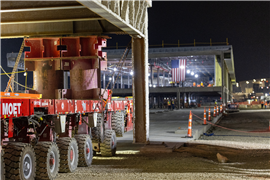 Bring in the modules: Mammoet using self propelled modular transporter (SPMT) to carry one of six prefabricated terminal modules at Dallas Fort Worth International Airport’s new Terminal F. Photo: Mammoet
Global delivery
If 2026 is the year modular construction becomes a defining force in global infrastructure, the question for SC&RA members is how to prepare.
The first step is early engagement. Modular projects succeed when heavy lift and transport providers are involved at the design stage, not after contracts are signed. Because modules determine the project’s logistics footprint, upstream insight can save months of rework downstream.
Next comes fleet strategy. Companies will need to evaluate whether their current mix of cranes and transport equipment aligns with emerging demand. In many markets, higher-capacity assets are increasingly necessary, and utilisation pressure suggests strategic partnerships or temporary fleet arrangements may become more common across borders.
Finally, the industry will need to double down on workforce development – operators, riggers and engineers trained not only in technical execution but in the sequencing and co-ordination required for modular delivery.
For SC&RA’s international community, the opportunity is significant. As modularisation reshapes how the world builds energy systems, manufacturing hubs and digital infrastructure, the companies best prepared to lift, move and position these modules will be the ones setting the pace.
In a global market defined by speed, scale and complexity, 2026 may well be the year modular becomes the new normal – and the year heavy lift and transport providers step even more firmly into the centre of global project delivery.
STAY CONNECTED


Receive the information you need when you need it through our world-leading magazines, newsletters and daily briefings.
CONNECT WITH THE TEAM