Read this article in 中文 Français Deutsch Italiano Português Español
Wheeled cranes: hybrid hits the market

25 November 2026
Julian Buckley looks at the drive technology used in some of the latest hybrid wheeled mobile cranes, with a review of how these new models could impact the market
Lifting capacity is the headline number when considering wheeled mobile cranes but, given the machine format, vehicle mobility is of equal importance. Diesel powertrains with power take off for hydraulics to drive the cranes have long been the standard but a growing number of models featuring new drive solutions have recently been launched onto the market.
These latest mobile cranes combine a high-efficiency diesel engine with battery packs to create a hybrid drive. When moving the carrier, electrical assistance can return improved fuel economy and further reduce emissions.
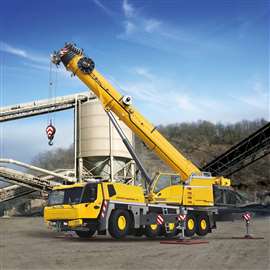 The new Manitowoc Grove GMK5150L-1e has a 160 kWh battery. Photo: Manitowoc
But there’s more. Once the vehicle is in place, the same batteries used to assist the diesel engine on the road are now being used to power the crane. This helps to improve the operator experience, while offering compliance with low noise and zero-emission site regulations.
Grove hybrid drive
Hybrid drives have featured on a series of recent entries in the mobile crane market. In April 2026, Manitowoc reported the first customer delivery of its Grove GMK5150L-1e plug-in hybrid model. Based on the GMK5150L, a crane which was premiered at the Bauma construction machine show back in 2016, this latest variant features a new drivetrain benefiting from electrical assistance.
The models features a Mercedes-Benz OM471LA 12.8-litre inline six-cylinder turbodiesel engine producing 390 kW. This is paired with four 40 kWh battery packs and a 163 kW generator. On the highway, the e-boost function can deliver a 30 per cent increase in acceleration over a non-hybrid version. Regenerative functionality via an eco mode can return a small amount of charge back to the batteries, or a generator-style power mode can fast charge the packs from 10 to 80 % capacity, using the diesel engine, in less than 60 minutes. Recharging when stationary can be completed at 22 kW using a 400 Volt AC connection, or an optional DC connection can deliver a maximum 200 kW charge.
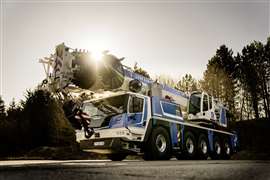 The Liebherr LTM 1150-5.4E can deliver four hours of untethered lifting operation from its battery pack. Photo: Liebherr
While specifics covering power delivery to the crane are unavailable, it’s likely the battery packs drive electric motors which in turn power hydraulic pumps to deliver boom and lift motion. The crane could have been developed to use an all-electric system but maintaining the hydraulic portion allowed adoption of electrical power without a complete redesign of the field-tested mechanism. The model has a maximum 60 metre boom.
The GMK5150L-1e carrier has a five-axle configuration with three driven axles. All wheels use the Megatrak fully-independent hydropneumatic suspension system with hydraulic lockout. All five axles steer on the highway, while the three rear axles support crabbing for on-site manoeuvring.
Maximum lift options
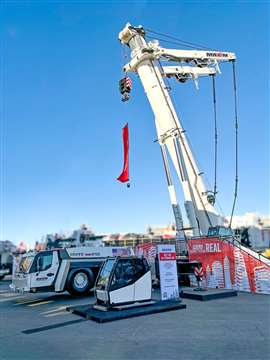 The new Manitowoc Grove GMK8700 on display at the ConExpo 2026 trade show in April. Photo: Manitowoc
Unveiled in March 2026 at the ConExpo trade fair in Las Vegas, the GMK8700 is now the largest mobile crane produced by Grove. Featuring an eight-axle carrier, this new model lifts 700 tonnes with the maximum 175 tonnes of counterweight. Fitted with the Megadrive system, the five driven axles are separated into two groupings and, in combination with the Megatrack suspension, each set is optimised for either road travel or jobsite mobility.
Boom length is either 54 or 80 metres and it can be fitted with a luffing jib, extending reach to a maximum 107 metres.
Being bigger means more transport options are available. The boom can be carried over the front of the crane or mounted rearwards on a dolly. A removable outrigger box adds further transport flexibility. As Manitowoc stated, “The ability to change how the machine and boom are transported can simplify route planning and logistics. It does not, however, mean the crane can travel in every configuration on every road.”
Liebherr hybrid entry
The largest mobile crane produced by Liebherr and for a long time the largest wheeled mobile crane in the world – is the LTM 11200-9.1. Positioned in the class above the GMK8700, this is a nine-axle heavy-lift model with a capacity of 1,200 tonnes, a 100-metre boom giving a maximum lifting height with extensions of 188 metres.
Like the Grove GMK8700, though, this mega mobile crane has issues with road travel. For example, the boom must be removed for on-highway movement, while axle weight limits the routes on which it can travel.
In December 2025 the Swiss-German company completed the first customer delivery of its new LTM 1150-5.4E to Mammoet with series customer deliveries to follow from Q1 2026. This five-axle crane features a hybrid drive which combines a Stage 5-compliant Liebherr six-cylinder 400 kW engine with a 98 kWh capacity battery pack. The superstructure is powered by an electro-hydraulic system similar to that of the Grove GMK5150L-1e, using a liquid-cooled 111 kW motor driving pumps to deliver hydraulic power.
With a smaller battery pack than the Grove, Liebherr reports the LTM 1150-5.4E can deliver up to four hours of standalone operation, although the crane can continue to work while plugged into mains electric power for recharging. Using an AC connection the pack can be recharged at up to 44 kW while the maximum rate for DC fast charging is 80 kW.
Like the Grove, lifting capacity is 150 tonnes, using a 66 metre telescopic boom giving a lifting height of 92 metres. Going back to the battery pack, Liebherr mentions it can be removed and the crane operated as a standard LTM 1150-5.4, although this is no battery swap system and change would likely involve some considerable work.
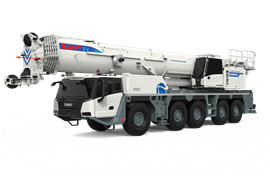 The Sany SAC2500E7PHEV offers fully electric carrier operation. Photo: Sany
Mighty mini from China
Machine manufacturers in China are making impressive headway with development of all types of electrified construction equipment. This includes wheeled mobile cranes, with hybrid diesel and battery powered models having been recently launched by a series of companies, including XCMG, Sany and Zoomlion.
At the smaller end of the scale there is the ‘Green Elf’, otherwise known as the XCMG XCA60_EV. Introduced in December 2024, this three-axle model uses a Mercedes-Benz OM936LA six-cylinder turbodiesel engine (230 kW) in combination with battery packs with a combined capacity of 115 kWh. With a total output of up to 400 kW, XCMG states the battery packs can reduce fuel consumption by more than 40 %.
The telescoping boom can be extended to 48 metres to deliver a maximum lifting height of 63 metres (with optional extras). The superstructure is operated in electric-only mode using a 170 kW motor. Maximum lift capacity is 60 tonnes.
Battery-electric drive
Another hybrid crane from China is the Sany SAC2500E7PHEV. Previewed in various global locations over 2025 before a European market launch in mid-2026, this model is positioned in the class above the Grove GMK5150L-1e and the Liebherr LTM 1150-5.4E.
On its five-axle carrier the crane has a 60,000 kg GVW and lifting capacity of 250 tonnes. Hybrid diesel-electric power for the carrier is delivered by a Mercedes-Benz OM470A 10.7-litre six-cylinder turbodiesel (110 kW, 200 kW peak) and onboard CATL battery packs with a capacity of 141 kWh.
That battery capacity supports a feature the models from Grove and Liebherr do not currently offer – pure electric carrier operation. Using only its electric traction motor, the SAC2500E7PHEV is reported to have a range of between 45 and 55 km (28 and 34 miles), although this will depend on load and conditions. For longer distances, the engine and battery packs work in parallel to drive the crane (unlike a series hybrid where electric motors exclusively power the wheels and the engine only recharges the battery packs).
Regenerative braking delivers power back to the batteries, while the engine can also be used as a generator for static recharging. As with any other PHEV, the packs can accept an external AC charge, in this case up to 40 kW, while 130 kW is the limit for DC recharging.
The crane superstructure takes power from the same battery packs used to drive the carrier, but via a separate 150 kW (peak 250 kW) motor. This powers the hydraulics for the 75 metre telescopic boom and related lifting movements.
Liebherr viewpoint
While a relatively recent addition to the wheeled mobile crane market, it’s anticipated more models using hybrid power will be introduced. That said, these battery-electric models will extend customer choice rather than replace all diesel-only models.
In May 2026, Philip Suhm, head of engineering technology co-ordination at Liebherr, had this to say about hybridisation in mobile cranes:
“Combining technologies can be valuable in specific applications, as hybrid examples show. One example is the Liebherr LTM 1150-5.4E mobile crane. It can run on battery power for crane operations for a limited time when no grid is available. It can also be powered by or charged from the grid when it is available.”
Suhm said he also believed a diesel engine will still be required for on-highway travel. “A diesel engine is still required today, because installing the required battery energy on such a machine is just not possible from a technical perspective. On site, however, the machine operates with zero local emissions. The diesel engine is HVO-ready, delivered filled with HVO.”
Despite what can be expected to be a higher purchase price than a diesel-only crane, factoring in electric operation (in a hybrid powertrain or the crane superstructure) should help to reduce running costs and deliver a favourable total cost of ownership. That, combined with the growing number of sites which require zero-emission operation, could see more lift and rental companies adding these machines to their fleets.
CONNECT WITH THE TEAM