Read this article in 中文 Français Deutsch Italiano Português Español
Why chin straps on hard hats could soon become a more common sight

12 January 2026
Chin straps on hard hats could soon become a more common sight if draft revisions to a US standard governing head protection are eventually brought into force.
The International Safety Equipment Association (ISEA) is currently developing an update to the ANSI/ISEA Z89.1 standard.
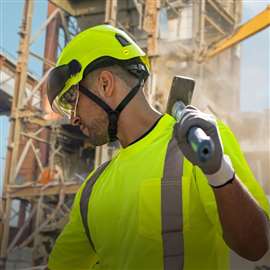 A construction worker wearing a PIP Traverse Type II helmet equipped with Mips (Image: PIP)
Under the proposed changes, which have not yet been finalised, a new “plus (+)” marking would be introduced to both Type I and Type II helmets.
For Type I, the plus marking would set out standards for added impact and shock protection, make chin straps mandatory, and add a retention system that prevented head protection from rolling off for a specified number of seconds.
For Type II’s “plus” marking, chin straps would also be mandatory and there would be a requirement for a retention system to prevent roll-off.
There had been suggestions that the revised Z89.1 standard would also address rotational forces and impacts, suggesting that rotational force increase the risk of traumatic brain injury (TBI).
However, speaking during a webcast organised by Safety + Health magazine, which is the official publication of the National Safety Council (NSC), Cam Mackey, president and CEO of ISEA, said that the draft revision to the standard does not address the issue. That’s because there isn’t currently a standardised test method. Although the ISEA is currently working on identifying or developing a standardised test method that would allow rotational forces to be considered for inclusion in the next revision of ISEA/ANSI Z89.1 standards.
Shifting attitudes to head protection
Nonetheless, the news demonstrates that higher standards for head protection are gradually being incorporated into personal protective equipment (PPE).
Mackey noted that there are still widespread misconceptions about industrial head protection, and highlighted a recent ISEA survey conducted with US-based PPE supplier J.J. Keller that found that 80% of safety professionals think all safety helmets offer Type II protection (which they do not), while 67% incorrectly think safety helmets don’t have a brim.
“At the ISEA we have a few tips for navigating the market. Number one – recognising that it is different. Say you did a big shopping exercise two years ago. Guess what? A lot has changed. There are new product options out there, the standard will very soon be changing.
“So whether you have great expertise or not, you want to work with someone really smart, whether it is at the manufacturer making the protection, the distributor or both,” he said.
It is not clear exactly when the new standard could come into force. Originally, it had been suggested that it could have been as early as Q4 2025, although Mackey did not elaborate other than to say it was coming “very soon”.
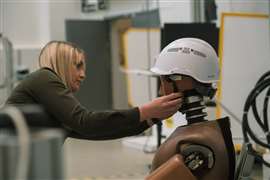 Image courtesy of Mips
ISEA is accredited by ANSI to develop the standard and has been consulting with various stakeholders as part of the process. It is also working with OSHA to incorporate the upcoming ANSI standards into OSHA standards. The revisions are also likely to have an impact beyond the US. While ANSI standards are not legally mandated in most other countries, they are often adopted my multinational companies operating globally and can be used as a procurement reference in countries where local standards are less developed.
As things stand, the 2019 version of the standard is currently in force. That requires Type I hard hats to offer protection from impacts on the top of the head. Type II offers top and lateral protection, while a chin strap is optional.
There are also classes that cover both Type I and II. Class C is conductive, while Class G (General) offers protection up to 2,200 Volts, and E (electrical) offers protection up to 20,000 Volts.
Speaking during the same webinar, Joe Brandel, business development manager in North America for Mips, which manufactures a safety system design to sit inside helmets and protect the brain from rotational forces, noted that OSHA itself has specified Type II Class G helmets for all of its own employees.
Brandel also pointed out that in a 2024 health and safety bulletin, OSHA urged employers to consider Type II head protection with chin straps for certain specific industries and types of work, including construction (especially where there is a high risk of falling objects and debris, impacts from equipment, awkward working positions, and slip, trip and fall hazards), and working from height.
The webinar took place on 11 December 2025, the same day that Mips announced it had signed an agreement to acquire all shares in Monaco-based Koroyd, which develops advanced impact protection technology for head and body safety, for €40 million.
STAY CONNECTED

Receive the information you need when you need it through our world-leading magazines, newsletters and daily briefings.
CONNECT WITH THE TEAM