Read this article in 中文 Français Deutsch Italiano Português Español
Why US contractor Clayco wants to tackle burnout among workers

26 June 2026
 Illustrative image generated using AI
For an industry that prides itself on toughness, construction is becoming increasingly aware of the cost of simply pushing through.
Long hours, demanding schedules, physically strenuous work, and time away from loved ones can all take their toll.
A fat order backlog, swelled by ravenous demand for data centres, is a good problem to have for many big US contractors. But it brings stresses with it too, not least on an overstretched workforce that chronically lacks enough skilled people.
Now one major US contractor, Clayco, believes there should be more attention paid to an important early warning sign of more serious mental health problems among construction professionals: burnout.
The company has partnered with the National Alliance on Mental Illness (NAMI) to raise awareness of burnout and encourage workers to seek support before problems escalate into more serious mental health challenges, substance misuse, or worse.
That focus reflects broader concerns within the construction industry. For years, employers and trade organisations have sought to address high rates of suicide, substance abuse and mental health struggles among workers. But Clayco believes there is value in identifying problems earlier, before they reach crisis point.
“We’ve been at the second highest suicide rate in the construction industry [in the US] for many years. And that was one of the more alarming things that got Clayco’s attention,” says Dan Lester, vice president of field culture and inclusion at Clayco.
“We also have the substance misuse. We have the highest death from overdose rate in construction.”
What burnout looks like
Burnout is often discussed casually, but Meg Delp, director of workplace mental health at NAMI, says it is much more than simply having a bad day at work.
“When we think about burnout, it is on a spectrum and can reach a point where it feels like stress that has gotten out of hand, where people feel like they don’t see an end in sight. I don’t know when this stress will end. It is unsustainable.”
The symptoms vary from person to person. Some workers respond by throwing themselves even harder into their jobs in an attempt to keep up with mounting pressures. Others begin to withdraw as exhaustion takes hold.
And as burnout worsens, it can have serious consequences.
“As we continue to push through burnout, we can start getting to some really serious mental and physical health concerns,” Delp says. “We can see high blood pressure, hypertension, insomnia. We can also see depression, anxiety, things that are both physical and mental health concerns.”
Importantly, burnout is rarely caused by a single factor. Work pressures can contribute, but so can challenges outside work, such as caring responsibilities or family pressures. Often it is the accumulation of stresses across multiple areas of life that pushes people beyond their limits.
Why construction is vulnerable
Construction workers are particularly vulnerable to burnout because there are several conditions in the industry that can make it difficult to avoid.
 Dan Lester, vice president of field culture and inclusion at Clayco
Clayco’s own survey of construction executives and tradespeople, conducted in July-August 2025, found that 64% of construction workers had experienced anxiety or depression within the last year, up from 54% in 2024.
Those surveyed identified physical demands, poor work-life balance, project deadlines and extended periods away from family as some of the biggest sources of stress.
Many workers spend months on remote projects, far from their normal support networks. Others face increasing workloads as contractors race to deliver large projects amid persistent labour shortages.
Lester points to the rapid growth of data centre construction as one example.
“Everybody wants their data centres built yesterday. The industry doesn’t necessarily have the workforce for that,” he points out.
But the pressures are not limited to craft workers. Executives and managers can experience many of the same stresses, particularly when they spend long periods travelling between jobsites and working away from home.
Spotting the warning signs
One challenge is recognising when ordinary workplace stress has developed into something more serious.
According to Delp, colleagues and supervisors should pay attention to sustained changes in behaviour rather than isolated bad days.
Performance may begin to decline, or workers may become increasingly negative, withdrawn or irritable. Absences and lateness can increase. Physical signs such as significant weight loss or weight gain may also emerge.
“We are looking for those changes that are a little bit more long lasting that might start indicating that this change is happening for a reason,” she says.
Perhaps most importantly, Delp argues that managers should resist jumping straight to disciplinary action when performance deteriorates.
“We want to really start shifting that narrative from their performance is dropping, let’s go to discipline, let’s go to problem solving. Instead, it should be about checking in with this person as a human and understanding that a little bit more first,” she says.
Changing construction’s culture
For those conversations to take place, however, there needs to be trust between workers and management.
For Lester, one of the biggest barriers to addressing burnout is not a lack of resources but a culture where workers still sometimes feel unable to speak openly about mental health, even amid greater awareness in recent years.
 Meg Delp, director of workplace mental health at NAMI
Construction has traditionally valued resilience and self-reliance. While attitudes have begun to change, many workers remain concerned that admitting they are struggling could damage their careers.
“When you start telling people, ‘Hey, it’s okay to tell me that you’re having an active issue with mental health and wellbeing,’ they worry that when they speak up about it then might get retaliated against either in some way, shape, or form,” Lester says.
“There’s a fear you might be getting a ding on your record that you’re not maybe as tough, or maybe you can’t handle the work.”
That concern was reflected in Clayco’s most recent survey, which found that many workers still fear stigma or discrimination if they seek support. In Clayco’s latest annual survey, 45% of construction workers said they would feel ashamed talking about their mental health, addiction or suicidal thoughts with their coworkers. That was despite the fact that 91% said they would be willing to support another construction worker who was experiencing depression.
Changing workers’ ideas of how their struggles could be perceived takes time.
“The entire narrative of our industry has to really shift,” Lester says.
“We’ve seen some things happening but it starts at the highest levels of the CEOs and the executives that are making the major decisions. And that stuff all trickles down into the field.”
What support does Clayco offer?
Alongside its partnership with NAMI, Clayco has expanded access to its employee assistance programme (EAP).
Notably, the programme is available not only to Clayco employees but also to subcontractors working on its projects.
“Whether you work for Clayco or not, you have access to the same thing that me and my family do,” Lester says.
The programme provides support on a wide range of issues, including counselling, legal assistance, childcare and eldercare support. The aim is to address some of the underlying pressures that contribute to stress and burnout.
According to Lester, utilisation of the programme has increased significantly as awareness has grown.
“We’ve seen an increase in our subcontractor usage. I think we’re well over 400% increased usage for subcontractors. Internally, well over 200% increased usage.”
For workers assigned to remote projects, Clayco has also experimented with initiatives such as flying family members to visit jobsites.
“We can’t get you to your family, we’ll bring your family to you,” Lester says.
Meanwhile, NAMI provides a nationwide network of support groups and educational resources that can complement workplace programmes.
“Wherever a Clayco employee goes, there is likely a NAMI support group there for them that can help them not feel alone,” Delp says.
Beyond awareness
Ultimately, both Clayco and NAMI argue that success should not be measured simply by the number of resources available.
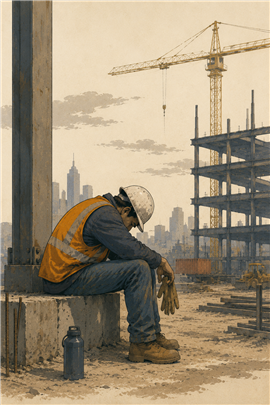 Illustrative image generated using AI
The bigger challenge is creating an environment where workers feel comfortable using them.
Lester recalls that even after years spent advocating for mental health awareness, he found it difficult to seek support himself after losing his brother to suicide.
“It was still hard for me to pick up that phone and ask for help for myself,” he says.
“I would tell you to go do it right away. But it’s just like how lifting the heaviest weight in the gym can be opening the front door.”
That recognition lies behind Clayco’s wider mental health pledge, which encourages companies to commit to supporting workers who seek help and to avoid actions that could discourage them from coming forward.
The initiative reflects a growing recognition that improving mental health in construction requires more than awareness campaigns or support services alone but the belief among workers that they can ask for help without jeopardising their careers.
Asked to define what success looks like in Clayco’s efforts to combat burnout, Lester concludes, “When you’re supporting people in these mental health challenges, some of the things that we have to do as a company for documentation and to make sure that you’re okay may seem disingenuous. We might be doing more paperwork and just checking on you more frequently. And that’s just why the culture has to continuously say, no, this is who we are. This is how we just make sure we’re checking on you and all those things.
“Success looks like people getting the support that they need. Using the resources is a great sign, but you don’t want to shame people for not using the resources either…Hopefully community saves lives. When your peers can help check on you, maybe even start the EAP conversation or the support conversation for you, that’s a healthy way for folks to start dealing with this. So, not going alone, but going together.”
STAY CONNECTED


Receive the information you need when you need it through our world-leading magazines, newsletters and daily briefings.


CONNECT WITH THE TEAM