Read this article in 中文 Français Deutsch Italiano Português Español
Wolffkran’s ‘technically demanding’ nine-crane Westminster job

17 June 2026
German crane manufacturer Wolffkran called its work at 1 Victoria Street in Westminster, London one of the “most technically demanding” crane operations it has run in the city, and some of the more difficult lifts are still to come.
 Four red Wolffkran cranes, background, on the 1 Victoria Street construction project in Westminster, London. Photo: Neil McAleer Photography
At the site, nine tower cranes are working in phases on a project, led by general contractor Mace Construct, to redevelop a former 1960s office block into low-carbon office and retail space.
A key part of construction involves retaining around 52% of the original structure; a strategy which required a unique crane plan.
Reusing the building’s original foundations instead of piling new ones restricted crane positioning. Each one could only be set over existing support points provided by the 60-year-old foundation.
During demolition, a single Wolff 355 B luffing jib crane, reaching out to 50 metres with a 28 tonne capacity, cleared excavators, tracked loaders, dumpers, skips, generators and structural steel from the confined site.
Four more cranes followed at basement level for the construction phase: a Wolff 166 B and three additional Wolff 355 Bs. Those cranes supported the building core, including the concrete slipform process.
 Wolffkran cranes at 1 Victoria Street. Photo: Neil McAleer Photography
More involved
Getting the cranes into position also took more than a standard erection, Wolffkran said. The manufacturer’s cross-frame system allowed engineers to adjust each crane’s four support legs independently between six and 10 metres, then rotate the entire tower to align with the available foundation points. One of the Wolff 355 B luffing jib cranes needed four different leg lengths within a single base just to land correctly; the most demanding configuration on the site, Wolffkran noted.
Construction is still underway, and the basement-level cranes are headed toward what may be the hardest phase yet: dismantling the units from inside a structure that will soon enclose the cranes almost completely. Wolffkran said the project will rely on ceiling hoists, low-level forklifts and skating systems.
Once dismantled, four more cranes will work on the roof to complete the building’s upper floors and façade; two 355 Bs and two 630 B luffers, mounted on spigots bolted to a steel grillage atop the building’s core.
 Photo: Neil McAleer Photography
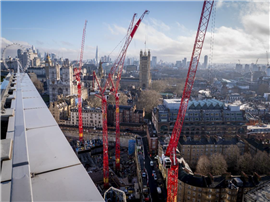 Photo: Neil McAleer Photography
CONNECT WITH THE TEAM