A Canadian conundrum: moving modules

16 July 2026
Sarens USA provided an engineered marine-to-land transfer solution to move industrial process modules in Canada.
The VCR Carbon Recycling Project involved the design and execution of a complex temporary heavy-haul marine interface on the St. Lawrence River in Varennes, Quebec to support the delivery of oversized industrial process modules to a carbon recycling facility. With no permanent heavy cargo offloading infrastructure available and shallow shoreline waters preventing direct barge access, the project required an engineered marine-to-land transfer solution capable of safely handling high axle loads in an environmentally sensitive area.
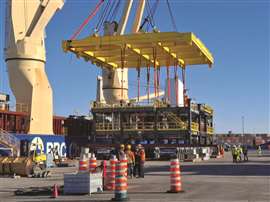 Modules were transferred to shore using SPMTs across the temporary heavy-haul bridge and a grounded barge interface.
The operation began at the Port of Bécancour, where nine oversized process modules and one lifting frame were discharged from a cargo vessel using the ship’s onboard cranes. Due to low allowable ground bearing pressures at the port, the modules were transported using double-wide 19-line SPMT configurations specifically selected to distribute weight and control axle loading. The modules were then rolled onto project cargo barges using a carefully coordinated RoRo operation, which became a key element of the logistics strategy by enabling efficient marine turnaround between Bécancour and Varennes.
The cargo consisted of nine oversized industrial process modules and one lifting frame required for installation at the carbon recycling facility. The modules varied in dimensions, support locations and centers of gravity, requiring engineered transport configurations tailored to each unit. Due to their size and weight, the modules were handled using SPMTs arranged in dual trailer train configurations matched to each module’s support layout. Transport operations included movement across the Port of Bécancour facility, followed by marine transport along the St. Lawrence River using a project cargo barge performing repeated back-to-back voyages.
At Varennes, modules were transferred to shore using SPMTs across the temporary heavy-haul bridge and grounded barge interface. Engineers developed a temporary marine interface utilizing an intentionally grounded and ballasted barge positioned on pre-installed timber protection mats to protect both the riverbed and the hull.
The temporary bridge measured approximately 60 meters in length. Construction of the bridge and marine interface required approximately 500 tons of structural steel and transport platforms, along with about 450 concrete blocks and 150 timber mats used at both the port and the project site for module staging, load spreading and ground protection
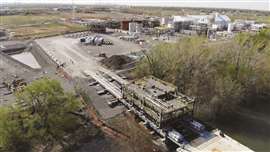 The temporary bridge measured about 60 meters in length and was engineered to support high gross transport loads across multiple transporter configurations.
Spring thaw restrictions
The project was executed during Quebec’s spring thaw restriction period, which imposed seasonal half-load limitations on public roads. A major innovation of the project was the use of a single fixed-ramp configuration designed to accommodate varying module centers of gravity and support locations. This eliminated the need for repeated ramp adjustments between module transfers, significantly reducing unloading time, operational risk and marine standby costs.
Safety planning addressed marine interface risks, temporary structural loading, environmental protection requirements and simultaneous operations.
The project successfully demonstrated an innovative heavy-haul solution for overcoming limited infrastructure, difficult shoreline conditions and environmental constraints while maintaining safety, efficiency and schedule continuity
STAY CONNECTED


Receive the information you need when you need it through our world-leading magazines, newsletters and daily briefings.
CONNECT WITH THE TEAM