ACT Exclusive: Link-Belt’s new 180-ton telecrawler revealed

11 February 2026
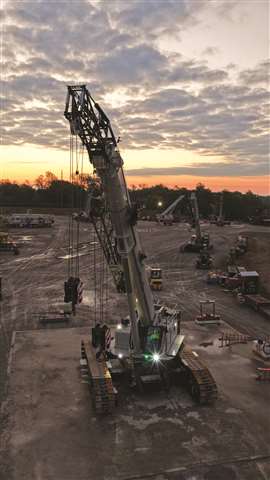 Link-Belt’s new TCC-1800 telecrawler lifts off at dawn at the company’s Lexington, KY headquarters, marking the first public glimpse of the crane ahead of its ConExpo 2026 debut.
Walking into Link-Belt Cranes’ Lexington, KY, USA headquarters, there is always a sense that something bigger is happening behind the walls. Engineers move with purpose. Screens glow with machine data and test results. And in the background, a familiar red-and-white fleet keeps evolving. But on this visit in early November, there was definitely a different kind of energy.
This time, I wasn’t there just to see what Link-Belt had already launched. I was there to see what they’re going to unveil to hundreds of thousands of attendees at North America’s largest construction equipment tradeshow. And it’s safe to say the excitement was palpable.
Waiting inside one of the company’s presentation rooms was my first detailed look at the TCC-1800, a 180-ton (163-metric-ton) telescopic crawler crane designed to fill a market need between the company’s 140-ton TCC-1400 and its flagship 250-ton TCC-2500. It is also Link-Belt’s answer to a fast-growing market segment: telecrawlers in the 150- to 200-ton class, where contractors are asking for more reach, more capacity and better jobsite mobility without stepping into a much heavier, harder-to-transport machine.
From the ground up
Following its big debut in the February issue of ACT, the TCC-1800 will make its first public appearance at ConExpo 2026 in Las Vegas, NV, before shipments begin in the third quarter of 2026.
“The TCC-1800 is the result of extensive analysis of customer demand and job site requirements for a telescopic crawler crane,” said Michael Dawson, product manager, lattice and telescopic crawler cranes, Link-Belt.
“From the ground up, the undercarriage design – built for a much larger crane (the 250-ton TCC-2500) – is now used on the TCC-1800 and exemplifies Link-Belt’s commitment to deliver a crane developed for the toughest jobs that is both efficient and built to withstand years of work. The TCC-1800 will be a great asset to any company with diverse lifting needs.”
The new telecrawler is rated at 180 tons at an 8-foot radius and features a 42.7 to 197.3-foot greaseless six-section pin-and-latch boom. With Link-Belt’s SmartFly bi-fold hydraulically offsettable fly and up to three 18-foot lattice extensions, maximum tip height reaches 314 feet, with 306.3 feet of reach. That allows the crane to work high and far while still retaining the defining advantage of a telecrawler: the ability to walk with a load.
At the heart of the machine is Pulse 2.0, Link-Belt’s in-house control and Rated Capacity Limiter platform. Now fully integrated across swing, travel, boom hoist and winches, Pulse 2.0 allows for fine metering, ground bearing pressure alarms and precise control, all accessed through a 10-inch touchscreen display. Operators also gain built-in diagnostics, Wi-Fi updates and remote troubleshooting, bringing a new level of digital support to the telecrawler class, the company said.
“Link-Belt’s foremost inspiration is to solve customer needs through innovation, consistently utilizing and developing new technologies,” Dawson said. “The TCC-1800 is no different, a robust, innovative crane that operates smoothly regardless of harsh job site conditions.”
With a preexisting telecrawler lineup from 55 to 250 tons, Link-Belt identified a growing demand for a telecrawler with capacities between 150 and 200 tons.
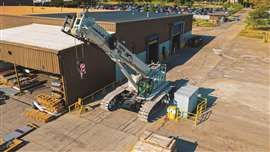 Shipments for the TCC-1800 telecrawler will begin by the third quarter of 2026.
Power comes from a Cummins QSB6.7 Stage V/Tier 4 Final diesel engine with auto-idle, paired with an optional Auxiliary Power Unit (APU) that keeps cab climate control, displays, radios and lighting running without the main engine. The APU reduces idle time, cuts fuel consumption and improves operator comfort during long shifts.
Beyond the boom
While the TCC-1800’s boom and control systems draw attention, the most significant engineering work may be what lies underneath the machine.
Link-Belt developed a completely new lower frame based on a set of core design principles focused on reliability, structural robustness and long-term durability. Proven components from the TCC-2500, including rollers, chains and nylon pad inserts, were carried over to maximize parts commonality and field-tested strength.
Each track frame now features its own independent extension cylinder, allowing operators to extend or retract the tracks smoothly from the cab, even while traveling. This also enables Variable Confined Area Lifting Capacities (V-CALC), giving the crane the ability to work with asymmetrical track positioning and maintain lifting charts through a full 360 degrees using Link-Belt’s smooth ramp-to-stop technology.
Link-Belt said the key challenge was to create a reliable 180-ton telecrawler that exceeds customer expectations. To achieve this, the commitment and focus of every member of this crane’s development was paramount, Dawson said.
“The innovation of its design required changes to manufacturing, from fabrication, machining, assembly and testing to introducing better practices and procedures in all aspects of this machine’s manufacturing,” added Dawson.
With the tracks fully retracted and steps folded, the crane measures just under 16 feet wide, improving access to tight sites and simplifying transport. Once deployed, it offers 40 percent gradeability, two-speed travel up to 1.7 mph, and the stability required for heavy lifts at long radii.
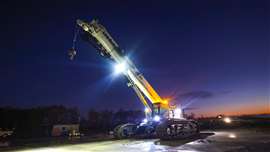 The TCC-1800 works through long-boom testing with its six-section, greaseless pin-and-latch boom and lattice fly extensions.
Transportability was a central design goal. The main transport load ships under 108,000 pounds, even with the boom, main and auxiliary wire ropes, a 120-ton hook block and a 10-foot SmartFly installed. This level of self-contained shipping is rare in this class, giving owners more routing and permitting flexibility, Dawson said.
The crane carries 77,000 pounds of upper counterweight and 9,000 pounds on the lower, striking a balance between lifting power and mobility that defines the machine’s role in modern construction.
Continuous innovation
During my time in Lexington, a team of engineering experts walked me through side-by-side performance charts comparing the TCC-1800 against competing machines. Across much of the working envelope, particularly at longer radii, the new telecrawler delivered stronger capacities and smoother control, reinforcing its position as a next-generation machine.
“Link-Belt is committed to carry on its rich tradition of innovation,” said Dawson. “The best ideas of our people working together toward one common goal: The continuous innovation of today is Link-Belt’s legacy of tomorrow.”
More than a single product launch, the TCC-1800 represents Link-Belt’s broader vision for the future of telecrawlers: cranes that are powerful, transport-friendly, digitally connected and designed to work in the tight, complex environments that increasingly define modern construction.
For ACT readers, this exclusive first look offers a glimpse of what is coming next, not just from Link-Belt, but from the telecrawler market as a whole.
CONNECT WITH THE TEAM