Read this article in 中文 Français Deutsch Italiano Português Español
Lifting and transport must go beyond logistics

13 July 2026
Load engineering should be defined as a standalone superior discipline, proposes Taner İçten, director of the YMB in Turkey
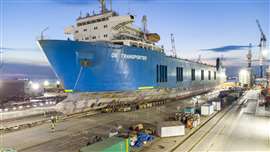 All in a day’s work: What did we do today? Lifted and moved an entire ship, that’s all. Photo: Hareket
Engineering disciplines historically evolved around specific problem domains such as structures, machines, transportation systems, energy, or production processes.
While this specialization enabled remarkable technological progress, it also created a significant conceptual gap regarding one of engineering’s most universal variables: load.
Load exists in almost every engineering discipline. Structural engineering analyses loads to predict system behaviour and stability. Mechanical engineering evaluates loads through forces, stress, and dynamic interactions. Transportation systems are built around load movement. Even digital systems operate under concepts such as “data load” and “system load.”
Yet despite this universal presence, load has rarely been recognised as an independent engineering discipline. Instead, it has traditionally been treated merely as a parameter, a calculation input, a transported object, or an operational variable within other disciplines.
This fragmented understanding creates serious operational and conceptual limitations, particularly in the management of non-standard, ultra-heavy, oversized, high-risk, and high-sensitivity loads that define modern industrial projects.
Today’s world increasingly depends on the safe management of loads that are: extraordinarily heavy, exceptionally long, excessively wide, structurally sensitive, and dynamically unstable.
The engineering knowledge governing these operations, however, remains dispersed across disconnected disciplines and conceptually hidden under a broad umbrella of conventional logistics.
This raises a fundamental question: Why has load, – one of the most critical variables in engineering itself – never been defined as an independent engineering discipline?
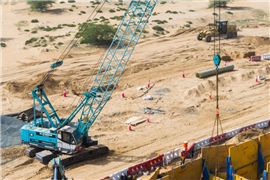
 Crane and transport specialist Hareket at work on Ramhan Island in Abu Dhabi, United Arab Emirates. Photo: Hareket
What is load engineering
Load engineering emerges precisely from this question. It may be defined as follows:
“An engineering approach that holistically addresses the processes related to the creation, preparation, lifting, transportation, positioning, and preservation of the functional integrity of a load through interdisciplinary engineering principles.”
One of the most important misconceptions in the industry is the assumption that complex lifting and transportation operations are simply advanced forms of logistics.
They are not.
Logistics primarily focuses on supply chains, storage, commercial flow, planning, routing, and distribution efficiency. Its main concern is economic and operational flow management.
Load engineering, however, focuses on: physical behaviour, structural integrity, force distribution, lifting dynamics, transportation mechanics, stability, environmental interaction and operational risk.
In simple terms logistics manages commercial movement and load engineering manages physical reality.
This distinction is critical because a logistics operation may optimise time and cost, while a load engineering operation must first ensure that the load physically survives the process itself.
Another overlooked reality is that lifting and transportation cannot truly be separated from one another. Before any load can be transported, it must first be lifted. Likewise, every lifting operation directly affects transportation stability through centre of gravity changes, structural stress redistribution, dynamic instability, and ground pressure interaction.
For abnormal, ultra-heavy, oversized, or high-sensitivity loads, lifting and transportation become inseparable engineering calculations rather than isolated operational services.
To evaluate this complexity more systematically, the HLWH (Heavy–Long–Wide–High) approach introduces an engineering-based classification model that analyses loads through the parameters of weight, length, width, and height. Beyond dimensional differences, this framework also evaluates critical engineering factors, including stability, centre of gravity, ground pressure, dynamic behaviour, and operational risk.
 Wind work is very much a combination of lifting and transport. Photo: Sistem
Measurable classification
To move beyond such subjective terms as heavy transport or special cargo, the HLWH analytical framework offers a measurable engineering-based classification model for evaluating load complexity. This approach enables complex load operations to evolve from experience-based practices into systematic engineering processes.
In Turkey Yük Mühendisliği Birliği (YMB – The Union of Load Engineering) has begun institutionalising this concept by creating a shared engineering language across more than twenty critical sectors, including energy, offshore operations, heavy industry, petrochemical investments, maritime projects, and large-scale infrastructure systems.
The historical evolution of load engineering resembles the transformation of logistics itself. A few decades ago, logistics was largely perceived as a transportation activity. Over time, increasing complexity transformed it into a recognized academic and engineering discipline.
Load engineering may now be at the beginning of a similar transformation.
Despite involving some of the world’s most complex and highest-risk industrial operations, the field still lacks formal academic recognition and global disciplinary identity.
Yet modern civilization already depends on it.
Without the companies and professionals providing lifting and transportation services that require load engineering there would be:
- no energy facilities
- no onshore or offshore wind farms
- no industrial plants
- no refineries
- no bridges
- no ports
- and no large-scale infrastructure project could ever be built.
Nor could heavy industrial machinery or strategic components reach factories, industrial facilities, or construction sites.
Ultimately, load engineering represents far more than the movement of heavy objects. It represents the engineering of physical reality itself.
Read the full version of this article in the July August issue of International Cranes and Specialized Transport magazine.
STAY CONNECTED


Receive the information you need when you need it through our world-leading magazines, newsletters and daily briefings.
CONNECT WITH THE TEAM