Finding his footing: one crane operator’s journey back to the cab after a double amputation

17 June 2026
Eddie Garcia has worked for TNT Crane & Rigging for the past 19 years. He credits the company’s management team, past and present, for helping him recover and get back to the job he loves, operating a crane.
Eddie Garcia was just 19 years old when he started a job as a ‘yard rat’ for a crane company.
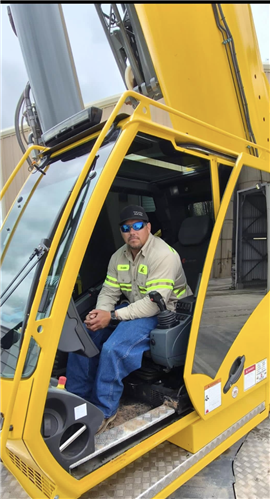 Eddie Garcia has worked for TNT Crane & Rigging for the past 19 years. He credits the company’s management team, past and present, for helping him recover and get back to the job he loves, operating a crane.
“To be honest, I hated it at first,” he said. “You had to start at the bottom, and my first job was on a drill rig in Corpus Christi, Texas. I was the swamper, the rigger who rigs up the derricks. It was intimidating at first, but as we moved from one rig job to the next, I began to fall in love with it all. Very quickly I knew I wanted to be a crane operator.”
Telling his bosses he wanted to be a crane operator was a challenge. But one day, when he was still a swamper on a refinery job, the crane operator asked him if he wanted to learn how to run the machine.
“The operator said, ‘come on up here,’” Garcia remembered. “It was an old 165-ton Demag. He showed me a few things, and I was hooked.”
Shortly thereafter he started crane operator training on a 100-ton Krupp. Once he was proficient, he was dispatched to the oil fields. A few years later he relocated to Fort Worth, Texas. The crane company he was working for was acquired by Houston-based TNT Crane & Rigging. He’s been working for TNT ever since, running ever bigger cranes and performing more complicated lifts.
Garcia’s 30-plus year ascent in the crane industry is similar to that of many operators. But in 2021, Garcia’s crane operating career took a dramatic turn. The unthinkable happened on his jobsite, an accident in which he was gravely injured. If not for the heroics of Dr. Lindsay Davault, Garcia said he wouldn’t be here to talk about it.
“She saved my life,” he explained. “She performed the double amputation on the jobsite.”
When he woke up in the hospital, his family and a cadre of friends and co-workers were there for support. It was in the hospital, facing the life of a double amputee, that he declared he would be back in the crane cab as soon as he was able.
“Everyone thought I was crazy,” he said grinning. “Even the doctor said, ‘Eddie, you are high on drugs.’ Quitting this job never entered my mind. I don’t know what else to do besides running a crane. I love running cranes.”
Garcia’s journey back into the crane cab is one of grit, gratitude and two prosthetic legs that were expertly engineered for operating a crane. It’s a fascinating story that I was fortunate enough to hear firsthand in an interview with him back in May.
Today, Garcia is back at the job he loves. On Instagram, he goes by Bilateral Beast – a nod to the double amputation and the relentless drive that brought him back. The name fits.
In his own words, he told me this compelling story. Garcia is an example of grace under fire and blood, sweat and tears determination. Above all, this man knows the value of a grateful heart. He said his rapid recovery was greatly improved by his desire to run a crane again, and the people in his life – family, friends and all the people at TNT Crane & Rigging, past and present.
What is the story of your prosthetics, which allow you to operate a crane?
At the Hanger Clinic, that is the team of doctors and therapists who got me here. They wanted me to use the Ottobock brand, specifically the GenX3 prosthetic. They have an advanced design, and they are known for allowing you to be able to walk downhill. I’m still not walking downhill, but I’m working on it.
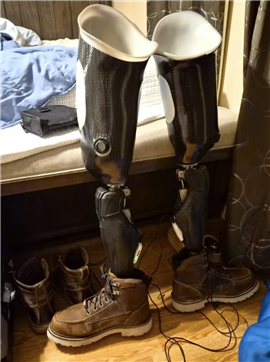 The Ottobock GenX3 prosthetics are engineered to assure Garcia the range of motion to operate a crane and drive a truck.
My prosthetist, Danica Nordstrom, went with me to the crane yard. I got up in the crane cab and put my foot on the accelerator. She was able to see the degree of the angle of the knee and make some adjustments as I went through the various motions from throttle to gas. When I said that feels right, she saved the information electronically. She did the same thing with me driving an 18-wheeler. While I can’t drive them all, I can drive a Peterbilt because the clutches are low. She saved all that information.
It’s the same with my pickup truck. I can drive it like a normal driver. I have an app on my phone, so that when I drive my truck, my legs will lock at a certain angle. I do the same for the crane I’m operating and I’m good to go and I start driving a crane. I’ve been back working for three and a half years.
What are the particular physical challenges you had to overcome to get back in the operator’s seat?
There were a lot. First off, you need to have very good upper body strength. Even before my accident, I was a very fit guy. I went to the gym every day. After I got home from the hospital, three days later I was at the gym. The doctor called and yelled at me. But I knew the stronger I got, the faster I’d get better.
The muscle memory returned. I started my prosthesis work very early, and I believe the gym was the number one reason that my healing process was so quick. I didn’t give up.
Do people treat you differently?
Yes and no. When I first came back to work, I wasn’t too sure how the customers would react to a guy with no legs. But on every single job, the reaction has been positive. We’ve never had a customer say a thing. Maybe they will see me walking kind of funny, and I’ll tell them what happened. They give me a fist bump and shake my hand. It’s been nothing but positive.
People will try to give me special treatment. If I need to get off the crane and go to a safety meeting, they will ask if I want a buggy. New customers and previous customers are happy I’m back.
You wouldn’t believe the outreach I have had. Phone calls and texts from all over the United States and Canada. In the hospital, when I finally got hold of my phone, I had tons of messages and phone calls. It was crazy, and it really warmed my heart that all my old buddies and the team at TNT were calling to encourage me and let me know they cared. The support has been unbelievable. I can get choked up talking about it.
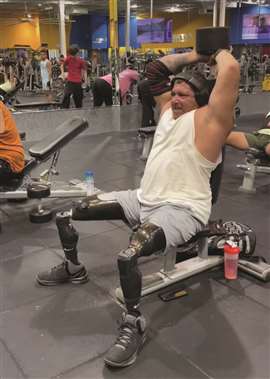 When he’s not at work, he’s most often at the gym. Eddie Garcia said strength training, before and after the accident, allowed him to get back in the crane cab sooner.
I have so many people who helped me and my family through all this. Mike Appling – that dude is an angel. Former and current TNT leadership along with Kevin Lawson, (regional president), they were all a big help to my family during a very stressful time. And today, all the guys from the corporate office are very supportive of me. I am very thankful for all the support. It got me through some hard times. My kids, Nadine and Little Eddie, have been here for me all the way. My son took a year off from college to see me through that first year.
What is your favorite crane to run?
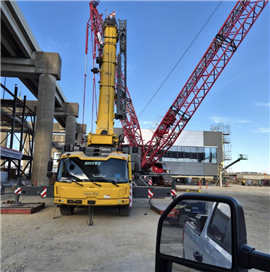 While his favorite crane to run is a crawler, Eddie Garcia recently has been running a 300-ton Grove all terrain crane.
If it was up to me, my crane of choice is a crawler crane. They are my favorite. But depending on the scope of the job, hydraulic cranes are what I’m usually running. Right now, I’m running a 300-ton Grove.
What types of jobs have you been on through the years?
I’ve been on every type of job you can imagine, throughout Texas and other states. I guess they are mostly jobs related to the oil field, but a lot of construction jobs too. I remember one job in 2017 that was really awesome. The customer was building an offshore jacket for an offshore production platform. I worked down in Corpus Christi on that job for nine months. It was a really nice job, and I got to be with my parents for an extended period of time because they lived in Corpus.
Do you have any favorite memories of jobs you’ve been on?
Wow, it’s hard to say. I have a lot of good memories about a lot of big jobs. The two jobs that come to mind are two I’ve worked on since the accident.
The first one, I was sent to Dallas to help build a park over the I-35 freeway. I was on that job for about three months, and my job was lifting and placing the pavilion and trusses. On the last day of the job, they surprised me by calling in the Dallas television news stations. We were finishing the work at the park, and I was going to set the last piece. First though, we wrote our names on the last piece, and they filmed us setting it.
The Dallas Fort Worth International Airport expansion for Acero Building Components is a job I’m very proud of, and I was grateful to work on. I was first there three years ago for seven months straight, building the A and C terminals.
These jobs are a reason I love my job so much. I love seeing something start as one thing and then becoming something else. And also, seeing people use something you built; it’s a good feeling.
A few months back I was back out at DFW Airport to help with the expansion of Terminal C and for the new Skylink passenger train project. We were setting modules on the bridge.
Why do you think the industry is having such a hard time recruiting crane operators?
It’s getting harder to get your crane operator certification. The rules are stricter.
You have to take the test, and people don’t want to put the effort into taking and passing the test. They get intimidated.
There’ is a lot of schooling you have to do. And you do have to get certified. It scares off a lot of people. They want to run the crane, but they don’t want to take the time to learn and take the classes required for certification.
You have been through a lot. What keeps you going?
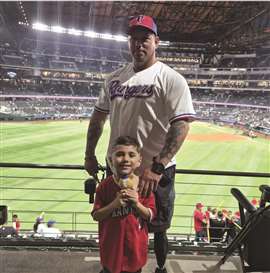 Eddie Garcia and his grandson Isaac at a Texas Rangers game.
My family, my friends, my coworkers, my company. Everyone checks in with me. I’m just so thankful for all the people who support me.
What do you do when you are not working?
When I’m not working, I’m at the gym. I also like to take my kids and my grandson out to the lake on my jet boat. I go to a lot of Texas Ranger baseball games. I also play the guitar, and I like to fish.
Last question, do you sometimes feel like you are a celebrity on a jobsite?
You know, it does come up a lot, what happened to me. A few times the TV news crews have come out to the jobsite.
Sometimes I tell the story and I get choked up. I don’t want all the attention. I sometimes get shy about it all. But, people want to know the story.
I remember being on a refinery job in Oklahoma. I went up to the permit shack and a guy and a girl there were giving out the permits. I told them what happened and the girl started crying. Her crying made the guy cry. I didn’t mean for them to start crying. They had heard about the accident [when it happened]. The news spread like wildfire.
“‘You are here,’” the girl said. “‘We weren’t sure you survived.’”
Yes, I survived.
STAY CONNECTED


Receive the information you need when you need it through our world-leading magazines, newsletters and daily briefings.
CONNECT WITH THE TEAM