Read this article in 中文 Français Deutsch Italiano Português Español
Gaining ground in self-erector set-up

16 September 2026
Kris Koberg discusses why self-erecting tower cranes need engineered outrigger pads.
Self-erecting tower cranes are rapidly gaining traction in the U.S. construction market for their ability to provide lifting capacity, long reach and quick setup in confined spaces. But while their compact design and automated erection process may seem to set them apart from traditional mobile cranes, one critical requirement remains exactly the same. Proper supporting must be used to setup self-erecting tower cranes.
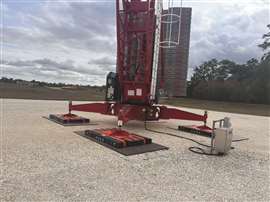 Outrigger support for self-erectors hinges on understanding corner loads, which are equivalent to maximum outrigger reaction forces. However, there is a key distinction between self-erectors and mobile cranes.
Just like mobile cranes, self-erectors transfer significant loads to the ground through its four outriggers. These reaction forces – known as corner loads – can be substantial, especially on larger models such as the Potain IGO T99. As self-erectors become more widely used across framing, light commercial, industrial and rental fleet applications, many contractors are encountering the need to evaluate ground conditions, bearing capacity and pad sizing for this category of equipment.
A rising market
Self-erector usage has grown steadily in the United States, driven by the advantages these cranes bring to repetitive lift environments.
“The U.S. market continues to embrace self-erecting tower cranes, with growing demand across a wide range of applications,” said Chad Jacobs, tower crane specialist at Stephenson Equipment, a Manitowoc dealer in the Northeast. Larger models such as the Potain IGO T99 are among the most frequently utilized and the U.S. is one of the top markets globally for cranes of this size.
The cranes are especially popular with framing contractors, who often work in tight, material-dense environments where a single crane can replace forklifts, telehandlers, or smaller mobile cranes. They are also well-suited for light-gauge steel work, small industrial projects and warehouse construction.
“Most self-erectors enter job sites through rental channels, with rental companies frequently handling transport and setup,” Jacobs said. “Depending on the project, either the rental company or the contractor provides the operator. But regardless of who is in the cab, one responsibility remains universal: ensuring the crane is properly supported from the moment it is erected.”
Understanding corner loads
Outrigger support for self-erectors hinges on understanding corner loads, which are equivalent to maximum outrigger reaction forces. These loads dictate the strength, stiffness and surface area requirements for outrigger pads or crane pads.
“The crane is supported on four outriggers and the total corner load is primarily influenced by the combination of lifted load and wind or jib line forces,” Jacobs said. “These factors work together to determine how the load is distributed across each outrigger.”
However, there is a key distinction between self-erectors and mobile cranes. Mobile crane outrigger forces can be calculated based on boom position, load and configuration.
“For self-erectors like the IGO T99, the manufacturer only provides a defined ‘worst-case’ value,” Jacobs said.
In addition, self-erectors must rotate freely with the wind when not in service. If the crane is not perfectly level, the counterweight will naturally settle toward the low side, creating undue stress on the structure and jeopardizing safety.
The approach is always the same. Understanding the reaction forces (corner loads), the size and shape of the outrigger floats and the allowable ground bearing capacity must be understood and determined to ensure selection of proper supporting materials. Supporting materials must be strong enough to withstand the loads and pressures, stiff enough to effectively distribute the loads and pressures and large enough area to keep the equipment level.
Modeling self-erector setup
The International Union of Operating Engineers’ Training Center in Crosby, Texas, recently replaced its Potain IGO T70 with the larger IGO T99 self-erector. This upgrade triggered the need to reassess the ground, supporting materials and crane pads.
Training & Equipment Assistant John Callahan explained that they started with having an engineering firm evaluate the soil. The firm recommended improvements, including adding crushed limestone to strengthen the supporting surface.
“We also planned to place steel plates under the outrigger pads following past practice, as we did on the Liebherr self-erector,” said Callahan.
To complete the setup, Callahan gathered crane specifications from Manitowoc and consulted DICA for pad recommendations.
“When it comes to outrigger pads, the people at DICA are the ones to talk to,” he said. “They have the most accurate, up-to-date info.” Based on crane data and ground conditions, DICA recommended their 24 square foot EcoMax crane pads with a rated capacity of 160,000 lbs., for the new IGO T99.
DICA’s FIT Assessments rely on information such as maximum outrigger reaction, or corner loads in this case, outrigger float dimensions and the allowable ground bearing capacity to determine appropriate pad size and material.
Callahan values the visibility and durability of the composite-steel hybrid system.
“I like the steel and composite combination and being able to see how the crane pad is made. I feel like it is easier to inspect,” he noted. He also praises the long-term durability: “DICA’s products hold up to the Texas heat and sun, even better than some of our cranes.”
Growing demand
Callahan sums up the industry’s shift toward engineered outrigger pads.
“The industry has come to expect professional, engineered outrigger pads. This is safer than using whatever materials you have on hand on a job site because you know that this set of pads is intended for use with that specific crane and are designed to handle the loads.”
Adoption of self-erecting tower cranes continue to expand in U.S. construction and industry experts believe the trend will accelerate. Jacobs noted that the IGO T99 represents leading-edge technology.
“These machines deliver extremely consistent and safe operation and proper outrigger matting is essential to maintain that consistency and protect the integrity of the crane and the ground conditions,” he said.
Jacobs predicts that the U.S. is “just beginning to tap into the full potential of what’s to come.”
As these cranes become more common, so does the need to properly support them. Engineered outrigger pads – selected using accurate crane data and sound ground assessments – are essential to maintaining the stability, performance and long-term safety of self-erecting tower crane operations.

About the Author
Kris Koberg is president and CEO of DICA, a family-owned manufacturer and distributor of supporting materials, ground protection, site access mats and associated products. He is a contributing member of the ASME P30 committee, a member of the NAMA (North American Matting Association) technical committee and chaired the SC&RA (Specialized Carriers & Rigging Association) task force to create a members-only document titled “A Guide to Outrigger Pad Materials, Selection and Usage.”
STAY CONNECTED


Receive the information you need when you need it through our world-leading magazines, newsletters and daily briefings.

CONNECT WITH THE TEAM