Read this article in 中文 Français Deutsch Italiano Português Español
Mammoet finds room for urban lifts in the Hague

25 March 2026
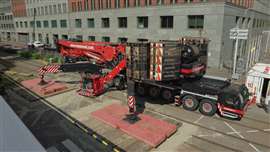 Finding enough space on the ground for the crane even to operate, let alone be set up, was a challenge. Photo: Mammoet
Multiple challenges on a rooftop lifting job in the Netherlands required careful planning by Mammoet.
The job was to replace building maintenance units (BMUs) on two adjacent Dutch government buildings in The Hague.
The international heavy lift and transport specialist had to operate safely while causing minimal disruption to the unceasing bustle of the city.
Working for Façade Access Solutions, part of the Alimak Group, Mammoet had to lift 16 compoenents for each of the Manntech BMUs. Smallest were the winches at 200 kg each while the column and undercarriage each came in at 3.5 tonnes.
It wasn’t just installation either as the old BMUs had to be removed and lowered to the ground.
A primary challenge was the lack of space available to set up and then operate a crane big enough to handle the job. Choosing the right type of crane was therefore crucial.
It had to be able to lift to a height of 180 metres and to operate in a very limited space at ground level. Initial preference was for a crawler crane, later rejected because of concerns its counterweight could collide with a nearby viaduct.
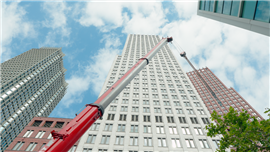 The scale of the job. Height of lift was 180 metres. Photo: Mammoet
Wheeled choice
Instead a 1,200 tonne capacity Liebherr LTM 11200 wheeled mobile telescopic crane was chosen configured with the Y-guy capacity enhancement system on the boom. Just driving this to the site on the narrow city streets was a mission in itself.
The plan was to be able to reach both
he engineering team also determined that there was just one setup location that would make it possible for the crane’s boom to reach the top of both buildings from one position, thereby not needing to relocate the crane. Only one possible position could be identified. “This was due to the Y Frame,” said Stefan Plugge, Mammoet project manager.
“We had to find a position that allowed us to stay clear of the buildings and the viaduct. From the one position we identified, the crane could service both buildings – thus avoiding the need to demobilise it to a different location, saving time and unnecessary disruption.”
During the first two days, for the crane set up, a smaller assembly area was defined. For the third day, to assemble the boom on the ground, the area was extended. It meant an important road in that area was only closed for one day instead of three.
To the job
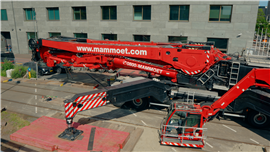 Mammoet assembling its Liebherr LTM 11200 wheeled mobile telescopic crane to lift loads weighing up to 3.5 tonnes to a height of 180 metres. Photo: Mammoet
Up on top of the building the old BMUs were dismantled before being lifted down by the 1,200 tonner to an adjacent street where they were stored before being transported away. The same place was used as a laydown area for the new components. Two lifting zones were established, one for small parts up to three metres long, and the other for larger ones up to 10.5 metres long.
Having the two lifting zones meant a shorter closure for a nearby road and canal.
The components were then lifted in a certain order to facilitate assembly up on the roof.
Fixed lifting points on all the components were provided at Mammoet’s request, Plugge said. “Nothing would be lifted using slings or other lifting approaches. We also agreed the maximum allowable wind speed would be low,” Plugge added.
Another safety aspect was provision of a crash deck on each roof to protect against any of the components causing damage in the event of a dropped load.
STAY CONNECTED


Receive the information you need when you need it through our world-leading magazines, newsletters and daily briefings.
CONNECT WITH THE TEAM