Read this article in 中文 Français Deutsch Italiano Português Español
Mammoet moves 3,700-tonne Hamburg railway bridge in one piece

25 November 2026
Mammoet transported Hamburg’s new Sternbrücke railway bridge through the city on self-propelled modular transporters (SPMTs) in July.
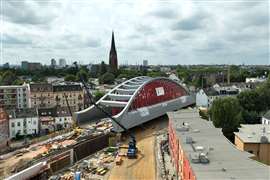 The bridge approaches its abutments as a Seeland mobile crane stands beside the route. Photo: Mammoet
The company said it set the 3,700-tonne structure on its abutments in less than 24 hours.
Deutsche Bahn owned the project, and SEH Engineering GmbH was general contractor. The old bridge had reached the end of its service life, and renovation was not feasible. About 1,000 trains a day use the crossing, which spans the Stresemannstrasse and the Max-Brauer-Allee. Around 30,000 cars a day use the Max-Brauer-Allee.
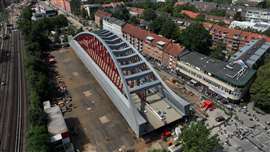 Spectators line the street as the 3,700-tonne bridge sits on its SPMTs beside the rail tracks where contractors assembled it. Photo: Mammoet
Mammoet began with a feasibility study in 2017 and finished its final revision in 2023.
“We determined that this was the only feasible way except for stick build,” said Lars de Haas, project manager at Mammoet. “However, stick build was never really an option, as there are hundreds of trains a day that use the bridge, so they didn’t want to close it for several years.”
Mammoet scanned the site and the whole route in 3D and fed the data into its Move3D engineering platform.
Tight spaces
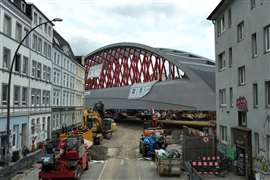 Peekaboo. The bridge rises above excavators and telehandlers working at street level between Hamburg apartment blocks. Photo: Mammoet
“We knew how narrow it was going to get and what space we had to work with,” said Jamie Groeneweg, lead engineer at Mammoet. When the bridge design changed, Mammoet set the maximum width and height it could transport on the Max-Brauer-Allee; the bridge travelled about 500 metres down the avenue.
Contractors assembled the bridge sections in a laydown area beside the Max-Brauer-Allee over 14 months. The area was so small that Mammoet could not stage its transporters beside the bridge.
“This was our biggest challenge: the logistics and organization of our equipment inside a very small area,” said de Haas. Mammoet used a just-in-time approach, bringing equipment to site in the order it was needed.
The transporters came in two configurations of four trains each, with 272 axle lines in total, and 16 climbing jacks rated at 500 tonnes each. Because space was tight, Mammoet assembled them in two stages. A mobile crane built the first configuration, and crews jacked the bridge from 2 metres to 4.5 metres so the transporters could drive underneath. The second configuration followed. Once the transporters took the full weight, they drove the bridge sideways onto the Max-Brauer-Allee.
Crews had prepared the road for a second jack-up of 1.5 metres, which cleared the new abutments. The bridge then rolled 500 metres to its final position. There the transporters turned it 45 degrees and jacked it down 1.8 metres. According to Mammoet, the route left only 30 centimetres to the buildings on either side at its narrowest points.
“It might not be the heaviest, nor the largest bridge we’ve moved, but it certainly had a big impact,” said Groeneweg.
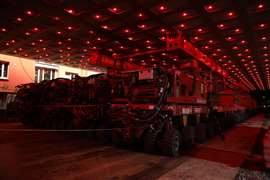 Hydraulic hoses link the SPMT modules beneath the bridge deck, lit red during the night move. Photo: Mammoet
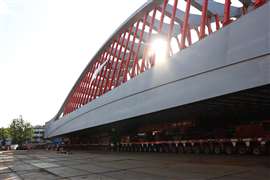 Mammoet SPMTs carry the Sternbrücke’s steel arch through the staging area ahead of the move. Photo: Mammoet
Hydraulic hoses link the SPMT modules beneath the bridge deck, lit red during the night move. Photo: Mammoet

CONNECT WITH THE TEAM