Module move
25 April 2008
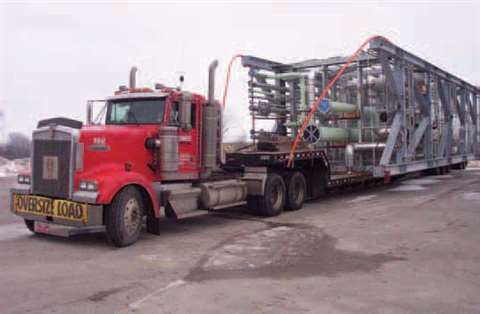
Moving 66 gas pipe modules from the plant where they were manufactured in Texas, US to a refinery in Detroit, Michigan proved to be a lesson in logistics for Emmert International. After assessing the weights and dimensions of the different sized modules, the task was to determine a feasible route. With severe cold weather in Michigan a prime consideration, Emmert had to work fast on planning, execution and completion.
After determining that 52 of the 66 smaller modules could be transported over the road, the plan began to take shape. The first 52 modules would be transported 1,730 miles (2,768 km) through Texas, Arkansas, Tennessee, Kentucky, Indiana and Michigan using four-axle trucks with three-, four- and five-axle step deck stretch trailers.
But the remaining 14 modules, which were 16 feet 6 inches tall and 70 feet long (5 x 21 m), would be too tall to transport over the road due to the height restrictions along the route. Emmert devised a plan to transport these modules to the Port of Houston, about a four-hour drive from the manufacturer in Tyler, and load them on barges and transport them via the Mississippi River through Chicago and on to Lake Michigan to Benton Harbor.
When the modules arrived at the port in Michigan, Emmert only had 10 days to get them moved across the state before weather restrictions went into effect. The modules were loaded onto three- and four-axle trucks with three-, four- and five-axle step deck stretch trailers. Scheduling was tight, and icy roads were an issue.
The State of Michigan gave Emmert special permission to use bucket trucks to lift overhead power lines out of the way for the loads to pass underneath. The planning for this job encompassed seven months, and required 150 hours of engineering and 200 hours of planning and coordination. Permits were required from six states, and hours totalled 2,900. •
STAY CONNECTED


Receive the information you need when you need it through our world-leading magazines, newsletters and daily briefings.


CONNECT WITH THE TEAM