New wind safety alert for luffing tower cranes

20 January 2026
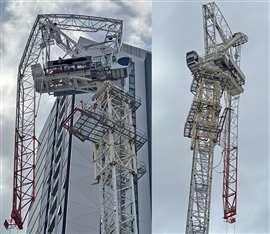 Two views of the December 2025 incident where the boom of a luffing jib tower crane was blown back over its buffers in strong wind. Photos: WorkSafe Queensland
Following recent incidents in Australia, WorkSafe Queensland has issued a safety alert to help prevent rope luffing tower crane booms from being blown back in strong winds.
When out of service, all tower cranes should be allowed to weathervane, i.e. be left with the slew brakes off. In extreme cases weathervaning can be less effective at reducing the risk of damage if the crane is left with a steep boom angle, the wind speed is high or the wind is suddenly changing direction.
By design luffing tower cranes are typically used on sites where there are often obstructions in their slewing circle. They should, however, be left out of service with the boom at the lowest possible angle (longest radius) where it can still free slew through 360 degrees without hitting any obstructions. In that position it has the best chance to weathervane and for the boom to not be blown back over the buffers or stops and incur damage.
Multiple incidents
This alert was issued on 19 January by WorkSafe Queensland, a government body providing information and services for work health and safety. It follows an incident in December 2025 where the 52 metre boom on a luffing tower crane was blown backwards at a Gold Coast jobsite in Queensland. There were no injuries.
A similar incident occurred two years earlier and since July 2018 there have been at least three similar incidents in other Australian jurisdictions involving rope luffing tower cranes with two in Victoria and one in New South Wales, WorkSafe said.
All but one of these happened when the cranes were out of service and unattended.
In the alert, titled Luffing tower cranes – extreme weather (wind) events, WorkSafe said the Gold Coast incident happened when the wind was strong and rapidly changing direction. The crane upper, with the boom inclination set at around 70 degrees (within the manufacturer’s safe limit), was unable react quickly enough when the wind suddenly changed direction.
“The force of the wind overcame the dead weight of the boom so it pivoted backwards. As the boom impacted the buffers and-or rear of the crane it folded and became draped over the rear of the crane. The hook detached from the hook block punching a hole in the deck of a gantry below. Other parts of the crane were also significantly damaged,” it explained in the WorkSafe alert.
Prevention methods
The alert also highlights the importance of fitting wind sails on the end of the boom where specified by the crane manufacturer for certain boom length and angle combinations.
In Queensland loads must not be lifted over neighbouring property but parts of a tower crane can “pass above a neighbouring property provided there are no loose materials or objects on the crane that could pose a risk of falling objects,” WorkSafe said.
“Preventing a crane from weathervaning over an adjoining property, may increase the risk of failure of the crane during extreme weather events.” This makes it vital to adhere to the maximum safe wind speeds when operating the tower crane with a load on the hook.
The Tower Crane Code of Practice 2017 acknowledges the Australian Standard AS 1418.4 Tower Cranes which states the following:
“Tower cranes should be designed to operate in wind speeds of up to 20 metres/second (m/s), 72 kilometres/hour (km/h). Notwithstanding this, the accepted safe maximum wind speed for a tower crane to operate is 15 m/s (54 km/h).”
The alert concludes “Unless a crane manufacturer can provide a detailed analysis and certify otherwise, rope luffing tower cranes should not be operated in winds exceeding 54 km/h.”
STAY CONNECTED


Receive the information you need when you need it through our world-leading magazines, newsletters and daily briefings.
CONNECT WITH THE TEAM