Riggers extraordinaire: toughest lifts of the year

05 August 2026
Six jobs, six solutions – a look at the gear and engineering problems no standard rig could touch. An exclusive report.
The SC&RA Rigging Job of the Year competition draws entries deep enough that no ceremony can do them all justice. Every year, alongside the winners, dozens of projects go underappreciated that may have taken top honors in any given year.
And this year’s non-winning entries reveal as much about the state of specialized rigging as the winners do, making it fair we look back and turn over a few stones for some of the most unique: Custom-fabricated saddle systems threading a dryer through a 18-metre alleyway; a girder frame suspending a 225-tonne transformer inches off Puerto Rico’s pavement; a temporary bridge and grounded barge built from scratch on the St. Lawrence River.
None of these jobs took home the brass, but all of them deserve a closer look.
What follows is a tour through six of this year’s most inventive non-winning entries; the gear, the engineering and the problem-solving that didn’t make the stage of the SC&RA Annual Conference, but earned a spot here.
Threading the needle
When McNally-Nimergood (M&N) was contracted by Fisher Contracting to erect two 67-metre pedestrian bridge spans over the Tittabawassee River at Poseyville Preserve Park in Midland, Michigan, USA, the land span was the straightforward half of the job. The river crossing was another matter entirely.
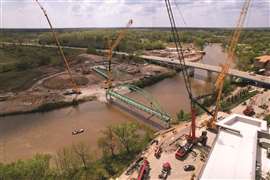 Three hydraulic cranes work in tandem to walk a 220-foot pedestrian bridge span into final alignment over the Tittabawassee River in Midland, Michigan. PHOTO: McNally-Nimergood
Environmental restrictions through the Michigan Department of Environment, Great Lakes and Energy eliminated the option of positioning a crane in the river; the original plan called for a Manitowoc MLC650 on a partially constructed crane pad within the waterway.
M&N engineers scrapped it and built a new solution around the equipment already on site. An LTM 1750-9.1 and Manitowoc 999 executed the initial tandem lift, walking the 62-tonne span approximately halfway across the river. At a predetermined transfer point, the load transitioned to an LTM 1450-8.1 and LTM 1400-7.1 working through an inverted lifting beam configured as an equalizer bar, allowing both 500-ton-class cranes to share the load within chart.
An LTM 1300-6.2 with a personnel basket elevated riggers to critical pick points so the LTM 1750 could be safely de-rigged and repositioned. The three hydraulic cranes then operated in a coordinated tridem configuration to walk the span into final alignment on its abutments.
The arch assemblies presented a separate challenge. The manufacturer said the 27-tonne components had never been set with a single crane. River access made a multi-crane solution impossible, so M&N worked directly with engineers to develop a rigging plan that put the lift within the LTM 1750-9.1’s charted capacity. It worked on the first attempt.
Inside job
An 18-metre-wide exterior alleyway at US Geological Survey’s (USGS) River Rouge facility in Michigan ended up being a constraint that shaped an entire project.
When Dobson Industrial arrived to remove a 45-tonne rock dryer and replace it with a new unit hauled from Louisville Dryer Company in Louisville, Kentucky, USA, that narrow corridor limited crane placement, outrigger extension and swing radius before even a single rigging decision was made.
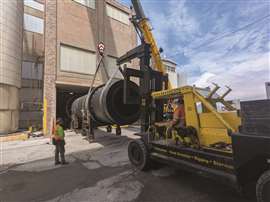 A custom adjustable saddle rigging system maneuvers a 100,000-pound rock dryer through a 60-foot-wide alleyway at USG’s River Rouge, Michigan facility. PHOTO: Dobson
Dobson’s answer was to design, engineer, fabricate, and install a custom adjustable saddle rigging system built specifically for this project. The saddle provided controlled vertical and lateral movement, allowing the 45-tonne vessels to be raised, lowered, and shifted side-to-side while navigating over fixed concrete barriers and beneath the structural steel, roof framing, and a fixed catwalk spanning the alleyway. No demolition. No structural modification. The existing plant stayed intact and operational throughout.
Engineered tandem picks with two cranes handled the load-out of the existing dryer and the set of the new unit onto the saddle system. From there, the saddle’s adjustability took over, threading the replacement dryer through obstructions that conventional crane picks couldn’t touch.
“Dobson’s engineered approach minimized plant disruption, avoided costly structural alterations, and allowed the owner to maintain production continuity,” the company noted in its project submission.
Island engineering
Puerto Rico’s aging infrastructure doesn’t forgive heavy transport. When Mammoet Americas was contracted by Noatum Logistics USA to help deliver a 227-tonne transformer from the port of San Juan to the Sabana Llana Transmission Center in Carolina, Puerto Rico (USA territory) – the largest transformer in the island’s history – the original plan (built around 18 lines of Goldhofer THP with wing dollies) had to be scrapped after a route survey revealed the convoy would be too tall to clear the island’s low bridges.
The solution was the Aspen Frame, a custom girder frame configuration that suspended the transformer inches above the road surface, dramatically reducing overall transport height while spreading the load across a greater distance for bridge crossings. Twin 300-ton turntables at either end of the frame improved maneuverability through tight urban corridors. The transformer was received on a 10-line PST-SL, transloaded onto the Aspen Frame connected to two 12-line PST-SL configurations, and moved toward the substation.
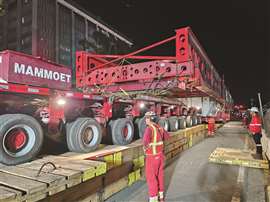 A Mammoet Goldhofer SPMT carries a large structural load through the streets of San Juan, Puerto Rico. PHOTO: Mammoet
One bridge along the route couldn’t handle the 411-tonne total transport weight regardless of configuration. Mammoet engineers designed a bridge jump operation using 37-metre ramps to carry the convoy across. Civil works removed fences, trees, and half a roundabout near a low arched bridge to achieve the turning radius needed to approach at the correct angle. At the substation, the transformer was transloaded to a single 14-line PST-SL, driven over its foundation, jacked up and lowered onto its pad.
Night moves
Buckingham Heavy Transport’s move of a 139-tonne, 300 MVA transformer from the Port of Baltimore to a substation in Mechanicsburg, Pennsylvania, USA, started with a problem that bridge engineers had to solve before a wheel turned.
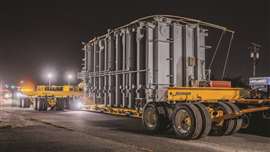
Several potential routes failed initial load assessments, and barge offload closer to the site was ruled out on cost. Buckingham pursued multiple overland permit applications simultaneously, ultimately selecting a direct route from Baltimore that incorporated wing dollies at three locations to distribute weight and satisfy bridge requirements.
The equipment configuration was a Kenworth W990 prime mover pulling a Goldhofer assembly of gooseneck, 6-line THP/SL, 330-ton transformer deck, 2-line THP/SL, 6-line THP/ADD, and power pack, supported by eight Buckingham wing dollies; the combined equipment weight exceeding 136 tonnes. The first 112 kilometres ran at night under permit, with crews managing traffic control, wing dolly deployment and a low-clearance bridge cleared by temporarily shifting construction barriers to access the construction lane.
 A yellow tower crane positions the 60,000-lb steel bridge over an active treatment basin at the Cedar Rapids, Iowa, water treatment facility. PHOTO: Buckingham
At the substation, Buckingham disengaged the prime mover and used the Goldhofer ADDrive system to navigate the final corners and grade into the facility without a second truck. Inside, the transformer was transloaded to six lines of SPMT, transported to its foundation, and rotated to final position using a Buckingham slide system.
Points of contact
When Barnhart Crane & Rigging was called in to remove a 27-tonne, 41-metre steel bridge at a water treatment facility in Cedar Rapids, Iowa, USA, the primary challenge wasn’t the weight, it was engineering a lift that could hold a structure of that geometry stable over an active water basin without a single fixed load path to rely on.
Working for Tricon Construction Group between September 15 and October 2, 2025, Barnhart’s team developed a self-equalising rigging arrangement built entirely from standard, off-the-shelf spreader bars, slings, and hardware. Rather than forcing loads into fixed pick points, the configuration used multiple spreader elevations and eight pick points across the structure to allow forces to redistribute naturally through the system. The approach reduced the potential for rotation, imbalance and localized overload while minimizing stress on the bridge itself.
Complicating the engineering was a gap between the documentation and reality. Field verification revealed several differences between the manufacturer and as-built drawings and the bridge’s actual geometry at the time of the lift. The final rigging arrangement was engineered around verified field conditions rather than the drawings.
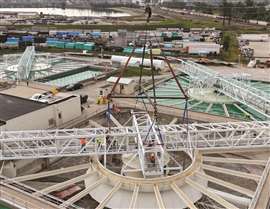 A yellow tower crane positions the 60,000-lb steel bridge over an active treatment basin at the Cedar Rapids, Iowa, water treatment facility. PHOTO: Barnhart
To validate the design before mobilizing, Barnhart’s engineering team built a physical scale model of the bridge and rigging system, not simply to confirm capacity, but to observe how the system would behave as a whole. The model allowed the team to evaluate load sharing, induced rotation, and wind effects before a crane was ever set.
“The innovation was not a custom piece of hardware, but the application of proven rigging components and engineering principles to solve a complex lifting challenge,” Barnhart said. “By understanding and refining the system’s behavior before arriving onsite, we were able to remove uncertainty and execute the lift with a high degree of confidence and control.”
Bridging the gap
The VCR Carbon Recycling Project site in Varennes, Quebec, Canada had no permanent heavy cargo offloading infrastructure, shallow near-shore water that prevented barges from reaching the bank, and an environmentally sensitive St. Lawrence River shoreline that ruled out most conventional solutions. Sarens USA built the infrastructure it needed from scratch.
The solution centered on a deliberately grounded barge, ballasted into position and seated on pre-positioned protection mats to distribute loads, protect the riverbed, and stabilize the hull. A spudded work barge was secured alongside, forming an interconnected marine platform. From there, a purpose-built 60-metre temporary heavy-haul bridge connected the platform to shore, creating the transfer corridor for SPMT operations between the transport barges and the site. The bridge required more than 500 tons of structural steel and platforms, 450 concrete blocks, and 150 timber mats for staging, load spreading, and ground protection.
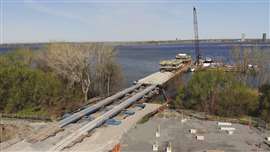 Skid tracks lead from the Varennes, Quebec, jobsite to the St. Lawrence River, where a barge and crawler crane await the next module load-out. PHOTO: Sarens
Nine oversized industrial process modules and a lifting frame were discharged at the Port of Bécancour using the vessel’s onboard cranes, transferred across the port on double-wide 19-line SPMT configurations sized to control axle loads within the port’s allowable ground bearing pressure, and loaded onto project cargo barges for repeated back-to-back voyages along the St. Lawrence.
At Varennes, 38 lines of SPMTs carried each module across the grounded barge platform and temporary bridge to its inland installation position. A single fixed ramp configuration accommodated varying module centers of gravity and support points across all nine units, eliminating ramp reconfiguration between transfers and reducing marine standby costs.
The operation ran April through June 2025, executed in planned shifts through rain and variable river conditions with zero recordable incidents.
CONNECT WITH THE TEAM