Rolls-Royce installs subsea crane
01 September 2017
Brazilian ship owning company CBO has commissioned engineering company Rolls-Royce to equip an existing offshore platform supply vessel (PSV) with a new patented dual draglink (DDC) subsea crane, including the cable traction control unit (CTCU), cabin, and control system. According to Rolls-Royce, this will be the first installation of a subsea crane designed to be able to use either fibre or steel wire rope.
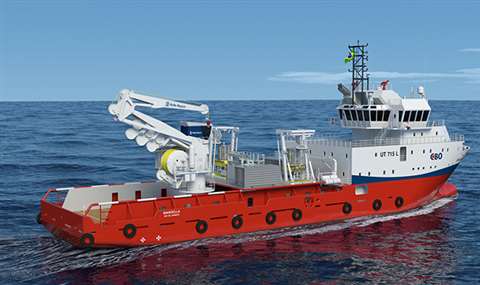
The hybrid DDC subsea crane will be installed on the vessel CBO Manoella, which is being retrofitted from PSV into a ROV support vessel (RSV). The active heave compensated crane is designed for continuous operation in a tough and corrosive offshore environment with a focus on efficient and safe load handling, said Rolls-Royce.
The crane that will be installed on CBO Manoella is a hybrid dual draglink crane with a lifting capacity of up to 50 tonnes and an operating depth of up to 3,000 metres. Although it will be equipped with a wire rope when it embarks on its first subsea assignment off the coast of Brazil, Rolls-Royce said the possibility of swapping to fibre rope provides flexibility in a challenging market. Because of the low weight of the fibre rope, the vessel’s deck load capacity can be increased by approximately 100 tonnes, Rolls-Royce claimed. Another benefit of using a low weight fibre rope instead of steel wire is increased lifting capacity at large depths, Rolls-Royce added.
The CTCU forms the crane winch and is located at the crane’s main boom. This saves space compared to when the CTCU unit is mounted below deck, said Rolls-Royce. It also makes it a better choice for retrofits, the company added. The horizontal elbow derrick movements provide active heave compensation (AHC). Rolls-Royce said this significantly reduces wear and build-up of heat in the lifting line compared to when the AHC is part of the winch.
Marcelo Martins, CBO technical director, said, “This is one of two vessels CBO is now retrofitting from PSVs to RSVs, and we are very satisfied about the flexibility of the crane from Rolls-Royce. A hybrid solution, with use of either fibre or wire, makes the vessel better prepared to take on a larger variety of future subsea tasks.”
CBO Manoella has a 76.7 m overall length, a beam of 17 m, and a gross tonnage of 2,668 tonnes. It is a Rolls-Royce UT 715 L design and entered service in 2009. It was then number two in a series of nine UT 715 L-designs ordered by CBO. Today the vessel is part of CBO’s fleet of 27 offshore vessels, of which 14 are UT-designs from Rolls-Royce.



CONNECT WITH THE TEAM