Read this article in 中文 Français Deutsch Italiano Português Español
How Skanska turned a U.S. bridge into its own crane

09 November 2026
No crane could reach the work. So what was a contractor to do? Turn the bridge into its own crane, of course.
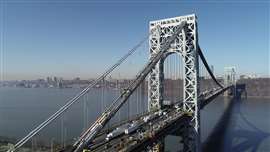 The George Washington Bridge, where Skanska is rehabilitating the span under a $452 million contract with the Port Authority of New York and New Jersey. Photo: Skanska
Global construction firm Skanska chose to swap 592 suspender ropes and hang 74 work platforms along the main cables of the George Washington Bridge, which connects Manhatten, New York City to the state of New Jersey, as high as 320 feet above live traffic and the Hudson River.
Ultimately, the Sweden-based contractor built a lifting system into the bridge itself as part of its own repair and refurbishment.
Skanska holds a US$452 million contract with the Port Authority of New York and New Jersey to rehabilitate the span. The scope includes replacing all the original suspender ropes, rehabilitating the main cables, installing cable dehumidification systems and replacing the main span sidewalks and upper-level railings.
“The design took an extraordinary amount of brainpower and imagination, because a suspension bridge doesn’t offer an obvious place to lift from,” Skanska told Crane and Transport Briefing.
Turning the George Washington Bridge into a crane
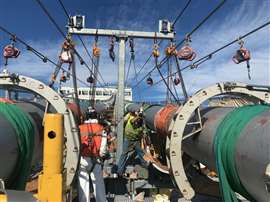 Crews rig chain hoists and sheaves on a work platform along the bridge’s main cables. Photo: Skanska
Skanska noted conventional cranes were impractical for work high on the cables of a bridge carrying traffic. Instead, the team used a custom hoist system, built by Allied Power Products of Oregon and staged inside the main towers. It could lift with a single hoist for smaller picks or with two synchronized hoists, for a combined capacity of up to 40,000 pounds. Skanska used 3D modeling to route the load lines. Each line exits the tower at roadway level and climbs through several sheaves to the tower top. It passes through more sheaves, runs out alongside the main cable to another sheave, then drops to the roadway to pick up its load.
The design kept the machinery protected inside the towers and let the crew place a lift point exactly where it was needed along the cable. No crane had to reach out over traffic or the river, and the space beneath the main cables stayed clear for follow-on work.
“In effect, the bridge became its own lifting structure,” Skanska said. “The machinery stayed protected inside the tower, the lift point could be placed exactly where it was needed along the cable, and no crane had to reach out over traffic or the river.”
Synchronized lifting proved the project’s key engineering challenge, Skanska said, because any imbalance between the two hoists shifts the load onto one side. The main cable work platforms show how the system worked. The team designed 74 custom platforms, each 20 by 60 feet and weighing 40,000 pounds. Together they put nearly 3 million pounds, about 1,480 tons, on the main cables, which Skanska compared to 37 fully loaded 80,000-pound tractor-trailers. Each platform arrived in four sections, and a 50-ton crane set them onto stands beneath the cable for bolting. The crew connected one hoist line, reeved in two parts, to each end of a platform. Running the hoists independently, they lifted it level and adjusted its pitch to match the slope of the cable. They then switched to synchronized mode and raised it into place.
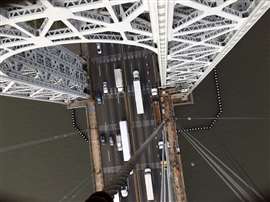 A view straight down from the main cable to the roadway, with traffic moving beside a work area. Photo: Skanska
“That’s roughly the weight of 37 fully loaded 80,000-lb tractor-trailers suspended above the Hudson,” Skanska said.
The rope exchange itself happened from a single closed lane with traffic moving alongside. Crews lowered old ropes, some weighing up to 9,000 pounds, straight into a dump-style trailer. They pulled the new ropes up and over the main cable from a large spool on a low trailer in the same lane. The new ropes arrived during the day by standard trucking on low trailers, with no oversize permits or overnight moves, and the bridge stayed open.
Every crane pick came from the bridge deck, so each lift was planned around lane closures, traffic control and swing radius. A 15-ton crane worked daily from a closed lane, setting the new galvanized sidewalk railing and making service picks. The heaviest lifts went to a Liebherr LTM 1220, which set the hoisting platforms inside the main towers. To land each one in the center of a tower, the crew bolted 8 tons of counterweight to one side, deliberately shifting the platform’s center of gravity so it would hang and orient correctly.
All lifting happened in daylight, with a 25 mph maximum wind speed. Vergona Crane and Bay Crane supplied the larger cranes.
The pedestrian path “South Walk” of the bridge reopened on 15 October, with the entire scope expected to finish by 2030.
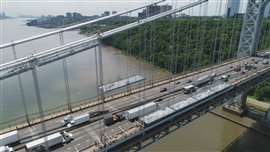 A work platform hangs from a main cable of the George Washington Bridge above the upper-level roadway. Photo: Skanska

CONNECT WITH THE TEAM