Read this article in 中文 Français Deutsch Italiano Português Español
Rough terrain cranes: built to last, lasting longer

07 September 2026
Rough terrain crane demand remains steady but the real story is what owners are doing with the cranes they already have.
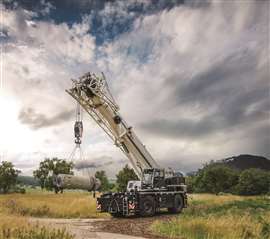 Liebherr LRT 1130-2.1 CAPACITY: 140 MAIN BOOM LENGTH: 197 ft FIXED JIB LENGTH: 35–62 ft BOOM LENGTH WITH JIBS: 279 ft TOTAL TIP HEIGHT: 294 ft COUNTERWEIGHT: 45,400 lb.
For the third year running, manufacturers describe the North American rough terrain (RT) crane market in almost identical terms: solid, stable, driven by Gulf Coast energy work and a nationwide data center boom, with the 100-US ton-and-up class pulling the most attention.
It could be a sign of the market settling after historic construction machine sales highs in 2022 gave way to more unpredictable cycles since.
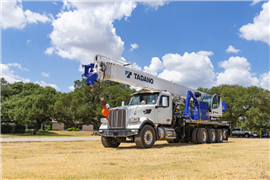
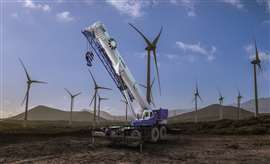 Tadano GR-1600XL CAPACITY: 160 tons; MAIN BOOM LENGTH: 42.8 to 200.1 feet; HYDRAULIC OFFSET JIB LENGTH: 33.8 or 59.1 feet; MAX LIFTING HEIGHT: 302.5 feet (with boom); COUNTERWEIGHT: 64,600 lbs.
But underneath the plateau and repetition, a smaller shift shows up: fleet owners aren’t simply buying their way to newer steel the way they used to. They’re getting more selective about when a new purchase is warranted, choosing to rebuild what they already own rather than replace it.
“I would say fleet refreshment activity is still occurring, but it’s become more disciplined and selective than it was in some previous cycles,” John Bair tells Crane & Transport Briefing. He’s the product manager for rough terrain cranes at Manitowoc. “Most fleet owners are being much more analytical about replacement decisions, focusing on utilisation, lifecycle costs and ROI, rather than simply replacing equipment based on age.”
It might be a sign of the times. Tariffs and strained global economic conditions have not lessened demand for cranes on urban jobsites, data center builds and energy infrastructure projects, but they appear to be changing how deliberately fleet owners spend against that demand. A crane bought reflexively on an age-based replacement schedule is a different capital decision than a crane bought because the utilisation numbers justify it; and manufacturers describe customers increasingly running the math before signing a purchase order.
Push to refurbish
Tadano is seeing something similar play out at the individual-machine level, not just at the fleet-strategy level. Lance Rydbom, the company’s vice president of product management and engineering, said many customers keep to a routine refresh schedule that hasn’t changed much in years. But newer patterns have emerged.
“One change we have seen for some fleets is a request to refurbish their existing aged Tadano rough terrains and make them ‘new’ again,” Rydbom said. “The steel works are still in great shape, but they would like to modernize and refresh where it makes sense to extend the life of their Tadano cranes.”
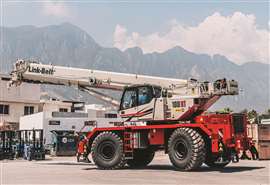 Link-Belt 100|RT CAPACITY: 100 tons MAIN BOOM LENGTH: 40.6 to 155 feet FIXED JIB LENGTH: 35 to 58 feet (bi-fold lattice SmartFly) BOOM LENGTH WITH JIBS: 221.4 feet TOTAL TIP HEIGHT: 237 feet (with optional 16-ft fly extension) COUNTERWEIGHT: 28,800 lb.
Those two comments describe a market that is still growing but is behaving with noticeably more discipline. A crane’s steel structure, unsurprisingly, tends to outlast its electronics, cab technology and operator-facing features by a wide margin. Owners appear increasingly willing to separate those two lifespans rather than replace a whole machine because a display is out of date.
Andreas Ernst, president of Raimondi North America, added that Terex is seeing “mixed market feedback, some are refreshing based on high utilization, others keep repairing due to higher replacement costs of cranes driven by tariffs.”
Brian Smoot, vice president of cranes at Sany America, described a similar observation from Sany.
“Fleet replacement continues, although it is more selective than before,” he said. “Some companies are extending ownership cycles when existing cranes remain productive. At the same time, aging fleets, rising maintenance costs, and parts availability issues are driving replacements. New cranes must demonstrate clear gains in uptime, safety, reach, and operating efficiency.”
It’s a pattern that quietly answers a question long asked out loud: how long is a rough terrain crane supposed to last? For years, the honest answer was as much shaped by fleet-turnover convention as by any hard engineering limit.
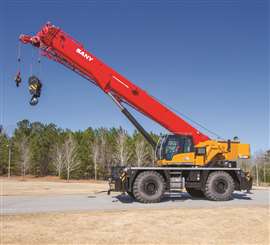 Sany SRA1200A CAPACITY: 120 tons; MAIN BOOM LENGTH: 41 to 183.7 feet; FIXED JIB LENGTH: 34.4 to 59.1 feet; BOOM LENGTH WITH JIBS: 242.8 feet; TOTAL TIP HEIGHT: 250 feet; COUNTERWEIGHT: 29,800 lbs. (hydraulically removable, self-installing)
But if customers are now asking manufacturers to extend that life deliberately, rather than treating a crane’s steel life as a fixed constant that expires alongside the electronics around it, that’s a meaningfully different relationship with the equipment than recent decades.
Demand rules everything
Energy work, data centers and infrastructure spending remain the demand drivers everyone points to, and there’s no reason to expect a pullback anytime soon.
But the full list of what’s pulling cranes onto jobsites this year is broader, and more geographically spread out.
Rydbom pointed to coast-to-coast airport expansions, bridge and highway construction, wind maintenance-assist work, data and server center builds, semiconductor plant construction, and continued oil and gas and LNG-related projects as the drivers behind what he called a solid North American market.
One highly productive area – the US Gulf region – Rydbom described as “flourishing” with oil and LNG work. He notes data center and AI-related construction “seems to be happening all over the country” rather than concentrating in any one region.
Bair offered a similar list with more regional texture. While he agreed the Gulf Coast remains the largest, most concentrated RT market in North America, driven mostly by energy infrastructure projects, he was clear that demand is far from isolated. Strong regional markets also exist across Western Canada, the Midwest wind corridor, mining regions in the western US, and utility and infrastructure projects spread throughout the rest of the continent.
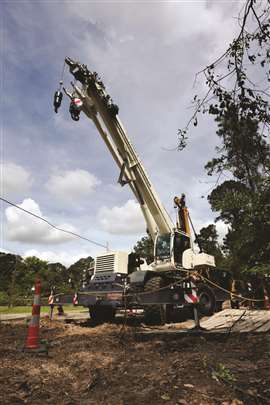 Terex TRT 55US CAPACITY: 55 tons; MAIN BOOM LENGTH: 123 feet; FIXED JIB LENGTH: 26.2 feet; BOOM LENGTH WITH JIBS: 148.9 feet; TOTAL TIP HEIGHT: 157 feet
Andreas Ernst, president of Raimondi North America (parent company of the Terex Rough Terrain business), said Terex RTs see high demand in the Southeast and Midwest, driven largely by oil and gas activity alongside major regional construction projects.
Smoot said the Gulf Coast, Texas and the Southeast continued to be among the strongest RT markets, driven by petrochemical work, industrial maintenance, power generation, data centers and new manufacturing facilities. He described the Midwest as “also active due to infrastructure, utilities, and industrial construction,” while noting that “regions with slower commercial construction, lengthy permitting processes, or higher project costs have been somewhat softer.”
Kelly Fiechter, product manager for rough terrain cranes at Link-Belt Cranes, described a steadier, if less dramatic, picture: stable rental and contractor-owned fleet demand for the back half of the year.
“There seems to be enough large infrastructure and project work underway to keep fleet owners busy,” Fiechter said.
Size matters
Where the manufacturers diverge slightly is on how excited to be about the top end of the market.
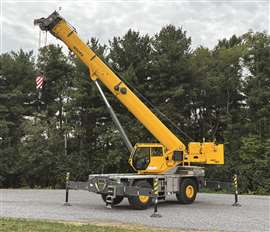 Grove GRT780 CAPACITY: 80 tons; MAIN BOOM LENGTH: 155 feet (five-section full-power boom); BI-FOLD BOOM EXTENSION LENGTH: 33 to 56 feet; BOOM LENGTH WITH BOOM EXTENSION: 211 ft; MAX TIP HEIGHT: 220 FT COUNTERWEIGHT: 17,500 lb. or 20,500 lb. counterweight options
Both Bair and Rydbom pointed to continued growth in the 100-ton-and-above class as jobsites grow more complex. Fiechter, by contrast, described growth at the high end as happening “at a measured pace” rather than the sharper trajectory some competitors are describing, with steady demand for Link-Belt’s larger RTC-80130 and RTC-80160 Series II models, especially for utility and plant work.
Bair added a useful qualifier to the top-end perspective: from a sheer rental-volume standpoint, it’s actually the 80- to 100-ton class, not the largest cranes above it, that remain the most popular segment of the market. The units owe their popularity to versatility across a wide range of applications. Bair also noted the 120- to 165-ton range has seen significant growth over the past two years, but it’s growing from a smaller base than the mid-size class that still does the bulk of the day-to-day work.
Smoot placed the core of the market slightly differently. “The 75- to 120-ton range represents the core of today’s RT market,” he said. “These cranes deliver the right balance of capacity and reach for major construction and industrial work while remaining economical to transport and mobilize.”
He called the 100-ton class “particularly versatile, serving steel erection, bridge construction, plant maintenance, and general rental applications.”
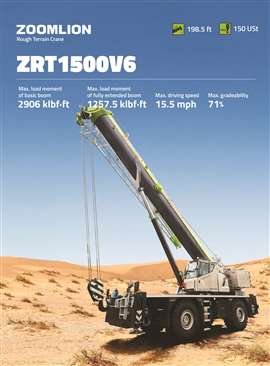 Zoomlion ZRT1500V6 CAPACITY: 150 tons; MAIN BOOM LENGTH: 199 feet (six-section); MAX TIP HEIGHT: 252 feet (with jib extended)
Ernst agreed that “80 [tons] and larger” are the most popular capacities Terex is seeing. Demand for smaller RTs, he said, is “somewhat limited,” driven by “reach and lift capacity requirements in today’s construction industry” rather than cost alone.
The smaller end of the market tells a more settled story than it has in past years. Fiechter noted that fleet owners have largely figured out how to substitute a larger crane for a small one at similar total cost of ownership once transportation is factored in. He said Link-Belt’s 75-ton 75|RT is a model built specifically to transport in one piece with full counterweight, narrowing the practical cost gap that used to favor a smaller machine.
Bair described smaller-capacity demand as real but permanently changed in scale, a function of both the industry’s overall shift toward larger capacities and the availability of alternative equipment types that can now cover ground once reserved for small RTs. But compact size, maneuverability, simplicity and low operating costs still make small RTs attractive for municipalities, water treatment plants, industrial maintenance and general construction work.
Across capacities, manufacturers described a consistent customer wish list: reliability and minimal downtime above all else, but increasingly weighed alongside ease of operation, serviceability, transportability and total cost of ownership rather than boom length and load chart in isolation.
“Boom length and load chart are still very important,” Bair said, “but uptime, mobility, operator experience, serviceability and total cost of ownership are often what ultimately drives the purchase decision.”
Smoot offered a different explanation for the same trend. “There is still demand for smaller RTs, though it is more application-specific,” he said. “Some traditional small-RT applications are now being served by carry-deck cranes, telehandlers, and other lifting equipment. Many contractors are also shifting toward larger RTs that can handle a broader range of work.”
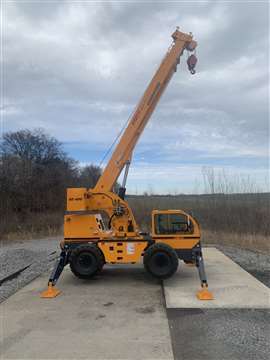 Broderson RT-400-B CAPACITY: 20 tons; SHEAVE HEIGHT: 90 feet (with boom extension); HORIZONTAL REACH: 90 feet (with boom extension); HEIGHT: 11 feet; WIDTH: 8.5 feet
On the site
For all the market-level analysis, it’s worth remembering what an RT crane is doing once it lands on site; manufacturers describe a machine whose value comes less from any single spec than from its ability to stay useful across an entire project’s life cycle. Bair described Grove RT cranes on power plant, oil and gas, wind farm and petrochemical projects as rarely limited to one task.
“In a way, they become the site’s utility player,” he said, “handling steel erection, equipment placement, component offloading, maintenance lifts and general construction support. The RT becomes the workhorse machine on the site.”
Link-Belt pointed to a recent example of that versatility in practice. A 130-ton RTC-80130 Series II assisted bridge construction in northern California intended to expedite emergency services response times, lifting 7,500-pound shoring beams at a 90-foot radius. Once the bridge deck work was complete, the same crane was brought back to trip a 78,000-pound batch plant for disassembly and removal from a nearby site – two very different jobs, on two different timelines, handled by the same machine.
“The utilitarian nature of these cranes makes them an economical choice for a lot of different kinds of work,” Fiechter explained.


CONNECT WITH THE TEAM