Read this article in 中文 Français Deutsch Italiano Português Español
Shifting the load: market outlook for 2026

18 December 2025
Crane demand has always followed the movements of economies, infrastructure and industrial growth. But what we are seeing now is something more structural.
Across regions, the market is reshaping itself around rapid urbanisation, energy transition and a wave of technology that is changing expectations for safety, precision and efficiency. For SC&RA members operating globally, these shifts offer both opportunity and new pressures on planning, investment and workforce development.
 Joel Dandrea, SC&RA chief executive officer
Recent industry outlooks point to steady market expansion through 2034 driven by big infrastructure budgets, renewable energy growth and modernisation across emerging economies. Yet the story underneath is more nuanced. Cranes are no longer simply tools for lifting. They are becoming smarter systems embedded within high-stakes projects where data, technology and sustainability targets increasingly define the pace of work. Understanding these currents helps companies prepare for what comes next.
In every region, infrastructure spending remains the biggest force behind crane demand. Europe is tightening around major refurbishment programmes and a historic push towards renewable energy. Wind installations in particular continue to require heavy lift capacity and specialised planning. Markets like Germany, France and the UK remain the core of European crane consumption, fuelled by offshore and onshore wind, urban transport expansion and the need to modernise ageing assets.
Asia Pacific continues to lead the global market by volume. Rapid urbanisation, population growth and large-scale industrialisation drive demand for mobile and tower cranes, particularly in India and Southeast Asia. Meanwhile, China’s Belt and Road projects extend crane utilisation across borders, linking ports, highways and energy corridors that rely heavily on both mobile and fixed lifting solutions.
South America and the Middle East add their own momentum. Mining output in Brazil, Chile and Peru continues to support demand for heavy lift equipment, while Brazil’s logistics upgrades and renewable investments create steady commercial opportunities. Across the Gulf states, mega-projects in Saudi Arabia, the UAE and Qatar maintain strong demand for large cranes, driven by new cities, ports and industrial zones. Africa follows similar patterns through mining expansion and key infrastructure corridors that require reliable lifting capacity.
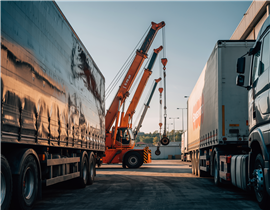 Cranes and transport equipment can be seen as becoming part of a global system. Image: Firefly AI
Combined capabilities
While global demand remains strong, the nature of that demand is changing. Crane buyers no longer want only lifting power. They want intelligence. Automation, telematics, IoT monitoring and advanced hydraulic systems are fast becoming standard expectations. Real-time diagnostics, load tracking and predictive maintenance reduce downtime and improve safety, bringing cranes closer to the digital systems that drive modern construction and transport networks.
Electric and hybrid models are also gaining ground. Driven by emissions targets and rising operating costs, companies are testing cranes with lower environmental impact and higher energy efficiency. Fully automated facilities are using up to five times more power than previous generations of buildings, which increases the need for cranes designed to operate in high-load, high-tech environments.
For companies working in specialised transport, heavy haul and lifting, the message is clear. Global crane demand is expanding, but expectations are rising with it. Projects are getting taller, heavier and more complex. Technology is reshaping how lifts are planned, executed and monitored. Environmental requirements are tightening. And in many regions, cranes are becoming central to energy transition projects that will define the next decade of work.
The opportunity lies in preparation. Investing in workforce training tied to new technology, understanding regional regulatory pressures and aligning fleet decisions with long-term project trends will help companies stay ahead. Whether operating in Europe, North America, Asia Pacific or emerging markets, the companies that thrive will be those that combine capability with foresight.
CONNECT WITH THE TEAM