Taller turbines no problem for 800 tonne cranes

16 February 2026
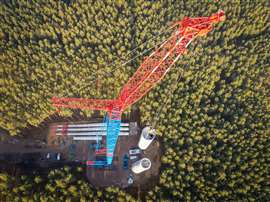
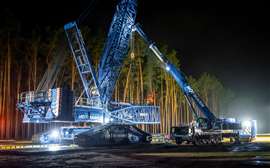 Hofmann assembling its LR 1800-1.0 crawler crane after transporting it from the installation site of the previous turbine. The auxiliary crane is a 250 tonne capacity Liebherr LTM 1250-5.1 wheeled mobile telescopic. Photo: Liebherr
Three big mobile cranes from three companies worked together on a major wind farm project in Germany to erect turbines with hub heights of 179 metres.
Wind turbine manufacturer Nordex Group developed the N175/6.X, a new model in its Delta4000 series, with a rotor diameter of 175 metres. Ten of them were erected on the Mahlsdorf wind farm at the end of 2025.
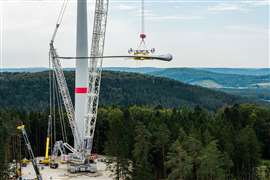
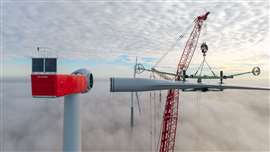 Nolte used special equipment to install the blades. It included a Liftra lifting beam and an Autonomous Positioning System from Seasight Solutions. Photo: Liebherr
Crane providers Hofmann, Neeb, Nolte each supplied an 800 tonne capacity mobile crane for the job. All were Liebherrs as were the six support cranes. For the main lifts Nolte supplied an LG 1800-1.0 wheeled mobile crane with lattice boom, while the others each supplied an LR 1800-1.0 lattice boom crawler crane.
As a single load the heaviest component of the turbines was the gearbox, weighing 83 tonnes. To lift this the cranes were rigged with the HSL4 boom consisting of 174 metres of main boom, plus 18 metre fixed jib. A total of 270 tonnes of ballast was on the crane for these lifts.
Saving time
Speeding up the work was important which is where the VarioTray ballast system came into its own. A total of 400 tonnes of suspended counterweight is needed to erect the mast. To quickly change configurations the system allowed the large 300 tonne ballast pallet to be disconnected from the smaller, 100 tonne, one.
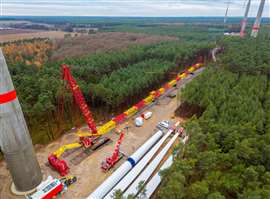 Neeb raising the assembled boom and jib on its LR 1800-1.0. A total of 400 tonnes of counter weight was used. Once it is up in the air the VarioTray feature allows separation of the 300 tonne ballast pallet from the 100 tonne one without having to unstack a load of slabs. Photo: Liebherr
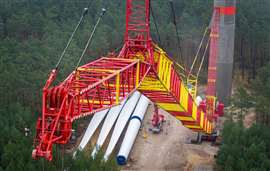 Neeb’s liebherr LR 1800-1.0 with the assembled boom and jib raised. Photo: Liebherr
Moving cranes between turbine locations on site is an area where time can be saved. Hofmann only partially dismantled its crane, down to the base unit with counter jib but without tracks, and moved it on self propelled modular transporter as a single unit.
The LG series crane on wheels is already easy to move. “We are basically a mobile crane company. Since the LG 1800-1.0 does not require the transport of 70 tonne crawler tracks, it is a better fit for our low-loader fleet,” explained Jürgen Peters, Nolte project manager.
Transporting the cranes to site and then erecting them is another part of the operation where time can be saved by having good teams and well-designed equipment. Ingo Klees, a member of the technical field service team at Neeb, explained, “As the wind farm was due to be completed by the end of the year, we were called in at short notice to provide support. Accordingly, the crane was moved within seven days, including dismantling and reassembly. And that despite the fact the crane had previously been in use in the Black Forest, some 850 km away from Mahlsdorf. This achievement was only possible thanks to an excellently co-ordinated team and a well-thought-out assembly and transport concept.”
Quick service in the event of breakdowns is also crucial. On this job one of the crawler cranes had a hydraulic pump problem. Within hours Liebherr Service, working with the crane company, had it fixed, Liebherr said.
 Hofmann lifting the first steel tower segment (65 tonnes) onto the lower concrete tower tower base section. Photo: Liebherr
CONNECT WITH THE TEAM