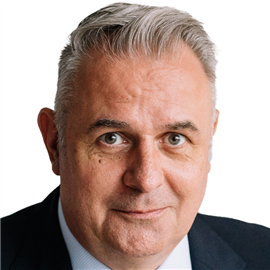
The human factor is critical: Josu Tornay

26 August 2026
While quality, service and expert engineering are critical elements, relationships rule, says Jaso’s Josu Tornay.
In 2023, Josu Tornay was recruited to restructure Jaso, a prominent Spanish manufacturing company, and to prepare it for international expansion. As CEO, Tornay has done just that. And he is not done.
“Jaso is a very well-known historical manufacturer in the Basque Country for overhead cranes, gantry cranes, construction hoists, elevators for the wind energy sector and tower cranes,” he said. “When it was offered to me, the project looked very attractive with clear goals.”
Tornay left Mondragon Corporation, where he had worked for some 27 years, and took on the role at Jaso. Time has flown by, he said.
International scope
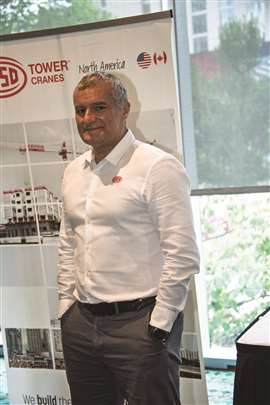 Josu Tornay, CEO, Jaso Cranes
Tornay is highly qualified for the position he assumed, holding a Master’s Degree in Telecommunications Engineering with electronics as specialty, and an MBA. At Mondragon, one of the largest corporations in Spain and the biggest in the Basque Country, he started in the electronic components division. He spent his last 11 years in the machine tool division, holding roles ranging from product manager to CEO. He worked for five years as expat in Germany.
“I was always in narrow contact with different international markets, including the United States, China and India,” he said. “I also enjoyed long stays and interesting projects in these countries.”
His first task at Jaso was to introduce and develop operational changes.
“Most of them are long-term structural changes with shorter-term milestones that we are successfully fulfilling,” he said.
The three main changes were to streamline management roles, establish quality assurance and continuous improvement protocols and overhaul the supplier portfolio, “deepening ties with key vendors and making necessary changes where there was no long-term potential.”
I met Tornay at the Tower Cranes North America event in Nashville back in June. True to form, he was constantly shaking hands, greeting old friends and making new connections. He agreed to answer my questions about Jaso, the American tower crane market and share his perspective on tariffs, distribution and related industry challenges. Tornay is sharp, articulate and easy to get to know.
What are the challenges of running a tower crane company like Jaso?
The challenges are multiple but the most complex, most important and also most rewarding area is related to human relationships. This includes not only the usual support to your team with ongoing projects but also sharing information so that everybody in the company is and feels involved in the project and being receptive to and looking for feedback from everybody, without fear of getting answers you might not like. Recognizing, facilitating, being an example, taking into account the emotions and feelings of everybody involved. All this is so easy and difficult at the same time! This is always the real challenge in an organization.
How long has Jaso been active in the North American market?
Jaso has been active in North America for almost 20 years. We started back in 2007 with our first major supplies of elevators for wind turbine towers, and moved into tower cranes in 2014, when we started working with Allied Crane, in British Columbia, Canada.
Are tariffs still an issue?
They certainly are when it comes to manufacturing and importing new tower cranes in the United States. One side effect is that they make the second-hand market more competitive relative to new cranes, since used equipment isn’t exposed to the same import costs. So tariffs don’t just raise the price of a new machine; they shift demand toward the resale market, which in the end helps to age the tower crane fleet. This is not good for anybody.
What is your distribution model in North America?
We work through a dealer network covering both coasts, in the U.S. and Canada. On top of that, we keep a direct presence with cranes owned by Jaso in markets where we can help our dealers complete their fleet. It’s a hybrid model: the dealers own the relationships and the local service, and we step in with our own equipment where it adds value. Our communication with partners tends to be very open. We do not work for the short term and our dealers know it.
What distinguishes Jaso tower cranes in the market?
Reliability, low maintenance cost and long-service-life design. We have tested solutions from Southeast Asia and Middle East to Northern Europe and North America, and this has produced cranes prepared for a wide range of conditions: cold climates, extreme heat, dust from mining or seismic exposure.
We have a long history in tailor-made solutions, and our customers know that we are there and listen to them when the market requires something special. As an example, PPVC has been one of our core markets for over a decade in Singapore, and that construction method has reached other markets, [such] as North America, where we can apply the lessons learned in Asia, with proven experience where others are just starting.
How would you describe the tower crane market in North America?
It’s a large and growing market, but a cyclical one, closely tied to construction activity and interest rates. It’s dominated by a rental model, with a handful of established rental companies controlling much of the fleet.
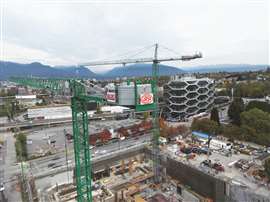 Working in Vancouver, BC, two Jaso J265PA luffing jib tower cranes, which were rented by Axiom Builders/Bosa Construction.
Historically it’s been built around standard construction processes, but we’re seeing steady adoption of modular and PPVC construction. Luffer cranes’ adoption in high-cost urban cores like New York, Toronto, Seattle and Miami is also a game changer. There are also meaningful regional variations: the needs of a dense downtown skyline are very different from lower-rise development elsewhere. What we see is a market that values reliability and total cost over just the sticker price of the machine.
How would you describe the markets where Jaso competes?
They’re very diverse, and that’s exactly what has shaped our product. In the Middle East we deal with mega-projects, extreme heat and dust. In northern Europe it’s cold, wind and a strong renewable-energy sector. In Singapore and Southeast Asia, we’ve been a leader in PPVC modular construction for over a decade. Competing across such different environments forced us to engineer cranes that perform reliably everywhere, and that knowledge and experience is what we now bring to North America.
What is your business philosophy?
The human factor is and has been part of our DNA in most Basque companies and of course at Jaso. We build long-term relationships with customers, employees, suppliers, etc. Service and quality in our work is the key to our future and the reason why we have been in the market for more than 50 years, with a leading positioning in markets like Australia, United Kingdom, Spain, Mexico, Argentina and others. Reliability, uptime and the total cost of ownership over the machine’s life is what we try to maximize for our customers. We’re an engineering-led company, and we back that up by being present and supporting our dealers where they need us, rather than just selling a machine and walking away.
What is it about the tower crane market keeps you engaged?
I am an engineer and I have always worked in industrial environments. The reason is that I like it. With tower cranes, every project is a real challenge to tackle, with engineering supporting the whole of it. Seeing a Jaso crane go up on a skyline never gets old. Regarding the Jaso project, we are building something new, modernizing the brand image and scope internationally, including the business we are building in North America for the long term. Being part of it keeps me engaged every single day.
STAY CONNECTED


Receive the information you need when you need it through our world-leading magazines, newsletters and daily briefings.
CONNECT WITH THE TEAM