Missing pieces: lack of skilled labor a headwind for USA data center boom

30 September 2026
Every hyperscale data center, every gigawatt of new grid capacity, every reshored factory construction project eventually poses the same question: who is actually going to rig it, lift it and set it in place? Increasingly, the honest answer is ‘not enough skilled people.’
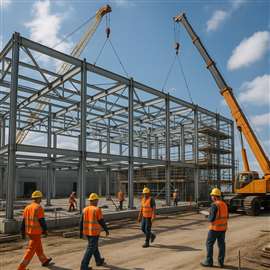 Rendered image, created by Chatbox, of a data center under construction. Photo: Chatbox
Every week brings another headline about the scale of the AI buildout; a massive cloud computing hyperscaler committing a few more billions to a data center campus or a utility announcing a new multi-gigawatt clean energy portfolio.
Financing is arranged, permits filed and renderings circulate, but a lingering question remains even after approval: who is available to do the physical work, and are they skilled enough?
“All of those projects are competing for the same limited pool of experienced operators, riggers, supervisors and project managers,” says Mike Sobolewski. He is a partner and engineering/construction leader at PwC US, one of the world’s largest audit, tax and consulting firms.
PwC rrecently released a report titled “The real risk to the AI economy: The engineering and construction labor crisis”, and Sobolewski shared comments with Crane and Transport Briefing about the realities of today’s labor market on our industries.
 Photo: PwC
It’s a labor crunch the industry hasn’t had to reckon with at this scale before, and companies that can’t staff up fast enough risk watching the work go to someone else.
The scale of the ask
“The crane and specialized transport industry is becoming one of the biggest enablers of the AI economy,” explains Sobolewski. “Every major investment we’re seeing, from data centers and power generation to grid modernization and advanced manufacturing, depends on safely moving and installing increasingly large, complex assets.”
The numbers behind the current buildout are worth absorbing, because they explain why this moment feels different from prior construction cycles.
A single modern AI training cluster can draw as much electricity as a small city, and the USA is already a top-10 electricity-consumer per capita globally. And USA data center power demand could double (or triple, by some estimates) by 2030, requiring dozens of gigawatts of new capacity for an already demanding electricity market.
Consider that a 250,000-square-foot data center can require roughly 1,500 skilled tradespeople to build, it’s understandable there’s concern about how much building is even possible.
The projects draw from the same finite pool of electricians, pipefitters, ironworkers, riggers, crane operators, project managers, supervisors and more. Added to it, US data center construction projects are largely in rural areas, sometimes dozens or hundreds of miles away from a major urban center. That is, these are already stressed labor groups.
And data centers aren’t the only driver: the Inflation Reduction Act and Infrastructure Investment and Jobs Act are still pushing clean energy, grid modernization and broadband construction, while the CHIPS Act is driving semiconductor fabrication builds and defense facility investment, as well as industrial reshoring, are adding even more demand on top.
The workforce math simply doesn’t align.
The USA faces a shortage of up to a million engineers, while more than 80,000 electricians will be needed annually over the next decade. This is amid the talent stream turning into a trickle the last decade, as a smaller fraction of people are graduating from apprenticeship programs each year; the average electrical lineman in the USA is 52 years old and a full apprenticeship takes four years to complete, while the average hyperscaler wants power delivered in 18 months.
Why this hits crane and transport differently
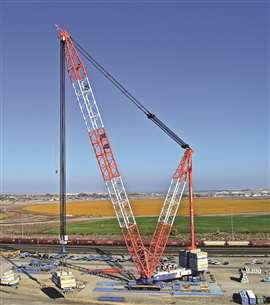 From data centers to power projects, crane activity remains strong heading into 2026 despite financial pressures and tightening insurance markets reshaping how companies plan.
For the niche crane and transport firms, the issue is compounded. Sobolewski explains why this corner of the industry is harder to backfill than most:
“What makes this especially challenging is that companies are trying to replace decades of experience, not just headcount,” he says. “Executing a complex lift or heavy transport operation takes judgment that’s built over years in the field, and that’s not something you can build or accelerate overnight. As workers retire, companies are losing operational judgment, mentorship and technical expertise.”
The consequence, per Sobolewski: “For crane and heavy transport companies, people have become just as critical a resource as equipment.
“Getting a project approved isn’t the same as getting it built. More and more, the main issue isn’t whether financing or permits are in place; it’s whether qualified crews are available when work is ready to start.”
That shift is already visible in how contractors are being evaluated. Bid strategies built entirely around price are giving way to blunt questions like: ‘will your people actually be available when the work is ready to start?’
Thinner bench strength at bid stage, longer mobilization periods, subcontractors poached mid-commitment, declining supervision ratios as experienced foremen become scarcer, and all of it shows up eventually as slipping schedules, rework and, in the worst cases, safety incidents.
Workforce under strain, not just short-staffed
The labor shortage is only half the picture.
Data center construction is becoming a political lightning rod, with the public’s sentiment turning against the high-tech builds; more than 100 US municipalities have enacted data center build moratoriums, as has New York State. For some contractors, avoiding the fray could be as valuable as the contract itself.
That’s because the existing workforce, by the industry’s own data, is under real and rising strain. A 2025 survey of more than 1,000 US construction workers, conducted for Clayco, found that 64 percent reported experiencing anxiety or depression in the previous 12 months, up from 54 percent just a year earlier. Separately, CPWR data shows suicide rates among male construction workers running nearly double those of working men overall, while construction workers account for roughly 17 percent of overdose deaths in the US working population despite representing only about 8 percent of it.
Bridget Caletka, a licensed counsellor and workforce mental health consultant, argues the industry’s default response – an Employee Assistance Program (EAP) – isn’t built to carry that weight on its own.
“An EAP is a resource, not a culture,” she says. Limited session counts, unfamiliarity among providers with the specific realities of field work, and employees’ own hesitation to use a benefit they don’t fully trust or understand all blunt an EAP’s actual reach. “The organizations making the greatest impact are the ones that pair access to care with supportive leadership, mental health education and an environment where asking for help is viewed as a strength rather than a liability.”
 Photo: PwC
Read alongside the labor-scarcity data, this becomes a genuinely uncomfortable pairing: an industry that urgently needs to retain and attract far more skilled workers is simultaneously documented as struggling with rising anxiety, burnout and attrition risk among the workforce it already has.
Losing an experienced rigger or crane operator to burnout doesn’t just cost a headcount, per Sobolewski’s own framing, it costs the judgment that took years to build and can’t be quickly replaced.
How companies are responding
Sobolewski points to companies “treating workforce strategy as part of their business strategy” – investing in training and apprenticeships, finding ways to retain experienced people specifically (not just hire new ones), and using technology to make existing crews more productive rather than simply trying to outbid competitors for the same finite talent pool.
The broader PwC analysis names five categories of valuable response:
- Offsite fabrication and modular construction (reducing the on-site labor footprint for a given project)
- Digital construction tools and field productivity software
- BIM-to-field integration
- Strategic workforce logistics (moving expert crews to where work is rather than relying on local supply)
- Updated training and upskilling programs aimed at building deeper competency faster on fundamentals
It should be noted that none of these solutions are meant to solve the underlying shortage. All of them are, at best, ways of getting more delivered output from a labor pool that isn’t growing fast enough on its own, which might serve as a signal that there’s little belief it will fill up anytime soon.
The uncomfortable bottom line
The broader PwC analysis makes a claim worth sitting with: workforce availability isn’t yet priced into how infrastructure investment gets modeled.
Capital risk, regulatory risk, commodity risk are all familiar variables analysts know how to hedge against, but whether there will be enough qualified crane operators and riggers available to execute a project on schedule is not a line item most financial models had to account for, and it may end up mattering more than any other line item for the foreseeable future.
For crane and specialized transport specifically, it’s the daily operational reality of trying to staff a heavy lift with people who have the judgment to do it safely, at the exact moment every other sector building the AI economy is trying to hire those same people.
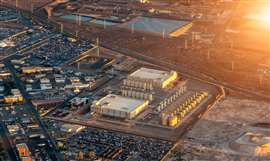 An aerial view of the large-scale Google Data Center in Las Vegas
STAY CONNECTED


Receive the information you need when you need it through our world-leading magazines, newsletters and daily briefings.

CONNECT WITH THE TEAM