Read this article in 中文 Français Deutsch Italiano Português Español
Report finds comms failures routine in crane, rigging and signaling operations

29 September 2026
A new report from the NCCCO Foundation and the National Safety Council’s Work to Zero program found that communication breakdowns during crane lifts are not isolated events but routine occurrences.
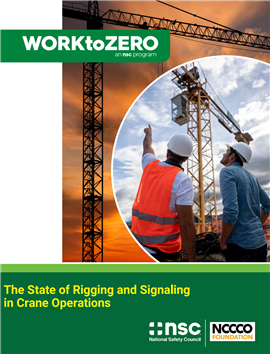
The report – based on a survey of 376 crane professionals, a literature review and in-depth interviews with industry veterans – examined how variability in training, signaling practices and organizational conditions shapes crane safety outcomes.
Nearly all respondents (98 percent) reported encountering a communication challenge within the previous 90 days, with weather interference, noise and line-of-sight limitations cited most frequently. Nearly half said communication failures led to full stops of lifting operations at least ‘sometimes’.
Nonstandard signaling practices emerged as a persistent problem. Fifty-nine percent of respondents identified inconsistent or nonstandard signals as a common challenge, with interview participants describing jobsite cultures where informal signals become normalized and newly trained signalpersons gradually adopt the habits of senior operators rather than standardized protocols.
“You teach them properly and they understand what the signal means, and then they get on the job site and they’re dealing with a crane operator who’s been in the seat for 20, 25 years,” one industry trainer told researchers. “Next thing you know, they’re just doing it the way the crane operator wants them to do it.”
Language barriers added a further layer of risk. Fifty-five percent of respondents reported encountering language barriers ‘sometimes’ to ‘almost always’ within the previous 90 days. Operators described developing improvised workarounds – inferring intent from context or using translation apps in real time – with outcomes that depended heavily on individual experience.
On the rigging side, the report found that unsafe practices are driven less by technical failures than by organizational conditions. Respondents identified inattention and distraction (49%), production pressure (48%) and poor supervision (47%) as the top contributors to rigging errors ahead of technical issues like incorrect equipment selection or load estimation. Fifty-two percent described lift planning as ‘last-minute’, ‘inconsistent’ or ‘absent’, even as 77% said their organization does not formally compromise safety for production schedules; a gap the report describes as a meaningful disconnect between policy and operational reality.
Certified riggers and signalpersons were consistently rated more effective than non-certified peers. Across eight core rigging competencies, roughly three in four respondents rated certified riggers as more effective. For signalpersons, certified workers rated higher across five of six competencies. However, that advantage nearly disappeared for nonstandard or site-specific signals, where only 37% rated certified signalpersons as more effective.
Neither riggers nor signalpersons are currently subject to federal certification requirements. OSHA requires only that they are “qualified”; a designation left to employer discretion.
The report recommends extending third-party certification to both roles, reinforcing standardized signaling as the default across jobsites, strengthening lift planning requirements and investing in multilingual training resources given Spanish-language workers now represent 34% of the USA construction workforce.
STAY CONNECTED

Receive the information you need when you need it through our world-leading magazines, newsletters and daily briefings.
CONNECT WITH THE TEAM