Read this article in 中文 Français Deutsch Italiano Português Español
When the ‘wrong’ crane falls first

09 September 2026
A decade of hurricane footage taught tower crane engineers an uncomfortable lesson: making one part of a crane stronger doesn’t always make it safer, it just changes where it fails.
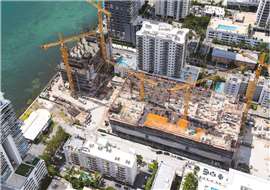 Morrow Equipment has had multiple tower cranes working at the Aria Reserve Project in Miami, FL.
Imagine two tower cranes working on the same project, tied to the same structure, riding out the same severe storm: one tops out at 400 feet, the other at 250 feet.
Take a bet on which one fails first in the surge, and most people would pick the largest crane: more exposure, higher top weight, etc.
But that gamble would be wrong more often than the industry might think.
Engineers who’ve reviewed hurricane failure footage say it’s frequently the shorter crane in a paired setup that goes down first, but not because it’s weaker. It’s because the shorter cranes often sit closer to the building face and catch lift-off force the taller crane (usually standing clear of that same wind shear) is less exposed to.
That finding synthesises what came out of a panel at this year’s Tower Cranes North America (TCNA) Conference, held June 10-11 in Nashville, Tennessee, USA. The panel was billed as “Wind, Weather and Rising Storms” and was moderated by JR Moran of Brasfield & Gorrie, and featuring structural engineer Rob Posch of Posch Engineering alongside Manitowoc’s Chris Noblit, director of engineering and service for tower cranes in North America, and Finnco Services owner Matt Finnerty.
The hour covered everything from crane selection, foundation design and storm preparedness in changing environments.
 Tower Crane North America 2026 “Wind, Weather and Rising Storms” panel. From left, Chris Noblit, Manitowoc; Matt Finnerty, Finnco Services; Rob Posch, Posch Engineering; moderator JR Moran, Brasfield & Gorrie.
Solve one weak link, another emerges
Perhaps the biggest takeaway is that solving yesterday’s problems seems to be creating new ones today.
Ask a structural engineer where a tower crane fails in high wind, and for years the honest answer pointed to the base. So, the industry built stronger bases, reinforced foundations, designed bigger masts.
Problem solved, right? Wrong.
“The last three or four cranes that failed in these high winds, they’ve been failing at the turntables,” Posch said. “It’s the next weakest length. So, if you make that stronger, it’s going to be the next weakest length [somewhere else in the structure].”
It’s a simple observation with a major implication: strengthening a crane component doesn’t eliminate the machine’s vulnerability, it just relocates it.
On the bright side, the industry has gotten better at reading its own breakdowns; largely because of relatively new (and now readily available) sources of evidence.
“Everything’s gone on camera now,” Posch added, noting they are now everywhere on a construction site. “And we’ve seen the cranes actually collapse in the hurricanes, [but] we can see where they’re failing, how they’re failing.”
In some cases, wind shifts mid-storm pushed cranes over at their slab connections, which isn’t considered a strength failure at any single point, but a directional failure: wind direction changes faster than a fixed structure can account for. Uplift force on the jib itself caused several documented failures over roughly the past six years, the panel noted.
But none of these instances are because the base was too weak. Instead, they were failures of assumption at set-up about where the load goes and in which direction.
Posch noted contractors are increasingly demanding stricter wind requirements on paper without always understanding what the equipment can physically deliver.
“We can make a base strong,” Posch said, “but then you still have this whole superstructure that’s not rated for high wind speeds.
“We’re still seeing failures at the upper part of the crane.”
A single number, doing too much work
 JR Moran, left, moderates a panel about tower cranes and severe weather with engineering experts at the 2026 Tower Cranes North America Conference in Nashville, Tennessee, USA, June 10-11. Photo: KHL Group
If there’s a villain in this story, it isn’t a component, it’s a number.
Every tower crane carries a wind rating: a single figure, usually expressed in miles-per-hour (MPH), that shows up on drawings, compliance documents and contractor checklists. It’s meant to communicate the extent of wind force a crane can withstand. The value is at the request of contractors, who want simple ratings to help them design and plan their build.
But the simplicity could be part of a larger problem. Perhaps the panel’s most candid moment was an acknowledgement that this number oversimplifies what’s a more nuanced situation.
“You have one value, one wind speed. It’s very difficult to try and put one wind number on a drawing,” Posch said, noting these don’t account for site-specific exposures. “It’s [more] about how that’s being applied to the crane [on that site].”
That’s because wind pressure doesn’t scale in a straight line with height. In real-time, Noblit worked through the math for a hypothetical 1,200-foot structure using a commonly cited reference wind speed of 175 mph at 10 metres; a typical set-up for South Florida code requirements. Noblit noted this ratio doesn’t translate cleanly to conditions at extreme height, where the pressure multiplier at elevation could effectively double what’s assumed at the reference point.
“It’s a considerably different wind speed up there,” he said.
It’s a nuance, he added, that isn’t always fully reflected in how lateral wind loads get calculated; a gap between the number on the page and the physics a crane 1,200 feet in the air actually experiences.
Standards are catching up
 Potain tower cranes on site in Tbilisi (Photo: Orbi Group Tbilisi)
Some of that gap may close soon, whether the industry is ready or not.
A new standard, EN/ISO 13001, is replacing the older EN 14439 industry wide. Under the old standard, manufacturers had a choice in how they calculated a crane’s wind rating – either from the side of the crane, or the front – with the front-load calculation substantially more conservative.
Under 13001, that choice disappears, and every manufacturer will now have to calculate from the front.
Converted to a practical figure, that shift brings the ultimate wind speed rating down slightly to roughly 97 mph, against a figure closer to 98 mph commonly used under prior ASCE 7 conventions.
The difference sounds small, but Noblit said it cuts in two directions at once: freestanding height capability will likely shrink somewhat under the new standard, while the crane itself gets meaningfully stronger against wind loading.
It’s a trade-off every manufacturer will be building to, whether a given project asked for it or not.
What’s known vs. unknown
JR Moran, left, moderates a panel about tower cranes and severe weather with engineering experts at the 2026 Tower Cranes North America Conference in Nashville, Tennessee, USA, June 10-11. Photo: KHL Group
Nothing here suggests tower crane engineering isn’t mature on wind risk. It’s quite the opposite. Base and foundation design is an established discipline, applied with real rigor project after project.
What this panel actually illustrated was more specific: an industry that has largely finished solving the failure mode it understood is only now building the vocabulary for the issues it’s still discovering: turntables instead of bases, the shorter crane collapsing instead of the taller one, a wind number that oversimplifies the very thing it’s supposed to communicate.
The industry’s preparedness and discovery now may save projects (and even lives) in the future. The standards will keep tightening, the footage will keep accumulating, and the next weakest link is presumably already out there, waiting for the next storm to hit.
STAY CONNECTED


Receive the information you need when you need it through our world-leading magazines, newsletters and daily briefings.

CONNECT WITH THE TEAM