Read this article in 中文 Français Deutsch Italiano Português Español
Why does crane capacity alone not confirm a safe and workable lift?

16 November 2026
When chartering for a project cargo much more than the vessel’s crane lifting capacity needs to be assessed, writes Konstantin Kalnyi
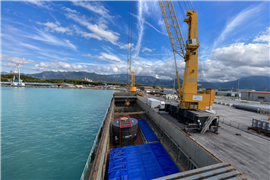 A heavy industrial unit being handled by shore cranes during a project cargo operation. Nominal crane capacity must be checked against the actual outreach, rigging weight and complete lifting sequence. Photo: Kiev Shipping Ltd
As with all crane types in all applications the nominal lifting capacity stated in a vessel description is only the beginning of the assessment.
Lifting using a ship’s cranes also requires additional or different considerations. Cargo geometry, crane outreach, rigging, stability, stowage position and conditions at the berth must all be checked before a heavy or oversized unit can be considered liftable.
When a cargo owner receives a vessel description showing cranes of 80, 120 or 250 tonnes, the immediate conclusion may be that any cargo unit below that figure can be lifted. In practice, the number stated beside the crane is not a final confirmation of lifting capability. It is only the starting point for a much wider technical and operational assessment.
A vessel may have sufficient nominal crane capacity and still be unable to load or discharge a particular unit safely. The problem may be outreach, cargo geometry, lifting points, rigging weight, stability, hatch dimensions, permissible deck loading or restrictions at the berth. These factors must be evaluated before the vessel is fixed, not after it arrives at the loading port.
Capacity depends on outreach
Like many other types, a ship’s crane does not normally retain its maximum lifting capacity throughout its entire operating radius. Its safe working load decreases as the distance between the crane pedestal and the load increases.
This makes outreach one of the first points to verify. The relevant question is not simply whether the vessel has a 150 tonne crane. It is whether that crane can lift the required gross load at the actual outreach needed to pick up the cargo, clear the ship’s side and place it in the intended position.
The required radius may be affected by the vessel’s beam, the position of the crane, the distance of the cargo from the quay edge and the selected stowage location. A unit positioned too far inland on the quay may require greater outreach than expected. At discharge, the available landing area may create a similar problem.
The crane’s load chart and operational limits therefore need to be examined. A headline capacity in a vessel description cannot replace this review.
Lifting more than the cargo
The total load on the crane includes more than the declared weight of the cargo itself. The weight of lifting beams, spreader frames, slings, shackles, hooks and other rigging equipment must also be included.
For a heavy unit, this additional weight can be commercially and technically significant. A cargo item weighing 95 tonnes does not represent a 95 tonne crane load if another 10 tonnes of lifting equipment are required.
Accurate cargo information is essential. The assessment should include the weight and dimensions of each unit, its centre of gravity, the position and capacity of its lifting points and any restrictions imposed by the manufacturer. Drawings and lifting plans should be provided where available.
Incorrect or estimated information can undermine the entire operation. If the centre of gravity is different from the position shown in the drawings, the unit may tilt after it leaves the quay. If lifting points are unsuitable or incorrectly located, the planned sling arrangement may not work.
Tandem complication
Two cranes working in tandem can increase the vessel’s lifting capability, but their capacities cannot automatically be added together as if they were one crane.
The share of the load carried by each crane depends on the position of the centre of gravity, the location of the lifting points, the geometry of the rigging and the relative movement of both cranes. Unequal load distribution can cause one crane to carry more than planned.
A tandem lift also requires co-ordinated crane movements and clear communication between the crane operators and the person directing the operation. The vessel’s approved operating procedures, crane load charts and applicable safety margins must be respected.
The assessment must therefore confirm not only the combined nominal capacity but also the permissible capacity of each crane at its individual working radius throughout the complete lifting sequence.
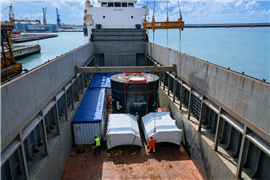 Oversized industrial equipment stowed inside a multipurpose vessel. Hatch access, stowage position, permissible deck loading and sea-fastening requirements must be assessed before the vessel is fixed. Photo: Kiev Shipping Ltd
Stability changes
A heavy lift can have an immediate effect on vessel stability. Once a cargo unit is suspended from the crane, the effective centre of gravity of the load is transferred to the crane’s suspension point. As the crane slews, the vessel may develop a significant list.
Ballast arrangements may be required to keep the vessel within acceptable stability and heel limits. The sequence of ballasting and de-ballasting must be co-ordinated with the crane operation, particularly during tandem lifts or when the cargo is moved across the vessel.
The lift should therefore be considered as a sequence rather than a single movement. Picking up the load, lifting it clear of the quay, slewing it over the ship’s side, lowering it through the hatch and landing it in its final position can each create different loads, radii and stability conditions.
Cargo fit and support
Successfully lifting the cargo over the ship’s side does not confirm it can be safely stowed.
Hatch dimensions, tween-deck clearances and obstructions inside the hold must be checked against the cargo dimensions and the required lifting orientation. A unit may fit inside the hold but still be unable to pass through the hatch opening with the necessary rigging attached.
The intended landing position must also be suitable for the cargo weight. Tank tops, tween decks, weather decks and hatch covers all have permissible loading limits. These may be expressed as tonnes per square metre and must be considered together with the dimensions of the cargo footprint and any supporting structures.
Grillage, timber, steel foundations or load-spreading arrangements may be required. Sea fastening must then be designed to protect the cargo against the forces expected during the voyage.
Lifting, landing and securing should therefore form one continuous transport plan. They should not be treated as three unrelated operations.
Berth conditions matter
Even a technically suitable vessel may face restrictions at the terminal. Available water depth, tidal variation, berth strength, quay layout and terminal safety rules can all affect the operation.
The cargo must be positioned where the vessel’s cranes can reach it. Sufficient space may be needed for trailers, self propelled modular transporter (SPMT) or other delivery equipment. The quay must also be capable of supporting the combined loads imposed by the cargo and transport system.
At the discharge port, the same questions apply in reverse. It is not enough to confirm how the cargo will be loaded. The landing area, onward transport arrangement and sequence for removing the unit from under the crane must also be ready.
Weather limitations are equally important. Wind can affect a large unit even when its weight is well within crane capacity. Cargoes with a large surface area may behave unpredictably when suspended. Rain, swell, poor visibility and vessel movement can impose further operational limits.
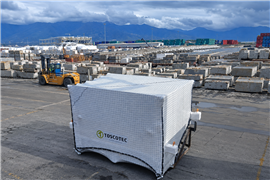 Project cargo being prepared for loading. Accurate dimensions, certified weight, centre-of-gravity information and suitable lifting points are essential for a safe and workable lift. Photo: Kiev Shipping Ltd
Clear responsibilities
The charter party and supporting fixture terms should clearly identify who is responsible for providing and paying for the lifting equipment, rigging design, lifting plan, survey attendance, specialist personnel, shore cranes and sea fastening.
The parties should also establish who supplies the cargo drawings and certified weights, who approves the lifting points and who bears the consequences if the information is incomplete or inaccurate.
Ambiguous responsibility can lead to delay, additional cost and disputes at the port. A vessel waiting while revised drawings, alternative slings or a different spreader beam are arranged can quickly generate substantial exposure.
The commercial fixture should therefore reflect the actual operational plan. Technical assumptions made during negotiations need to be verified before they become contractual commitments.
Confirm capability
A vessel should not be described as suitable merely because its nominal crane capacity exceeds the cargo weight. Suitability exists only when the complete operation has been checked: cargo particulars, crane capacity at the required outreach, rigging, lifting arrangement, vessel stability, hatch access, stowage position, deck strength, berth conditions, weather limits and allocation of responsibilities.
The purpose of this review is not to complicate the fixture. It is to identify incompatibilities while alternatives are still available.
Crane capacity opens the discussion. A safe and workable lifting plan completes it.
 Konstantin Kalnyi
About the author
Konstantin Kalnyi is CEO and founder of Kiev Shipping Ltd, a Ukrainian independent shipbroker with more than 25 years of experience in ship chartering and maritime brokerage. His principal areas of expertise are project cargo, breakbulk cargo and dry bulk cargo chartering. His practical background combines the perspectives of ship owners and commercial vessel managers with those of cargo interests and independent ship brokers.


CONNECT WITH THE TEAM