Read this article in 中文 Français Deutsch Italiano Português Español
Mammoet moves nuclear reactor components into position

13 February 2026
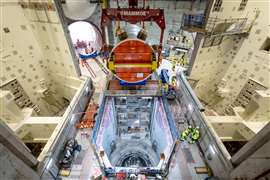 Moving componens into postion at nuclear plant (Photo: Mammoet)
In Somerset, UK, located in the south-west of the country, construction of the first in a new generation of nuclear power plants is underway.
The project involves some large-scale components, including the reactor pressure vessels and steam generators. Manufactured by Framatome, the company contracted Mammoet to manage delivery of these key elements.
Framatome required a technical solution that was not reliant on any pre-existing on-site lifting equipment. This was to ensure that the operation could be performed safely and to schedule, while other work continued around the site.
The biggest technical challenge for Mammoet’s team was how to deliver the components through a small opening in the reactor building.
“The congestion around the unit, and the spatial limitations within which we were required to perform our activities gave Mammoet an interesting challenge,” explained Darren Watson, Sales director at Mammoet.
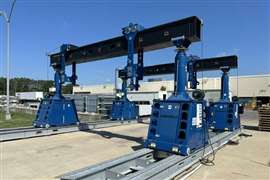
To achieve this, Mammoet’s engineers designed and constructed the OLS (Outside Lifting System). Using a combination of winches and strand jacks, the OLS lifted the components directly from SPMT and, as part of a controlled operation, lowered them onto a skid system enabling their transition into the building.
Typically, skidding systems are laid in straight lines. However, due to the shape of the reactor building, a 30-degree curve was needed. This would allow the components to enter the structure at the correct angle for subsequent installation.
This system incorporated a turntable – tailor-made to accommodate the transport saddles for the components - which allowed the units to be rotated as they traveled along the skid path.
Once moved into the building, the components were lifted and rotated from horizontal to vertical orientation before being lowered into their final installation position. For this operation, two Mammoet Temporary Lifting Devices (TLDs) were fitted to the existing polar crane.
The larger TLD, with a capacity of 600t, performed the main lifting operation using a containerized winch for the hoist. The second TLD, with a 320t capacity, used strand jacks to complete the reorientation of the loads.
This grid-powered solution also helped to reduce the carbon impact of the project, while a reduced noise level helped to provide a safer working environment.
“We engineered a solution, including a gantry system, which spanned from the identified pickup location and would bring the components to the required height for relocation into the building. This system also had to lift and maneuver these large sensitive components,” added Watson.
STAY CONNECTED


Receive the information you need when you need it through our world-leading magazines, newsletters and daily briefings.
CONNECT WITH THE TEAM