22 June 2026
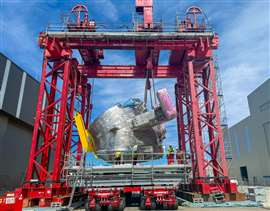 Mammoet’s temporary gantry crane with SPMT underneath the load, a 400 tonne segment of a giant vacuum vessel. Photo: ITER
In what was described as an outdoor ballet specialist international heavy lift and transport contractor Mammoet conducted an unusual operation of combined techniques.
The job was done under clear blue skies at the ITER project site in the south of France. ITER is an international scientific research project designed to demonstrate the feasibility of fusion power.
This latest installation involved lifting and rotating a large component using a temporary gantry crane erected for the purpose.
Mammoet set up the heavy lift hydraulic gantry near the entrance to the assembly hall. It was configured for the rotation of vacuum vessel sector #3 weighing 400 tonnes.
This was the third time ITER’s machine assembly team used the system for one of these components. Last time it was used because the assembly hall’s built-in heavy lift and handling equipment was already occupied with other installation work at the highly complex project. Instead of slowing down assembly and losing progress gains achieved with efficient operation, it was decided to bring in equipment and expertise to allow work to continue concurrently albeit outdoors.
Weather forecast
Being weather dependent was a risk but this latest all day operation, the third of its type, was completed smoothly, under strict safety conditions, ITER said.
On the first two sectors, temporary lifting lugs were welded to the components on site before rotation could begin. For this latest unit, the lugs had been welded on at the factory, thereby allowing the load to be rotated just six days after arriving on site, according to ITER.
After the rotation was completed, it was transported to a workshop on self propelled modular transporter for repair to its bevelled joint surfaces. These faces are where the sectors are joined by welding. Their accuracy is crucial because these joints are part of the project’s first nuclear safety barrier. Material is ground off where it protrudes and added in where it is insufficient before the sector is positioned with the others and the joints are fully welded.
About ITER
The ITER project under construction in Saint-Paul-lez-Durance, in the south of France, is designed to demonstrate the scientific and technological feasibility of fusion power. Fusion research is aimed at developing a safe, abundant, and environmentally responsible source of energy. ITER, the Republic of Korea, the Russian Federation, and the United States contribute equally to the remaining costs.
STAY CONNECTED


Receive the information you need when you need it through our world-leading magazines, newsletters and daily briefings.
CONNECT WITH THE TEAM