Read this article in 中文 Français Deutsch Italiano Português Español
Bridging the gap: cranes take on complex lifts across major projects

29 April 2026
Large-scale spans or small trusses, bridge work is proliferating across North America.
Border wall bridges
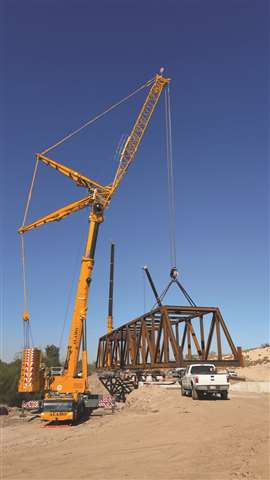 Alamo Crane Rental used its LTM 1300-6.2 to construct two steel truss bridges.
Alamo Crane Rental assisted in the construction of two steel truss bridges along the Texas border as part of the Laredo South Comanche Ranch Border Wall project. Each bridge site had five concrete beams and one steel beam. The concrete beams weighed 50,000 pounds (23 tonnes) each and required a 75 foot (23 metre) working radius. The 38,000 pound (17 tonne) steel beam required a 75 foot (23 metre) radius. Due to the job’s topography, it was necessary to tear down and rebuild Alamo Crane Rental’s 360 US ton (300 tonne) capacity LTM 1300-6.2 when moving from one location to another.
Months later, Alamo Crane Rental returned to the site to begin setting the components for the new bridges. Again, Alamo used its LTM 1300-6.2 to begin constructing the first of the two steel truss bridges. Their components were fabricated in Coolidge, Arizona, and delivered to the site on 10 legal truckloads.
The first steel truss was 120 feet (37 metres) long. Once the bridge was fully constructed, Alamo’s 770 ton (700 tonne) LTM 1650-8.1 assisted in setting the 290,000 pound (132 tonne) steel bridge using a team-pick maneuver, across a creek feeding into the Rio Grande River south of Laredo.
The second steel truss bridge was 195 feet (59 metres) long, weighing 315,000 pounds (143 tonnes). Again, using its LTM 1300-6.2, the Alamo team assisted its customer to assemble most of the bridge on false work that included “launching rails” and Hilman rollers. The launching rails extended 50 feet (15 metres) past abutment one and were supported by a pair of 400 kip (181 tonne) shoring towers on three drilled shafts. After the truss was assembled, the bridge was jacked up and lowered onto the 14 Hilman rollers.
The bridge design allowed the team to cantilever about 70 feet past the shoring towers. On the abutment two side of the creek, ACS’s LTM 1650-8.1 (with luffer) was set up on four drilled shafts about 20 feet (6 metres) in front of the abutment. The pick was started by gently pushing the truss until it was cantilevered about 45 feet (14 metres) past the end of the launch rails. At that point, the LTM 1300 flew a rigger, in a man basket, out to the abutment two end of the truss to rig the LTM 1650-8.1 to the truss. The truss was pushed another 20 feet before both cranes picked the piece and set it on its bearing pads.
Bridge girder setting
Setting 63 prestressed concrete girders across seven spans over an active Union Pacific rail corridor requires precise planning and the right equipment. With girders reaching 166 feet (49 metres) in length and individual picks approaching 95 tons (86 tonnes), Bigge Crane and Rigging’s project in Manteca, California, was expertly performed.
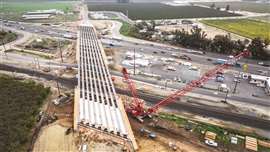 Bigge positioned a Manitowoc MLC300 in VPC-Max configuration as the primary crane
No two spans were the same, and each had its own set of challenges. One span had to be completed overnight within a hard railroad window. Others pushed the working radius well beyond what a standard lift plan could accommodate. Bigge’s team had to solve each challenge while keeping the project on schedule.
Bigge positioned a Manitowoc MLC300 in VPC-Max configuration as the primary crane, capable of handling picks up to 190,000 pounds (86 tonnes) and covering the majority of spans as a single-crane solution. Span 3 required a different approach. Bigge’s team paired the MLC300 with a Liebherr LR 1160, working nine girders simultaneously from opposite sides, the MLC300 at a maximum radius of 116 feet and the LR 1160 at 35 feet (11 metres).
Between spans, Bigge’s crews dismantled the MLC300 completely and remobilized across active Union Pacific tracks. The move was completed in two shifts without interrupting railroad operations.
Seven spans. Four crane configurations. Active railroad maintained throughout. The project was completed on time.
Mid-air splices, tandem picks
The Main Street bridge over French Creek in Saegertown, PA was recently replaced with a new 368-foot steel structure. All Crane Rental of Pennsylvania supplied heavy lift equipment for general contractor Mekis Construction on behalf of PennDoT. All deployed two all-terrain cranes to execute a series of carefully co-ordinated tandem picks. While each crane lifted its own steel girder segment, operators had to work in unison, positioning their beams simultaneously so ironworkers could complete mid-air splices.
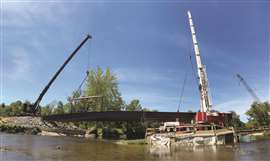 ALL Crane Rental of Pennsylvania deployed two all-terrain cranes to execute a series of carefully coordinated tandem picks.
“The beams met in the middle, partially resting on the bridge pier,” said All’s Mark Damich. “Each crane stayed rigged to its beam, supporting most of the weight while ironworkers completed the connections.”
A 550 US ton (450 tonne) Liebherr LTM 1450-8.1 was positioned at the south abutment with 139 feet (42 metres) of main boom at a 120 foot (37 metre) radius and full counterweight. On the north side, limited space required construction of a temporary causeway, allowing a 360 ton (300 tonne) Liebherr LTM 1300-6.2 to operate with 144 feet (44 metres) of main boom at an 80 foot (24 metres) radius.
Each crane lifted its girder segment from a flatbed (56,000 pounds on the south and 44,000 pounds on the north) then swung 180 degrees to set one end onto the pier. The cranes held the loads for up to two hours while ironworkers completed five separate splices. The resulting two-lane bridge features 11-foot travel lanes, 5-foot shoulders, upgraded guiderails and stabilized slopes, ensuring a safer passageway.
Night-time work challenges
At first light in South Texas, newly set bridge beams rest, quiet evidence of the region’s accelerating investment in infrastructure and mobility. By nightfall, jobsites glow under street lighting, cranes move with measured precision and the rhythm of overnight construction takes over. Sam Burrell of Sterling Crane USA reveals the beauty and dedication in night-time jobs and the planning and co-ordination required to execute it safely. (See photo below.)
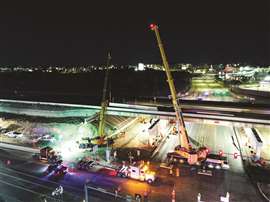 Sterling Cranes USA used its Liebherr LTM 1350 6.1 and Liebherr LTM 1130 5.1 to set bridge beams
Bridge beam placement remains one of heavy lifting’s most exacting tasks, where engineering, logistics and field operations must align within tight footprints and closure windows. Every lift reflects preparation: ground assessments, crane configuration, traffic control strategies and environmental considerations.
The process mirrors the broader infrastructure environment: deliberate, collaborative and dependent on multiple disciplines working in sequence. After dark, the emphasis shifts more visibly to safety. Lighting plans are designed to remove shadows at pick points and travel paths, access zones are controlled and clearly marked, and high-visibility PPE becomes part of a larger system of accountability.
Pre-lift briefings reinforce roles, communication methods and contingency procedures, while fatigue management and supervision levels are adjusted to reflect the added risk profile of overnight work. What the public ultimately experiences is a reopened roadway and a new span in place by morning, but behind that outcome is a carefully structured operation where safety planning is the framework that makes progress possible.
Sterling’s scope of work was setting bridge beams for new lanes of traffic. The beams were generally 99.5 feet (30 metres) long, with the heaviest beam weighing 120,500 pounds (55 tonnes). Some 30 beams were placed over a two-night operation. Cranes used included a Liebherr LTM 1350 6.1 and a Liebherr LTM 1130 5.1. The beams were rigged using PL13 black endless slings. Each night, from the time cranes were set up to the full rig down, spanned about 12 hours. The job was located just north of San Antonio, Texas.
Racing against time
As anticipation built for the inaugural Java House Grand Prix of Arlington, BOSS Crane and Rigging played a pivotal role in transforming the streets of Arlington, TX into a world-class racing venue. In preparation for race day on March 15, 2026, BOSS’ crews set a 57,000-pound pedestrian bridge over the roadway track, an infrastructure component designed to keep foot traffic moving safely. and efficiently.
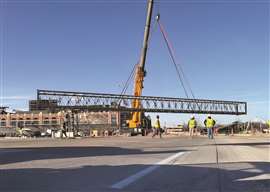 Spanning 140 feet, the structure was lifted into place using BOSS Crane & Rigging’s Liebherr LTM1160.
Spanning 140 feet in length, the structure was lifted into place using a Liebherr LTM1160 all-terrain crane. The bridge crosses a portion of the 2.73-mile street circuit that weaves through Arlington’s entertainment district, intertwining AT&T Stadium and Globe Life Field.
The lift was executed in the early morning hours to minimize public disruption. The highway was shut down and crews began to rig up around 4 a.m.
The pedestrian bridge is just one component of BOSS’ broader scope for the project. The team was also responsible for installing Pit Lane suites, two separate 202,000-pound club seating sections, and several grandstand sections strategically located around the 14-turns that make up the track. Each element required meticulous planning and strict adherence to safety protocols to ensure structural integrity and spectator safety.
BOSS’ sister company, Bennett Motor Express, played a key role by transporting concrete barriers and fencing materials to create a safety buffer between race cars and spectators. Once the event was over, the BOSS and Bennett teams dismantled and removed each structure, restoring the streets of Arlington back to business as usual.
he Don Welge Memorial Bridge is a major bistate infrastructure project underway to replace the aging Chester Bridge, a critical Mississippi River crossing that links Perryville, MO and Chester, IL, via Missouri Route 51 and Illinois Route 150. The original bridge, built in 1942 and repaired after storm damage in 1946, has struggled with structural limitations, narrow lanes and periodic closures due to maintenance and flooding.
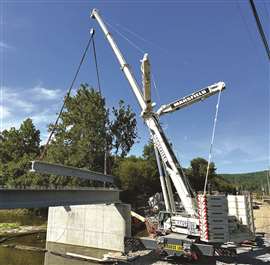 The Mansfield team utilized its 500-ton Liebherr LTLM 1400-7.1 to lift 100,000 pounds at an 80-foot radius.
Connecting communities
Mansfield Crane Service was tasked with lifting prestressed concrete beams over the Cohocton River in Corning NY. The Mansfield team utilized its 500-ton Liebherr LTLM 1400-7.1 to lift 100,000 pounds at an 80-foot radius.
The contractor built a causeway into the riverbed to allow setting two spans from one setup location. Each span consisted of five beams. The work was was accomplished in one 10-hour day. Using a larger crane decreased the overall time and interruption to work.
A critical crossing
The new bridge is intended to address these longstanding challenges and provide a safer, more reliable passage for the roughly 7,000 vehicles that use the crossing daily.
The bridge features a threetower, 2,900-foot-long cablestayed design built upstream from the existing 80-year-old structure. This modern configuration will significantly improve safety and capacity, offering two 12-foot lanes and two 10-foot shoulders, effectively doubling the width of the current bridge.
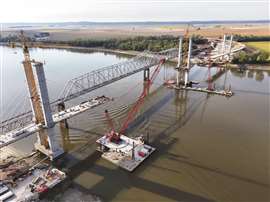 Morrow Equipment provided two Liebherr 630 EC-H 20/40 tower cranes and one Liebherr 550 EC-H 40 tower crane.
Beyond its engineering significance, the bridge carries meaningful community symbolism. It is named after Don Welge, a longtime Chester resident and a persistent advocate for replacing the aging structure. Welge championed the need for a safer and more modern crossing during the final 15 years of his life, and the memorial naming honors his dedication following his passing in 2020.
Morrow Equipment provided two Liebherr 630 EC-H 20/40 tower cranes and one Liebherr 550 EC-H 40 tower crane to Ames Construction for the project. Special tie-ins were required to enable two of the cranes to be centered between the main bridge pylons, in addition to the base towers anchored below the waterline on the bridge foundation piers.
“This, like almost all bridge jobs, required extensive planning and engineering work,” said Morrow’s Peter Juhren.
STAY CONNECTED


Receive the information you need when you need it through our world-leading magazines, newsletters and daily briefings.

CONNECT WITH THE TEAM