Read this article in 中文 Français Deutsch Italiano Português Español
Crane safety systems and artificial intelligence

10 August 2026
Artificial intelligence is supporting a new, dynamic set of safety systems for use on and around tower cranes – while others use a wholly physical approach. Julian Buckley reports
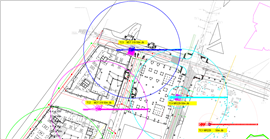 Potain’s Top Tracing 3 safety zoning system. Photo: Potain
In some cases the application of artificial intelligence has no clear benefit. Does your fridge need AI assistance? Maybe not. But for other more complex tasks the power of AI cannot be ignored. This is particularly true when looking at crew safety systems used around tower cranes.
Hong Kong-based ViAct offers machine- and system-agnostic safety platforms for a series of industries. For the construction sector, the company offers an automated AI system which analyses video in real time to both predict and react to potential danger.
Leveraging what is described as error-free progress tracking, using the ViAct video monitoring system across a building site can deliver a 95 per cent reduction in accidents. This, with a 70 % reduction in manpower costs.
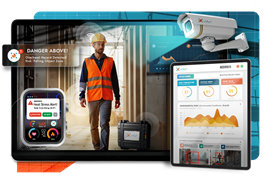 ViAct offers technology to identify heat stress in workers
Background analysis
The system works by taking video from existing CCTV and other sources and feeding that into on-site Edge AI processors, called ViMOV, which analyse the footage. A library of more than 200 computer vision modules helps to interpret what the cameras are relaying.
From this ViAct is designed to instantly recognise dangerous situations, including missing safety gear, unauthorised access and proximity to working machines. Should a violation or near-miss be flagged, the system sends an alert (audio and-or visual or mobile push notifications) to team leaders within one second. All AI-produced data is saved in the cloud for tracking or auditing.
In addition to the existing features, ViAct is now piloting an AI-driven heat stress management across construction sites in Singapore. The system can detect when a worker is reaching a heat stress threshold.
The pilot aligns with Singapore Ministry of Manpower guidelines requiring active monitoring of Wet Bulb Globe Temperature levels – wet bulb measures whether the body can shed heat effectively through sweat, which becomes problematic in high heat and humidity. Early deployments of the new ViAct feature has resulted in a 63 % reduction in heat-related medical cases and 95 % adherence to hydration and rest schedules.
Remote operator
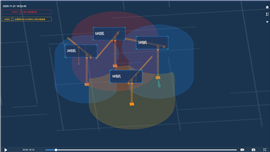 Glodon’s Smart Crane Guardian system. Photo: Glodon
Glodon is a China-based developer of systems using AI across a series of business sectors, including construction, building design, power and education.
Within this broad portfolio resides Glodon’s Smart Crane Guardian. Bringing together information from a network of sensors for AI analysis the system can prevent tower crane collisions. In addition, much like the system from ViAct, analysis of video from high definition cameras helps to eliminate human error and related safety risks.
A primary function is the anti-collision system. Before a crane can enter an overlapping work zone, the system alerts the operator and reduces speed; should the operation continue to where there is imminent danger of contact, the system can bring the crane to a full stop.
The Smart Crane Solution can go one step further – removing the operator from the tower crane. This has the operator working from a ground-level location with a dashboard showing multi-dimensional operations in real time.
With the intention of not only protecting workers but removing them completely from a heavy-lift environment, the system is said to improve both efficiency and safety.
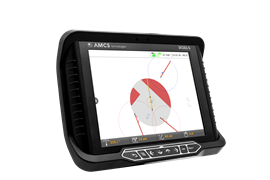 Interface screen for the DCS 61-S system from AMCS Technologies. Photo:
Mobile solutions
AMCS Technologies is a French company specializing in safety solutions for cranes and lifting operations. Since 1994 the company has been developing technologies designed to improve safety, productivity and operational efficiency on construction projects around the world. Its latest-generation DCS 61-S anti-collision and zoning system continues to be deployed on major construction projects and lifting operations worldwide.
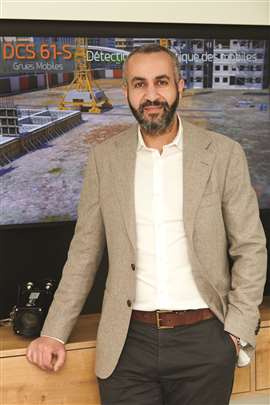 Radoine Bouajaj, AMCS sales director. Photo: AMCS Technologies
In an interview with Crane and Transport Briefing in 2025, Radoine Bouajaj, AMCS Technologies sales director, outlined the product development journey. “Our first anti-collision systems were designed to be reliable and user friendly. Over time we have evolved the technology to become more intelligent, precise and integrated. Each generation has improved safety, usability and adaptability.”
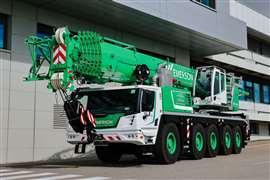
In addition to tower cranes, AMCS technologies can also be applied to mobile cranes. For these machines, the DCS 61-M system incorporates many of the same advanced safety functions found on tower crane applications, including the visualisation of potential interference areas and alerts to help prevent collisions.
Unlike tower cranes operating in relatively fixed environments, however, mobile cranes are regularly deployed to new sites where operating conditions can vary significantly. Each new location introduces its own set of obstacles, restricted areas and operational constraints, all of which must be taken into account.
To address these challenges the system combines multiple sensors and positioning technologies to continuously monitor the crane’s location and movements in real time.
The system uses high-precision multi-constellation GNSS positioning. No-go and restricted areas can be defined using geometric shapes and polygons. These predefined zones can then be activated or deactivated by the operator according to site requirements. This allows the system to manage operational and safety constraints throughout the crane’s working envelope.
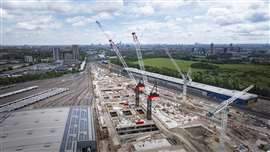 The new Buddie System is used by Marr Contracting with tower cranes on the HS2 construction site in the UK. Photo John Zammit
Buddie System offers physical safety link
The Buddie System is another crane safety technology where, instead of leveraging sensors and AI, this tool uses a more physical solution.
Instead of devices analysing data or video to spot a potential problem, the Buddie System relies on skilled site managers. If a situation is seen, a lanyard attached to a signalling device is pulled and this alerts the crane operator to initiate a pre-determined action (slow down, stop, etc.).
Up to 10 lanyards can be paired to a single crane-mounted alert device. Maximum range is about 1,000 metres and multiple devices can be active on a single site.
While the tech seems simple, the physical connection between the ground crew and crane operator removes any potential for a communication to be missed or misinterpreted.
Manufacturers also offer crane safety systems
 Potain’s TT3 system can cover up to 16 cranes. photo: Potain
Crane manufacturers are also offering tower crane safety systems. Case in point is the TT3 (Top Tracing) crane anti-collision system from Potain.
The system can support up to 16 cranes on one network, while also identifying and actively operating up to 30 prohibited areas.
Sensors pick up signals from RFID tags on the machine to determine and complete inter-crane management, including proximity limits. Other system features include hook height management in prohibited areas, travelling track management and wind speed detection.
If there are more than 16 cranes it is possible to add another radio frequency, plus TT3 is backwards compatible with the original TT1.
Potain TT3 is available for CCS (Crane Control System) self erecting and CCS top slewing cranes.
CONNECT WITH THE TEAM