Read this article in 中文 Français Deutsch Italiano Português Español
Engineered Rigging lowers 150-tonne falsework 60m for bridge replacement

07 July 2026
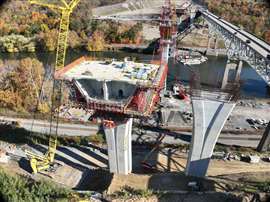 The Beaver River Bridge Replacement project in Pennsylvania, USA. Photo: Engineered Rigging
Engineered Rigging, headquartered in Indiana, USA, provided a synchronised strand jack system to lower falsework from concrete pier tables for the Beaver River Bridge Replacement project in North Sewickley Township, Pennsylvania.
The project is said to involve the largest contract in Pennsylvania Turnpike Commission (PTC) history. The PTC is the independent state agency that operates, finances and maintains the 565-mile toll road system known as the Pennsylvania Turnpike.
Fay, S&B USA Construction (Fay) served as general contractor on the reported $290 million (€254 million) project, which involved construction of two cast-in-place segmental bridges, each 1,645 feet long, 70 feet wide and 200 feet high (501 by 21 by 61 metres). The bridge site presented limited access, with no banks or road access to the river below.
The project required pier tables measuring 74 feet by 40.5 feet (22.5 by 12 metres) built atop each bridge pier as a foundation, with counterweight and anchor point for the equipment used to cast the concrete bridge segments. Crews erected falsework and pumped nearly 741 metres of concrete into formwork to build the tables. Once the concrete cured, the falsework had to be lowered as much as 60 metres so it could be disassembled at ground level – a process that had to repeat at each of six piers.
Engineered Rigging’s Enerpac solution
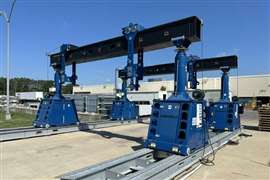
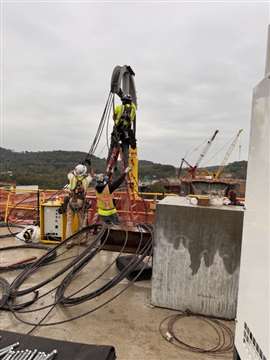 Workers position an Enerpac strand jack for the Beaver River Bridge Replacement project. Photo: Engineered Rigging
Engineered Rigging supplied four Enerpac 64-tonne strand jacks equipped with strand guides, powered by electric-driven hydraulic power packs connected to an up-station diesel generator. The system used Enerpac’s SCC-Smart Cylinder Control System, which let a single operator monitor and adjust load distribution across each jack in real time during the incremental descent.
Tim Sippey, Fay’s superintendent, said the computer-controlled models represented an upgrade over manual systems he had used previously. “We were able to complete the project with less manpower that is typically required for a job of this size,” Sippey said.
He also noted the first pier cap lowering took a full work shift; by the third pier, the crew completed the process in half a shift.
Austin Uric, project engineer at Fay who has worked on the Beaver River Bridge project for three and a half years, said the strand jacks’ performance and safety features reduced potential error in the lowering process.
Rental model
Fay rented rather than purchased the strand jack system, avoiding the capital outlay and maintenance overhead of owning high-capacity equipment built for a narrow range of high-precision applications.
The rental arrangement also gave Fay flexibility to scale deployment to the project’s needs; when construction of the eight pier tables paused, Engineered Rigging worked with Fay to leave the equipment on site until work resumed.
“[Renting] gave the contractor flexibility to scale the deployment to the project’s specific needs. Up front conversations about a pause in construction of the eight pier tables allowed Engineered Rigging to work with Fay to leave the equipment on site until work resumed,” Engineered Rigging said.
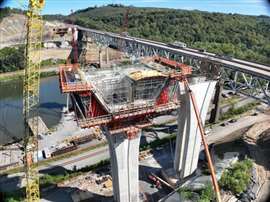 The Beaver River Bridge Replacement project in Pennsylvania, USA. Photo: Engineered Rigging
STAY CONNECTED


Receive the information you need when you need it through our world-leading magazines, newsletters and daily briefings.
CONNECT WITH THE TEAM