Read this article in 中文 Français Deutsch Italiano Português Español
Hoist rope innovation to fix a pain point

24 November 2025
A high-performance hoist rope is crucial to the safety and efficiency of crane operations.
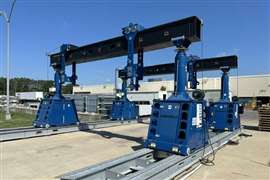
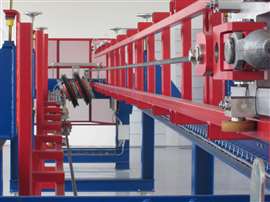 Test rig for the new Casar Lazerlift hoist rope. Photo: WireCo Casar/Tadano
As lifting demands escalate, engineering breakthroughs in rope design, for example, resistance to rotation, are pushing the industry into a new era of reliability and performance.
In addition to strength, heavy lifting requires precision, consistency and longevity. For global crane manufacturers like Tadano, these demands are compounded by increasingly extreme working environments, particularly in renewable energy projects where, for example, the height of wind turbines continues to rise.
Traditional rope types have been approaching their limits, especially in applications involving repetitive cycles and multilayer spooling. A new rope was needed. Tadano turned to its long-term rope supply partner for a solution. It started using a new rope, Casar Lazerlift, described as a next-generation hoist rope. Developed by WireCo, it is designed to confront the mechanical stresses of wind turbine erection and heavy-duty lifting. Lazerlift offers a combination of high line pull, low weight and superior spooling behaviour, the company says, marking “a notable shift in how cranes can be engineered for both performance and longevity.”
Engineering against failure
Multilayer spooling is a notorious challenge for crane designers. In wind turbine erection, where operations involve repetitive and cyclic lifting over extended periods, even ropes rated for high performance begin to show premature wear.
Tadano engineers observed these effects first-hand. “For mobile cranes, a high line pull at minimum weight and acceptable lifetime is key to success as they are not designed for duty cycle operation,” Alfons Weckbecker, manager design crawler cranes at Tadano, says. “High line pull reduces necessary reeving and avoids inefficiency in a reeving system. Minimum cable weight reduces weight in hook blocks and other related components.”
The issue, however, became acute when lifetime limitations of existing ropes like Eurolift and Starlift began to surface under real-world conditions. “We became aware of lifetime issues in multilayer spooling,” Weckbecker notes. “This issue is not new and is known by most crane and rope manufacturers. This is unfortunately not the case with the calculation of the effects of multi-layer spooling in the latest version of the ISO 16625; I am very dissatisfied with this from a standardisation perspective.”
The root of the problem lies in the interaction between rope design and usage pattern. Repeated cyclic loads, combined with tight spooling geometry and heavy payloads, concentrate stress points within the rope body. Over time, this leads to internal degradation and wire breakage, often long before the rope reaches its rated capacity. The result is a shorter service life, unpredictable maintenance cycles and, in the worst cases, premature replacement during critical operations.
Despite repeated attempts over the last decade to find a solution, no supplier had been able to meet Tadano’s needs, the company says. Under pressure from a customer to resolve durability issues, Tadano turned to WireCo. This time, the response was different.
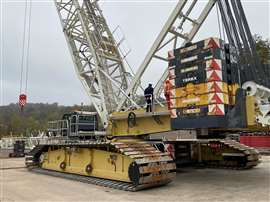 Tadano heavy lift crawler crane used for testing the new rope. Photo: WireCo Casar/Tadano
Pressure of testing
WireCo’s development team was already investigating the problem independently and was ready with a proposal for joint testing. “They showed their latest ideas and asked for the possibility to co-operate for testing this new development on a Tadano crawler crane,” Weckbecker recalls.
This co-operation materialised in a controlled cyclic testing programme, replicating the customer’s operating conditions and comparing the damage behaviour of Lazerlift against previous rope types. The results were definitive. As forecast by WireCo’s experts in development of special wire ropes, the lifetime in the test environment by far exceeded the cycles reported by the customer before the first wire damage.
This was not a marginal improvement. The difference in durability shifted Tadano’s view on rope selection for heavy-duty use. “We decided instantly to take over this rope type in cranes specialized for windmill erection business, i.e. CC 38.650-1 or CC 78.1250-1,” Weckbecker adds. “Over the next few months and years, we will observe whether the rope proves itself in real-life use and then decide whether we will also use it on other crane types.”
The rationale behind this decision was both pragmatic and strategic. It was not only about addressing a current challenge, but also about establishing a platform for future crane models to meet growing market expectations for uptime, safety and operational economy.
Efficiencies and costs
Tadano’s decision was not only about solving a technical issue. It was also about reshaping the lifecycle economics of crane operations. In high-intensity applications, every damaged rope introduces risk, cost and operational downtime.
“We expect that the Lazerlift rope enhances the rope lifetime in multilayer spooling in general, especially in repetitive cyclic lifting applications, and reduces the total cost of ownership of the rope and crane,” Weckbecker explains.
Longer-lasting ropes do more than reduce replacement costs. They enhance operational predictability. Every unplanned rope replacement means unplanned crane downtime, lost productivity and, often, reputational impact. In the high-stakes world of infrastructure construction and wind energy logistics, these disruptions have real financial consequences.
Lazerlift’s longer life is built into the design. Its structure combines internal strands with a reinforced core and a distinctive 5+1 outer strand configuration. This geometry resists the kind of radial pressure and internal twisting that typically degrades ropes in multilayer spooling. It is also designed to retain breaking strength under severe cyclic load, ensuring even under punishing conditions, the rope maintains performance and safety thresholds.
The company points out the above qualities are not delivered at the expense of handling or compatibility. WireCo’s engineering considers drum winding systems such as Lebus grooving, where diameter tolerances must be exact. Production tolerances are refined to work seamlessly within such constraints, ensuring the rope not only lasts but behaves predictably within the crane’s mechanical system.
Tough performance
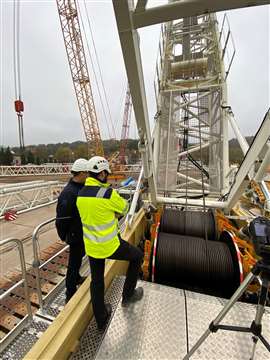 Testing the Lazerlift rope spooling in multiple layers on a Tadano crawler crane. Photo: WireCo Casar/Tadano
The successful rollout of Lazerlift was not just the result of product innovation but of proximity and collaboration. Tadano and WireCo have maintained a close technical relationship for decades, reinforced by their geographic proximity in Germany. That alignment proved critical in a moment of urgency.
“The co-operation with WireCo, located in Kirkel-Limbach near our facility, is a strong and proven co-operation over decades,” Weckbecker says. “They support us in any requests and issues. For the issue described before, nobody offered a solution in the last decade. We were therefore surprised that they had been working on the subject for years and were able to offer us this new rope development when we were under pressure.”
That level of responsiveness is a rare advantage in an industry where the pace of innovation often lags operational need, WireCo says. While many suppliers reacted to Tadano’s challenges with standard product options, Wireco says it had already anticipated the issue and invested in a proactive solution.
The result is not just a better rope but a stronger foundation for shared innovation. With Lazerlift entering serial production and the first cranes reaching deployment, both parties now have a reference point to build on. Feedback from the field will shape future iterations. Real-world data will refine specifications. A proven collaborative model will serve as a blueprint for future product development.
Durable solution
For Tadano, the introduction of Lazerlift marks more than a technical success. It is a validation of long-term engineering values, trust, testing, and precision design. The performance gains achieved in testing are meaningful. Still, the real outcome is strategic: a product positioning them to meet the evolving expectations of customers across wind energy, infrastructure and heavy industrial construction.
For the industry at large Lazerlift is a reminder that some of the most important innovations are hidden in plain sight. “Hoist ropes may not headline trade shows or investor presentations but they underpin the very mechanics of safe, efficient and scalable lifting,” the company says.
Tower heights keep increasing, turbine weight increases and deployment timelines tighten, so the pressure on every crane component will grow. Ropes bearing those loads will be expected to do more than ever before. Lazerlift may set a new benchmark.
A real-world pain point was identified and Tadano validated a solution, implementing it where it matters most.
STAY CONNECTED


Receive the information you need when you need it through our world-leading magazines, newsletters and daily briefings.
CONNECT WITH THE TEAM