Read this article in 中文 Français Deutsch Italiano Português Español
Industrial lifting: think big, build small

23 March 2026
With job sites increasingly cramped and projects more complex, manufacturers of industrial lifting equipment are developing compact and innovative solutions. Daniel Searle reports.
Job sites are increasingly cramped and projects continue to get more complicated so manufacturers of industrial lifting equipment are working hard to develop compact and innovative solutions.
Italian crane manufacturer Ormig’s portfolio focuses on fully electric pick and carry cranes, engineered for handling heavy loads and moving machinery – often in the increasingly confined spaces of industrial settings.
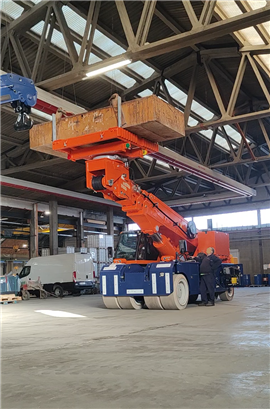 Ormig 100iE with self-levelling platform attachment. It can be used to handle all sorts of loads, like this large flat crate. Photo: Ormig
A key focus in overcoming space limitations is optimising the ratio of lifting capacity to crane dimensions. “This is the foundational technical concept shared across Ormig’s modern electric fleet,” says the company’s technical department. “The company’s primary goal is to offer the best lifting capacity within the minimum dimensions possible, allowing the cranes to solve the most challenging situations.”
The current range includes cranes with maximum lifting capacities from 15 to 100 tonnes, with all models measuring between 1.84 and 2.44 metres wide.
As well as keeping the machines relatively small, another consideration when manufacturing indoor electric cranes for potentially cramped industrial sites is manoeuvrability.
“Our cranes are engineered to steer in a perfect circle, ensuring a minimum steering radius,” says Ormig. “This is made possible by the Ormig patented steering mechanism. This system allows the crane to rotate around the front axle, always keeping four groups of wheels in contact with the ground.
“The rear steering wheels maintain their position at the extreme corners of the chassis even during full steering, providing a wider area of contact that maximises lateral stability when manoeuvring with a load applied.”
To further assist in tackling a wide range of jobs, Ormig cranes can operate in various configurations, depending on the number of modular counterweights installed.
“The base machine configuration is kept lightweight for easy transportation by truck across every country without the need for special permits,” says the technical team. “Lifting capacity then increases gradually up to the maximum capacity by adding these detachable counterweights.”
The company has also recently introduced its hydraulically-operated tilting boom head, which provides up to 90 degrees of movement at full hydraulic power. This enables the final part of the boom to open and handle the crane’s maximum capacity autonomously, even under load – giving improved access to difficult-to-reach locations, narrow corners, and areas close to the ceiling.
Attachment innovation
To assist with industrial lifting work, Ormig patented an attachment for the top of the boom of its heavy-duty crane models. The hydraulically-operated and self-levelling platform is designed to handle heavy loads by lifting them from underneath, rather than above.
“This tool is particularly helpful when installing or dismantling overhead cranes inside of industrial sites or any other object that can’t be picked from above while needing to be rotated in position,” says Ormig’s technical team.
“In many cases, cranes owners and machinery relocators used to build a bulky support to be added on their more classical forks fixture; this could mean using a non-optimal solution in terms of safety and operability.
“We were able to invent this more practical system thanks to the hydraulic head of our cranes, which we were first to develop on our pick and carry electric cranes.
“The head itself takes care of the levelling of the platform while derricking the boom.”
The company outlines a typical scenario in which the attachment makes the installation of an overhead crane straightforward. The crane would firstly bring with it the stand and the platform, then place the overhead crane on top of the platform that is awaiting on the stand, before self-mounting the platform itself on the hydraulic head of the boom.
The crane then lifts the overhead crane and places it on its rails, utilising the hydraulic rotation capabilities of the platform. These same steps can be performed in reverse to dismantle an overhead crane, or any other object that can’t be picked up from above.
Interchangeable boom
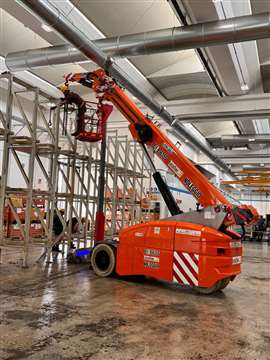 The battery-electric V130RX industrial pick and carry crane from Tadano Valla fitted with a basket to make it into an aerial work platform. Photo: Tadano Valla
As well as being designed to be as compact as possible, fellow Italian manufacturer JMG’s recently-launched electric pick and carry M Series cranes feature an innovation to maximise versatility.
The series which comprises the MC 15.08 and MC 100.08, incorporates an interchangeable boom system, enabling each model to be quickly and easily equipped with a single boom, manual extension or jib, fork, or hydraulic jib.
“With a lightweight, modular chassis compatible with short arms, single extensions, jibs, forks, or booms, the MC 15.08 was conceived as an open technical platform – configurable according to the task, not as a fixed model,” explains JMG.
“The result is a crane that can transform in just a few minutes – from a precision tool for industrial assembly to a logistics unit with forks, or a lifting solution with articulated jib.
“A versatility that reduces operational costs, simplifies fleet management, and maximises return on investment.”
This same approach is applied to the MC 100.08, which has a capacity of 15 tonnes, compared with the 5 tonne capacity of the MC 15.08.
Designed for tight job sites such as industrial corridors, workshops, and logistics centres, the MC 15.08 is just over 2 metres long, 1.1 metre wide, and 1.6 metres high, with a chassis extendable by 400 mm.
JMG describes the cranes as “designed to tackle complex operational challenges in increasingly tight spaces”, while still providing load capacity and operational flexibility.
Complexity and safety
In addition to the challenge of tighter working spaces, Tadano Valla identifies two further factors influencing what end-users demand from crane manufacturers.
“Once regarded as a specialised niche, the pick and carry crane market is now undergoing a phase of rapid growth and transformation,” says the company. “Increasing industrial complexity, tighter working spaces, and higher safety expectations are pushing manufacturers to rethink both product ranges and technology.”
The Italy-based manufacturer was acquired by Japanese crane giant Tadano in early 2025, with the move helping the company meet new demands. “Within this evolving landscape, Tadano Valla has emerged as a stronger and more complete player than ever before, combining its long-standing expertise in electric pick and carry cranes with the industrial scale, engineering resources, and global vision of the Tadano Group.”
The manufacturer’s goal is to expand its range while remaining faithful to the traditional Valla philosophy, which is to prioritise compact dimensions, precision, safety, and reliability in demanding industrial environments.
To this end, the company introduced its heavy range of pick and carry cranes, with capacities from 35 to 50 tonnes. These models, the company notes, bridge the gap between standard industrial handling equipment and lifting machinery for heavier, more complex projects – while maintaining the manoeuvrability essential to the sector.
Tadano Valla’s production focus is on its 4.6 and 20 tonne models – its most popular cranes. But demand is growing across its entire range, says Valla chief executive Paolo Balugani, “We are growing quickly, possibly faster than the market as a whole. Last year we manufactured between 80 and 90 units, and Tadano is looking for us to increase production further.”
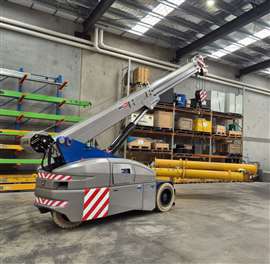 Tadano Valla’s V130RX provides both lifting and access capabilities. Photo: Tadano Valla
Additional features
Tadano Valla’s latest generation of cranes for industrial lifting incorporates innovations to improve ease of use and efficiency.
“We have also introduced a system to monitor oil contamination, which warns operators when oil changes are required, as well as a new self-installing counterweight system,” says Balugani. “When it comes to the telescopic system, the Valla way is direct hydraulics – no cables or chains. This is a key advantage for maintenance and, importantly, for boom stiffness.”
A touchscreen has been added in the crane cabs – and is also available on the remote control transmitters – providing detailed operating data.
“One of the cranes’ key patented features is a ground pressure monitoring system on the wheels, enabling operators to see the load on each wheel and the ground pressure being applied, with an alert when maximum capacity is reached to help prevent floor damage,” says Balugani. “Cranes like these are aimed at machinery and industrial movers, as well as heavy-haulage operators.”
Also beneficial is the cranes’ modular construction, which enables many components – including several new technical features, including a disc braking system – to be shared across all the models, assisting the sourcing of spare parts.
The hydraulic system uses variable-displacement piston pumps driven by an electric motor, with the combination providing a 20 per cent improvement in battery life.
More productive
Investing in the right equipment for the job led to immediate productivity gains for a concrete components manufacturer in the USA.
Advanced Precast Company makes full use of its new rubber tyred gantry (RTG) crane, both to lift and transport the structural and architectural prestressed concrete products it makes at its Iowa factory.
It recently added the Shuttlelift DB50 RTG crane.
Since 2008 the company has expanded to now occupy a 70,000 square-foot facility with four casting lines. “We are a small facility, but we are fast in how we operate,” said Randy Anderson, director of operations.
As business expanded, the need for a new gantry crane became increasingly clear. Their DB50 includes several features found invaluable to operators and maintenance staff, Anderson said.
He noted Shuttlelift’s large cabin which he described as “a nice working space for our operators.” The maintenance team also likes the benefit of being able to access and service critical components thanks to the low-mounted hoist design.
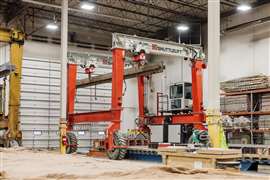 The Shuttlelift DB50 rubber tyred gantry crane helps Advanced Precast Company streamline its material handling processes. Photo: Shuttlelift

CONNECT WITH THE TEAM