Read this article in 中文 Français Deutsch Italiano Português Español
Different approaches to cranes and lifting for data centre construction

04 November 2026
Data centres are becoming a common fixture across the world, and different regions have different approaches to the lifting equipment used. Daniel Searle reports
The recent surge in the use of artificial intelligence (AI), along with online ‘cloud’ storage, are just two drivers behind increasing investment in data centres.
Expansion of the sector has been so sharp that, according to the 2026 report from global think tank International Data Center Authority (IDCA), data centres now have a total footprint of 67.7 GW – a growth of 36 per cent over the last two years – and they consume 2 % of the world’s electricity.
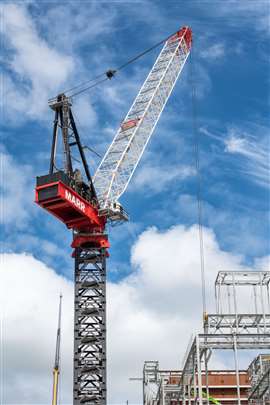 Marr Contracting’s approach to data centre construction is to deploy a smaller number of high capacity tower cranes, including this Favco M2480D. Photo: Marr Contracting
The IDCA identifies the USA as by far the world’s largest country for data centres. China and Germany follow, in terms of terawatt-hours consumed by the nations’ data centre grids.
Australia is a growing region for the sector too, with its network using as much electricity as Japan’s or the United Kingdom’s, says the IDCA.
Despite how common the facilities are becoming, the construction of each data centre requires planning and expertise from those involved, especially the lifting partners.
Marr Contracting has been working on data centres for almost a decade and is now engaged on more than ten large-scale data centre projects across Australia and mainland Europe. Its methodology, says the company, has helped its clients to deliver projects in half the average time.
“The first time we were asked to look at craneage on a data centre, our client told me they were struggling with competing critical paths: installing in-ground water, power and communications services while also needing to build vertically,” says Simon Marr, Marr Contracting managing director.
A move towards heavy precast elements and structural steel required a high-capacity crane solution, the company explains, while the extensive in-ground services made a traditional mobile or crawler crane approach increasingly difficult. The project was becoming a compromise between progressing the in-ground services and constructing the structure, resulting in programme delays.
“We could see that the construction methodology could deliver a faster, safer build. What was needed was the right crane solution to unlock it,” says Marr.
Towers of power
 Simon Marr, managing director at Marr Contracting: “The first time we were asked to look at craneage on a data centre, our client told me they were struggling with competing critical paths.” Photo: Marr Contracting
The company therefore proposed an alternative approach: using fewer, higher-capacity tower cranes positioned to service the entire site and lift larger components, thereby enabling vertical construction and in-ground services to progress concurrently.
By removing the interface between mobile cranes – which required multiple positions around the site – and the ongoing installation of in-ground services and replacing it with high-capacity tower cranes in fixed locations, both critical paths could progress simultaneously.
The result was a halving of the construction programme while substantially reducing programme risk, the company says.
Today, the approach is enabling clients to adopt greater levels of off-site fabrication and modularised construction, with fewer cranes, less congestion on site, and safer, faster construction, the company adds. It also supports the installation of the large volumes of mechanical equipment required later in the construction programme, which is key to fit-out and commissioning.
This method was illustrated earlier this year at NextDC’s S4 Sydney data centre development, where contractor Multiplex, with support from Marr Contracting, deployed the first M2480D tower crane – one of three M2480Ds planned for the site, along with two M1280Ds and an M860D. All the models are manufactured by Favelle Favco.
The 330 tonne capacity M2480Ds were chosen to install prefabricated and precast elements, including lift cores, electrical switch rooms, and mechanical plantrooms. The cranes are configured in a two-fall arrangement with a 30 metre fly jib extension, and each crane can carry out a 22 tonne lift at a 102 metre radius, representing the first time Multiplex has engaged cranes of such capacity on any project worldwide, Marr says.
Another of NextDC’s Australian data centre developments, the M2 Melbourne project, also deployed a high-capacity tower crane: an M2480, described by contractor Kapitol as the world’s largest luffing-jib tower crane. It was configured at the site with a 55 metre jib in a two-fall hoist arrangement, enabling lifts of up to 110 tonnes – or around 72 tonnes at full radius. The crane was selected to install rooftop plant across the facility, including generator modules, battery enclosures, and transformer units.
Inside and out
USA-based crane rental company Maxim Crane Works cites data centres as one of its areas of activity, noting the schedule pressure associated with the projects is typically much greater than standard commercial building work. This is partly because capacity at the centres is often leased before construction commences, making any delays potentially costly.
Therefore, the optimum selection of crane services, says the company, is less to do with equipment availability and more about the alignment of the lifting strategy with a critical delivery schedule.
The types of cranes used differs according to each phase of the construction, with crawler cranes deployed for heavy structural steel components; all terrain cranes for mechanical and precast lifts; tower cranes for constrained or vertical sites; and boom trucks for commissioning work.
The company also identifies another difference between the construction of data centres and conventional commercial buildings. The mechanical weight and density of the components installed in data centres – such as generator sets, chiller plants, cooling towers, and switchgear – are often supplied as prefabricated modules with higher single-lift weights than those typically found in office or retail projects.
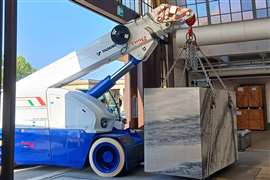
For the indoor work, Texas-based crane and heavy haul company Rhino Specialty Services highlights the capabilities of its fleet of Jekko mini cranes.
Also noting pressurised schedules are typical in data centre projects, the company mentions its cranes are suitable for tight spaces, fitting through standard doorways and operating in constrained server hall access points.
Typical indoor tasks include server rack placement and relocation; the setting of HVAC units, and CRAC and CRAH cooling systems; UPS and battery cabinet positioning; and lifting generator switchgear inside the building shell. As a further benefit, the company’s electric Jekko cranes eliminate emissions, thereby keeping indoor air quality compliant and meeting GC environmental specifications.
The mini cranes are also used on outdoor and structural work, such as the lifting of cable tray and bus ducts; placement of transformer and generator pads; and the setting of units on rooftops, for example, chillers, condensers, and dry coolers.
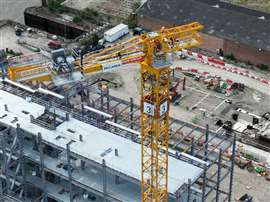 Radius Group supplied and erected four Potain tower cranes at the Ada Infrastructure data centre project at London Docklands. Photo:
Data in Docklands
UK-based Radius Group supplied and erected four tower cranes at the development of a new multi-storey data centre in London Docklands.
When completed, the campus – established by data centre company Ada Infrastructure, in what represents its first development in Europe – will house three 70MW data centre buildings. McLaren Construction has been awarded a shell and core contract – due to be completed in mid-2028 – to build the first of these, as well as the infrastructure for the whole campus and the interface for a future district heating network.
The project also features a community multi-purpose facility, enhanced public spaces around the site including improved pathways for pedestrians and cyclists along the River Thames, and repairs and improvements to the Thames River wall including a new flood defence barrier.
Radius Group supplied the site with three new Manitowoc Potain MDT 569 M25 tower cranes – delivered from the manufacturer’s facility at Moulins, France – and a Potain MDT 809 M25 from Belgium.
The erection programme was faced with certain logistical challenges where all four cranes were subject to the operational restrictions of London City Airport. Two of the cranes were particularly affected, requiring their entire top kit to be erected withing a restricted window between 13.00 on a Saturday and 10.00 the following morning. These operations required careful planning and co-ordination to accommodate the airport’s operational requirements.
Crane components were sourced from locations across Europe, including mast sections from France, Belgium, Ireland, and the UK, with counterweights coming from Germany. The co-ordination of the deliveries of these parts with the scheduled erection windows required detailed planning and collaboration between Radius, the client, suppliers, logistics partners and the site team.
Beyond the tower crane installations, Radius Group’s Plant Installation division is also supporting the project with the specialist lifting and positioning of mechanical and electrical infrastructure. This wider involvement demonstrates the company’s ability to provide integrated lifting solutions across multiple stages of complex data centre construction projects.
Radius Group’s experience in the data centre sector extends beyond the UK to Belgium, Netherlands and Norway, reflecting the company’s growing involvement in data centre construction.
CONNECT WITH THE TEAM