Read this article in 中文 Français Deutsch Italiano Português Español
Tower cranes: a big part of the digital future

15 June 2026
Owners are benefiting from the increasing capabilities of digital technologies, including remote support, data gathering and operational assistance.
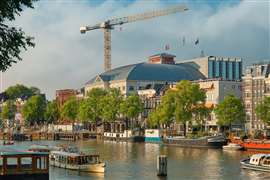 A 370 EC-B 12 Fibre tower crane from Liebherr, fitted with fibre rope, at work in Amsterdam on the inner-city hotel project Amstel 111. Photo: Liebherr
From watches and televisions to fridges, ‘smart’ technology has been incorporated into all manner of sectors and applications in recent years. The tower crane sector is no different, with digitised support and data collection two of the more common features being added to the latest models.
“Expectations have expanded dramatically,” says Dr Mohamed Abouelezz, head of business development and product management at Germany-based Wolffkran.
“Our customers no longer want a pure equipment supplier; they want a partner who understands the whole process and thinks beyond the machine itself. This shift means support now goes far beyond delivering a tower crane. It includes comprehensive deployment planning, site logistics support, simulation of construction workflows, and operator training – particularly on digital assistance systems such as Wolff HiSPS, our anti-sway solution.
“Equally important is high-performance on-site service with rapid response times. Wolffkran addresses this demand with solutions such as Wolff Assist, a digital remote maintenance system that is voice-controlled and hands-free via smart glasses, enabling faster diagnostics and support directly on site.
“We also observe another clear trend: customers are demanding more data, transparency and connectivity from their cranes. With Wolff Link, we provide real-time insight and diagnostics that help optimise operations and improve decision-making. In addition, our newly launched Wolff Cam – a hook-mounted camera system – further enhances visibility on site while meeting the growing demand for transparency and improved operational control.”
Philipp Weckerle, head of product management at Liebherr, says, “The market is becoming increasingly competitive, with manufacturers from China and India rapidly expanding their tower crane offerings. At the same time, the pace of technological advancement remains high. One of the most significant trends in the European market today is the growing focus on remote connectivity and data collection from tower cranes, aimed at improving both safety and operational efficiency.”
Thibaut Le Besnerais, vice president of marketing and development for tower cranes at Manitowoc, also identifies digitalisation as an important trend.
“Digitalisation is a key factor in shaping the market,” he says. “Through our Potain Connect telematics platform – available across our European range – customers can access real-time data on crane utilisation, monitor performance, and plan maintenance more effectively, ultimately helping to reduce downtime and improving return on investment.”
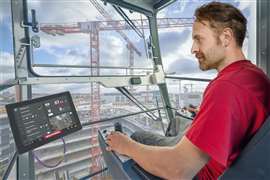 One of Wolffkran’s recent digital innovations is the Wolff Cam, a hook-mounted camera system that provides footage in the operator’s cab. Photo: Wolffkran
Operator support
The latest smart technology in tower cranes isn’t just about data – advances are also helping the operator.
Liebherr, for example, has introduced operator assistance systems in its K-series self erecting tower cranes.
“These features include functions such as Sway Control, Vertical Line Finder, Positioning Pilot, Guided Hook and Sway Control Plus,” says Weckerle. “Currently, around 70 per cent of customers opt for these systems when purchasing self erecting cranes.
“The overarching goal is to allow crane operators to concentrate fully on the load itself, rather than on constantly adjusting crane movements. Even highly experienced operators must manage multiple tasks simultaneously, and these assistance systems are designed to reduce that burden ultimately enhancing both safety and efficiency on construction sites.”
Fibre revolution
Beyond digital developments, sustainability is also valued by tower crane customers, says Abouelezz.
“Many markets increasingly prioritise partners with strong environmental credentials and energy-efficient solutions,” he says. “Through Wolff Onsite, we offer technologies such as the P-Grid Hybrid Generator – a 2-in-1 power solution that combines a diesel generator with a high-capacity lead-carbon battery system to significantly reduce fuel consumption and emissions.”
And the multiple benefits of fibre ropes has seen the technology continue to gain popularity among tower crane owners, Liebherr reports.
After the manufacturer introduced its Fibre technology in 2019, there are now almost 400 Fibre cranes in service across the globe, says Liebherr, accounting for around 40 % of sales.
One major benefit of fibre ropes is the relative ease with which they can be repaired, in the event of damage. Liebherr has expanding its repair capability and as a result, on-site repair rates have risen from 50 to 80 %. Combining this with rope shortening, up to 90 % of all rope damage can be addressed on-site, says the manufacturer.
Meanwhile, Liebherr adds, based on the service feedback it has received, the theoretical failure rate of the ropes is below 2 % – bolstered by an optimised repair process incorporating an improved stitching method using enhanced materials. The total service life of fibre ropes in Liebherr’s cranes is now 14 years.
The technology provides further advantages, some due to the lighter weight of the ropes compared to their steel counterparts – such as easier handling, and higher load capacities, with increases of up to 40 % achievable.
Customers are continuing to adopt fibre ropes, says Liebherr – helped by the fact existing tower cranes can be fitted with the technology, or converted back, as required. The manufacturer cites a number of its customers who have moved, or are in the process of moving, to exclusively using fibre ropes.
For example, Benjamin Grillmeier, head of building construction at Beutlhauser Holding, comments, “We want to convert our entire rental fleet to Fibre cranes. To do this, we are purchasing exclusively Fibre technology for all new acquisitions and plan to retrofit our existing cranes to Fibre technology.”
Knud Feurig, managing director at Feurig Baumaschinen, also highlights the resilience of fibre ropes, saying, “The fibre rope is extremely robust and tolerates operator errors. Most damage can be repaired quickly and straightforwardly on site. We have therefore decided to invest 100 % in Fibre technology for all future purchases.”
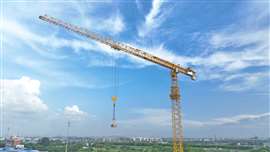 The Potain MCT 2205 from Manitowoc offers 80 tonnes of capacity, making it suitable for large infrastructure projects. Photo: Potain
Crane deployment
Taller buildings in city areas will see demand for tower cranes continue to climb in that sector, says Abouelezz.
“We expect luffing jib cranes to further increase their share in major city projects. This is driven by the continued trend toward taller buildings, combined with strict urban regulations that limit oversailing of neighbouring properties. Luffing cranes are particularly well suited to these conditions, as they allow lifting operations within a tighter footprint and offer greater control in congested environments.”
There is also growing demand for high-capacity flat-top cranes within the flat-top segment, he adds. “We are observing rising demand for high capacity and large clear-jib cranes, especially for infrastructure and large-scale projects. This trend is clearly reflected in the strong market response to our Wolff 8095 Compact, our most powerful saddle jib crane, which has been very well received by customers across multiple markets.”
Demand is also coming from other areas. “In 2026 construction activity is not dominated by one single project type,” says Abouelezz. “Instead, it is shaped especially in Europe by several key demand drivers: infrastructure renewal, energy transition, housing shortages and digitalisation.
“These drivers translate into a broad mix of project types. The most prominent examples we currently observe include data centres and cloud infrastructure campuses, energy projects including nuclear power plants and wind farms and transportation infrastructure such as roads and bridges renovations.”
Le Besnerais also highlights urban projects as a source of demand for tower cranes, among others. “Looking ahead to the rest of 2026, the outlook for the tower crane market remains positive, supported by continued investment in infrastructure, energy and urban development. At the same time, customer expectations are rising. Contractors are placing greater emphasis on performance, reliability and data-driven insights to maximise productivity on increasingly complex jobsites.
“Our cranes support a wide range of projects globally, from infrastructure developments and data centres to residential and commercial construction. We are seeing particularly strong demand in projects that involve prefabrication, where cranes must handle larger, heavier components with precision and reliability.”
 Continued demand for tower cranes in inner-city projects has been forecast, such as the Kirkstall Road development in Leeds, UK, where eight Wolffkran cranes were deployed. Photo: Simon Vine
Fit for purpose
Manitowoc has designed some of its newest models to fit the needs of these end-use sectors, such as projects involving prefabricated components.
“Over the past year, Manitowoc has continued to strengthen its Potain tower crane portfolio with several new product introductions and updates designed to meet evolving jobsite demands,” says Le Besnerais. “Among the most significant launches is the Potain MR 819, our largest luffing jib crane to date. It has a capacity of 64 tonnes and up to 70 metres of jib length. Developed in close collaboration with customers, this crane is engineered to handle heavy precast elements and support major infrastructure projects, while maintaining a short out-of-service radius (from 18 metres to 16 metres) depending on jib length, making it ideal for congested jobsites.
“We have also introduced the Potain MCR 505, a high-performance luffing jib crane with up to 25 tonnes of capacity and a compact design suited to congested urban environments. Its advanced control systems and smart monitoring capabilities provide precise load handling and real-time performance insights, helping customers improve productivity and efficiency on site.”
The manufacturer also recently added to its range of high-capacity tower cranes, with the 80 tonne Potain MCT 2205. “The crane is ideal for large infrastructure projects, power plants, and other mega projects that require the lifting of very heavy loads,” notes Le Besnerais.
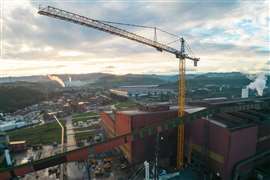 The first Liebherr 1188 EC-H Fibre tower crane to be used in Spain was deployed by ArcelorMittal at a decarbonisation project. The steel manufacturer latterly purchased the same model of crane for its operations in Brazil. Photo: Liebherr
CONNECT WITH THE TEAM