Read this article in 中文 Français Deutsch Italiano Português Español
Developing a workforce without borders

25 June 2026
The pressure is on, not just to “find people” but to develop a workforce strategy spanning markets, regulations, projects and more.
Across construction, lifting and specialized transport, workforce shortages are no longer isolated to one country or region. They’ve become a global operational challenge affecting project schedules, equipment utilisation and long-term growth planning alike.
Whether in North America, Europe, the Middle East or parts of Asia, companies are competing for many of the same skilled professionals – crane operators, riggers, drivers, technicians and project managers capable of supporting increasingly complex work.
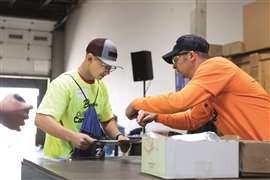 As part of the Workforce Ambassador Program, Boulter Industrial Contractors in the USA gets next-gen workers involved at a public Career Day
For SC&RA’s international members, the conversation has evolved well beyond simply “finding people.” The real challenge now is building a workforce strategy that can adapt across markets, regulations and project demands while supporting long-term business stability.
Part of the issue is demographic. Across many regions, experienced workers are ageing out of the industry faster than they are being replaced. At the same time, younger workers often have limited exposure to careers in lifting, rigging and specialized transport. Even where interest exists, training pipelines frequently struggle to keep pace with demand, particularly as projects become more technical and safety expectations continue to rise.
That pressure is being amplified by the kinds of projects driving today’s market. Data centres, grid modernisation, energy transition infrastructure, manufacturing expansion and modular construction all require highly co-ordinated execution with little room for error. These are not labour-light projects. They demand skilled crews capable of operating safely and efficiently under compressed schedules and increasingly complex conditions.
As a result, many companies are broadening how and where they recruit.
Greater emphasis
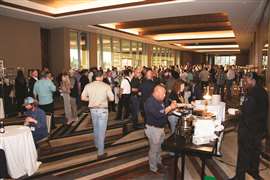 SC&RA members gathered for the 2023 Crane and Rigging Workshop in Oklahoma City, USA
Cross-border hiring has become more common in several regions, particularly where local labour pools cannot fully support project demand. International operators are increasingly moving experienced personnel between markets to address shortages, support large-scale projects and maintain continuity across operations. In some areas, companies are also working more closely with governments, trade organisations and training institutions to streamline workforce development and improve mobility for qualified workers.
Apprenticeship and internal training programmes are also receiving renewed attention. Companies are recognising workforce development can no longer be treated as a short-term hiring function. It is becoming a strategic investment tied directly to operational capacity, safety performance and future growth.
Technology is also shaping the conversation. Digital lift planning tools, simulation-based training and fleet management systems are helping crews work more efficiently while supporting faster onboarding and knowledge transfer. Technology alone will not solve the labour shortage. It can, however, help experienced workers operate more effectively while creating clearer pathways for training the next generation.
Moving challenges
For international companies, workforce mobility introduces its own complexities. Credential recognition, licensing standards, visa requirements and regional labour regulations vary significantly across jurisdictions. Even when qualified workers are available, moving them efficiently between markets can be difficult. That makes planning increasingly important, particularly for companies operating across multiple countries or regions.
To that end, retention is becoming just as critical as recruitment. In a competitive labour environment, workers have more choices, and companies are placing greater emphasis on culture, career progression, training and quality of life to keep experienced personnel engaged. The industry has long been defined by demanding schedules and time away from home but many employers are recognising that sustainable workforce strategies require a broader focus on employee support and long-term development.
For SC&RA members workforce strategy is rapidly becoming inseparable from business strategy itself. The companies best positioned for the future will not simply be those with the largest fleets or the broadest geographic reach. They will be the ones capable of building, developing and retaining skilled teams able to adapt across projects, markets and evolving industry demands.
In an increasingly interconnected industry workforce challenges are no longer confined by borders. Increasingly, neither are the solutions.
STAY CONNECTED


Receive the information you need when you need it through our world-leading magazines, newsletters and daily briefings.
CONNECT WITH THE TEAM