Read this article in 中文 Français Deutsch Italiano Português Español
Below the flight path: lifting under airport restrictions at Nice’s Haliotis 2

09 June 2026
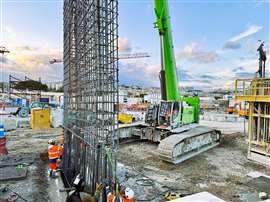 A Sennebogen 6113E lifts reiforcements cages on the the Haliotis 2 wastewater treatment plant in Nice, France. Photo: Epvre Delquie
One of France’s largest water treatment projects is underway on a narrow strip of land between the Promenade des Anglais and the runways of Nice Côte d’Azur Airport.
Before construction of the Haliotis 2 treatment facilities can begin, extensive deep foundation works are required along an existing dike structure.
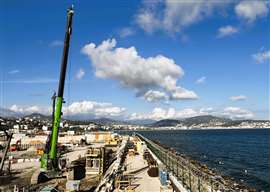 A Sennebogen 6113E telescopic crawler crane on the Haliotis 2 wastewater treatment plant project in Nice, France. Photo: Epvre Delquie
Fayat Fondations is carrying out the groundwork as part of a €700 million (US$807 million) project, with a Sennebogen 6113E telescopic crawler crane – provided by SAML, a Fayat Group subcontractor – at the centre of operations. The 6113E handles the lifting, positioning, and pick-and-carry transport of reinforcement cages throughout the foundation work, with its ability to travel under load and telescope the boom under load proving critical on the confined site.
The work involves constructing 82 stabilising barrettes – deep concrete elements used to prevent slope failure – along approximately 500 metres of dike. Each is around 6.5 metres wide and 800 mm thick, with reinforcement cages placed and concreted at depths of up to 40 metres using diaphragm wall techniques.
“On this site in particular, the simultaneous control of all movements is crucial,” said Gilles Cortes, foreman and crane operator. “We can operate the undercarriage, upper structure, and boom movement at the same time without setting down the load. This makes positioning the reinforcement cages significantly easier.”
Full 360° load capacity allows loads to be moved independently of upper structure orientation — an important feature given the tight working envelope.
Beyond the barrette work, the 6113E handles all other lifting tasks on site, including installing and extracting casing and managing equipment during the desanding of boreholes. Extraction operations place elevated dynamic forces on the machine, which Sennebogen says the crawler undercarriage and structural design are engineered to absorb.
The Haliotis 2 project is scheduled for completion in the coming years, with the treatment plant set to become one of the largest of its kind in France once operational.
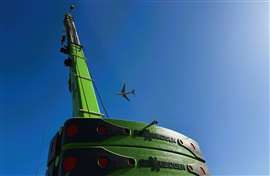 The Sennebogen 6113E operates within strict boom height limits imposed by the proximity of Nice Côte d’Azur Airport, requiring an electronic Virtual Wall system to define the crane’s permissible working area. Photo: Epvre Delquie
The airport proximity added a further constraint. Aviation regulations cap the permissible boom height, requiring the crane to operate with an electronic height limitation system — referred to as a Virtual Wall — that defines the working area precisely. The boom tip also carries an aviation warning light for day and night operation.
CONNECT WITH THE TEAM