Read this article in 中文 Français Deutsch Italiano Português Español
Heavy load moved using historic UK canal waterways

26 August 2026
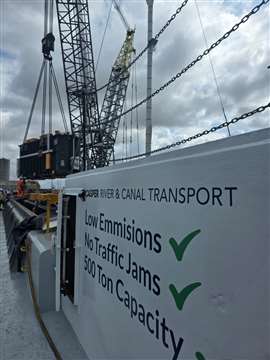 Transformer being loadad onto MB Off-Roader barge (Photo: Casper River and Canal Transport)
Most heavy-lift logistics operations will use road transport once a load arrives in port. But a pair of transformer units are being moved to their final destination using a different method, using an inland waterway route.
The two transformers, each of which weigh in excess of 180 tonnes, were delivered to the Port of Goole, UK, in August this year. From there, they were transferred to the MB Off-Roader, owned an operated by Casper River and Canal Transport.
The MB Off-Roader will transport the transformers towards the final leg of their journey using the Aire & Calder Navigation. Upon arrival at Eggborough, a purpose-built pontoon will allow the units to be discharged before completing the final move.
Delivering the transformers using the inland waterway avoids extended road routes and the typical abnormal load planning, permits, heavy-haulage equipment and coordination with local authorities for traffic management.
The decision to move the cargo via the Aire & Calder Navigation is aligned with the government-supported ‘Water First’ approach to freight planning. The connected Sheffield & South Yorkshire Navigation further offers a variety of off-loading options.
More than this, the project highlights how a historic waterway can still be useful in the 21st century. The Aire & Calder Navigation dates back more than 300 years, to when it was the primary connection between the industrial centres of Yorkshire and the Humer estuary.
In the 1960s, improvements saw the route upgraded to conform with the 600-tonne Euro-barge standard (under CEMT Inland Waterway Class 2).
“This project demonstrates exactly why we established Casper River and Canal Transport,” said Sean Taylor, Operations manager, Casper Riber and Canal Transport.
He continued: “The installation of the temporary pontoon at Eggborough is an especially important part of the project because it demonstrates that we are not necessarily limited to established facilities. These are substantial commercial waterways with a remarkable freight heritage, and we believe they still have an important role to play in 21st century logistics.”
CONNECT WITH THE TEAM